Assisting Smallholders
This page gathers the Assisting Smallholders section of Dr. Tinsley’s Smallholder Agriculture site in one place. Each topic opens with a short introduction; the full discussion is in the Read More panel beneath it. Use the list below to jump to a topic.
- Assisting Smallholders – An Innovative Approach
- Donor Contributions – Enhancing Infrastructure Support
- Government Contributions: A Word of Caution
- Smallholder Communities – A Symbiotic Association
- First Value Added – Clean Bags of Grain
- Crop Genetic Pump – A Possible Task for NGOs (ECHO Asia Note Article)
- Informal credit – Usury or Administrative Costs
- Effective Project – Enhanced Accessed to Mechanization Via Reconditioned Used Tractors
- Indirect Enhancement – Village Grain Mills
- Indirect Enhancement – Domestic Water Supply
- Drudgery Relief: The Key to Diminishing Food Security Risk (Brink: Edge of Risk Article)
- Enhancing Value Chains – Start at Farm Level
- Informal Information & Distribution System – How effective? How to utilize?
Assisting Smallholders Producers: An Innovative Approach
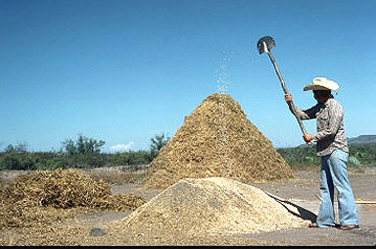 If, as mentioned elsewhere on this website, the Basic Premise which has guided the development effort for the poverty alleviation of smallholders over the past 40 years has over looked the limited resources most smallholders have to manage their land, including some Major Calorie Deficits that will restrict the hours they smallholder can work each day, and this is the main reason for Limited Adoption of the technical packages developed and promoted for their benefit, what might be a more effective approach to poverty alleviation for smallholders and their communities?
-
Read More About Assisting Smallholders Producers: An Innovative Approach
Maximum Efficiency: The first thing might be to recognize that smallholders, despite possible limited education, are reasonably intelligent and very capable of adjusting to changes in agronomic technology and economic conditions, and they have been doing so for generations, at least to the limit their operational resources will allow. Thus they might best be considered as skilled practitioners of the art of farming, who are most likely managing their land at the maximum efficiency their total resources will allow, with the limited operational resources to manage their land being a substantial drag on the climatic potential for which most production technologies are developed and promoted. Basically, to use the vernacular, the farmers are “maxed out”. The visual manifestation of this is the extended crop establishment period that frequently extends up to eight weeks from the start of the growing season, and renders any early establishment promotions, as well as all management practices dependent on them, beyond the capacity of the farmers to utilize, except on a very limited portion of their holdings.
While this might go contrary to conventional wisdom of labor surpluses in rural communities, the conventional wisdom may be more an operating hypothesis that needs to be reviewed and substantiated than proven fact. A review of which may be decades overdue. It is possible to have a adequate labor force in terms of people, but have only sufficient calories to work only three or four hours a day. To accept the surplus of labor in rural communities would require some alternative explanation as to why smallholders would risk their livelihood in deliberately delaying their crop establishment, with declining potential yields increasing the risk for food security with each days delay. Risk aversion does not really make a lot of logical sense, and has to be considered as another long standing working hypothesis that needs to be substantiated.
Under these conditions, about the only technical advances smallholders can utilize are those with limited labor requirements such as improved varieties, which are a simple substitution for what they are already doing, and perhaps nitrogen fertilizer, provided there are no ceiling price policies on staple crops that reduce the economic optimal rates. Maybe some low labor inputs technical advances such as insecticides will also be accepted. Time of planting and plant populations interact directly with the prolonged crop establishment time and efforts to reduce the time by lower the plant population. In addition, weeding has to wait until most crops are planted and since it is already to late, impacts of the quality of the weeding. The delay in weeding and the rush to complete it can quickly impact yield potentials and produce quality, particularly for quality sensitive high value crops currently being heavily promoted for poverty alleviation as part of value chain promotions. Since all these management practices interact with the limited resource base, they most likely represent things farmers fully understand, appreciate the importance of, would like to do, but do not have the means to accommodate, and do not require extensive extension demonstrations to inform farmers what they know but can not take advantage of.
Community Interventions: Under these circumstances the best assistance to smallholders might be indirect assistance through the larger community. As discussed elsewhere in this website, smallholders might best be considered as members of a community composed of producers and support service providers, with the relation between them more Symbiotic than exploitive, if for no other reason than the overall Financially Suppressed Economy which limits discretionary funds, restricts what business can charge for the services they provide, forces the small business to operate at a maximum of administrative efficiency, and severely limits profits.
Community service providers would include the traditional village based retail shops and the private traders that migrate in and out of communities, and serve as the primary link between producers and agri-industry to provide agriculture inputs and buy produce, as well as providing other household needs that have to be purchased. While private shops are often considered to be exploitive of the smallholders there is really no hard evidence to support this, particularly when they offer the immediate cash settlements smallholders depend upon. They are also better able to deal with a Financial Management Strategy the emphasis retaining assets in kind as long as possible. This means marketing small quantities over a prolonged marketing period, for which cash payments are essential.
Perhaps most of the condemnation of private traders has to be viewed as representing the vested interest of those promoting government parastatals or development projects mandated by the donors to funnel assistance through farmer cooperatives. Instead of being exploitive of smallholders the private businesses tend to be highly fragmented into village based family enterprises with limited market volume that requires substantial markups just to support their families as is the case for Tomato Traders in Nepal. They could actually be operating below the poverty standards as are the Tomato Vender in Zambia and Banana Trader in Uganda. Rather then being exploitive of the smallholders, these private dealers are more likely the most cost effective and convenient provider of these essential services. They also provide much of the Informal Credit with the potential usury 100% quoted interest rates. However, these rates maybe more reflecting the cost of administering the credit and the games producers play, than the availability of credit. The true cost of credit could be substantially lower for those smallholders who, as most developed country debtors do, provide rapid high quality in-kind repayments shortly after harvest and are given an in-kind discount such as 10 kg of maize seed as reported in Zambia.
In addition, support services, not usually considered by the development community, but could be the most effective at alleviating poverty, would include village based businesses emphasizing resource enhancements that relieve the drudgery of farming. The biggest would be those providing access to contract mechanization services for land preparation, mechanical threshing, and transport, etc. This would assist the farmers to expedite the prolonged crop establishment and allow them to concentrate on other crop management activities including those with high labor requirements needed to enhance the quality of high valued crops and take full advantage of the projects promoting value chains of high valued cash crops for poverty alleviation. The key word here is “access” as most smallholders can not afford tractors and their limited holdings do not justify it. Thus, the emphasis is on providing private, individually owned tractors to members of the community who would then drifted out of farming to become primarily contractors to the smallholders for land preparation, transport and possible threshing, etc. Most of the land preparation and threshing for smallholders in Egypt, Pakistan, Iraq and Afghanistan is done via these privately owned tractors. In irrigated subtropical areas like Egypt, with two mutually exclusive annual cropping seasons each year (winter and summer), tractor operators can easily have a 200+ day work year just for tillage, excluding additional opportunities for transportation and threshing. This would compare to a 220 day work year for most professionals in developed countries. The emphasis has to be on private, individual ownership, as public sector mechanization units and group ownership has proven highly ineffective. Typically group ownership, either as part of a public sector mechanization unit or community cooperative, will only get 3000 or the 10,000 designed service life, before the equipment has to be surveyed out.
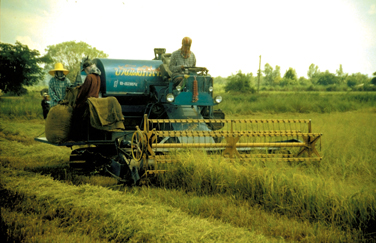
In part because of the Basic Premise that has guided the assistance effort for smallholders has emphasized technical solutions rather then resource enhancement, mechanization has been under rated by the development community, but certainly not by the smallholder producers. The example is the retirement of the water buffalo in favor of power tillers for paddy production in much of Asia. This was done without any donor assistance and halved the crop establishment time for rain fed paddy and perhaps allowed some intensification of farm enterprises including the combination of poultry or swine production suspended over fish ponds. In irrigated areas, the shift to Power Tillers has increased the crop intensity to five rice crops every two years. This is further assisted by the use of contract combining with small combines that can operate in the 1 rai (1/6th ha) fields common in Thailand. Similarly mechanization is slowly taking place in Africa, again without donor assistance as noted in the Madibira rice irrigation scheme in Southern Tanzania. Here in the five years after donor funding and advisory facilitation ended the farmers have purchased 50 Asian manufactured power tillers. Three fourths of these were self financed with those financed through the local project sponsored credit union mostly going to officials in the credit union. Perhaps one of the most effective projects could be rounding up Used 65 hp Tractors in developed countries and shipping them to developing countries for reconditioning and sale to individuals in smallholder communities.
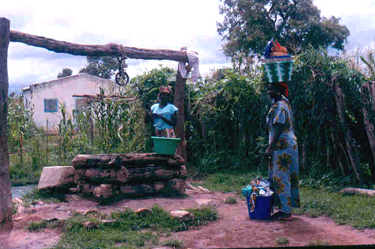
In addition to farm mechanization some indirect means of enhancing the resources available to smallholders could be undertaken. An example would be Grain Mills that have virtually eliminated the pounding of maize by mortar and pestle in most of Africa. Some of these grain mills may have been financed via development projects seeking income generating activities for women’s clubs, but most have been self financed. Again, over the past five years in Madibira the number of maize and rice mills has more than doubled as people invested their proceeds from the newly constructed irrigation scheme into service providing businesses. Such mills will have a crop production impact as they decrease the domestic drudgery, mostly for women, and allow them more time to assist with the management of crops or engage in other economically rewarding activities. Another means of indirectly enhancing the resources smallholder have to work with is improving Domestic Water Supplies. This can substantially reduce the amount of time women spend collecting water, and that time can be used for other economic activities.
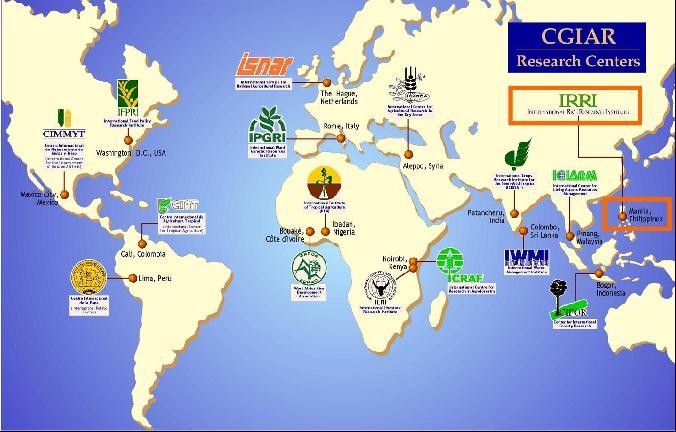
The Donor Contributions can effectively facilitate the community based assistance to smallholder with technical assistance and micro-finance to establish the support service business or improve the overall community infrastructure of domestic water supply and feeder roads. However, little Government Contributions should be anticipated or encouraged as most governments are too Financially Stalled to effective facilitate most efforts, as noticed by the extent Variety Improvement has been deferred to the IARCs as part of the CGIAR system. All to often government officers are inclined to take advantage for development opportunities for Informal Income opportunities.
Farmer Organizations: As reviewed extensively elsewhere in this website, Farmer Organizations should be viewed more in terms of information sharing and political empowerment similar to producer associations in the USA, and not as a business model for providing inputs and marketing produce. Somehow, with the overall suppressed economic conditions and administrative environment, which is largely determined by informal income seeking civil servants, common to most developing countries, cooperatives have not been able to obtain the Competitive Advantage envisioned. This has resulted in most of the produce intended for the cooperatives to be side sold to private traders even accepting a 20% discount on the cooperative price for immediate cash settlement as is the case in Zambia. Such side selling has to be recognized as representing a perceived loss of competitive advantage on the part of the farmer beneficiary rather then a violation of contracted commitment to an out-grower scheme or obligation under cooperative by-laws. The continued emphasis on the cooperative business model for assisting smallholders has to viewed as the result of some Deceptive Bordering on dishonest reporting, needed by implementing contractors to assure future extensions and projects. The primary mechanism for this deceptive reporting is to overlook the sustainable overhead cost to operate the cooperative or worse allocating the overhead costs as a financial benefit to the smallholders.
Donor Contributions – Enhancing Infrastructure Support
 Technical Support & Micro-Finance: Donor funded projects could make some major contributions to facilitating the development of the community support services. One area would be working with the small village enterprises to expand their capacity to assist the farmers with supplying inputs, buying produce and even production credits. This could represent an enhancement on the USAID funded CARE implemented Rural Enterprise Agribusiness Project (REAP) in Zambia. This type of project could be expanded to allow the village enterprises to manage most of the production credit assistance as they have been doing. It might fall under the informal credit conditions, but they are able to deal with farmers as the individual entrepreneurs they are and have a reasonable good credit repayment record. As mentioned above, the real interest may be substantially lower than the quoted rate depending on the games the producers may play and in-kind discounts available for timely high quality in-kind payments. It must be appreciated that most institutional sponsored production credit programs trying to subsidize interest rates have not been sustainable without a continuous influx of funds, as the farmers played the same games with the donor projects as they did with the village enterprises, and the donor projects do not have the mechanism to increase interest rates to cover the additional administrative costs. The bottom line is it is better to quote high interest rates and discount for fast repayments, then quote low rates and get caught with excessive supervision costs.
-
Read More About Donor Contributions – Enhancing Infrastructure Support
In assisting with village retail outlets, care should be taken to provide any short term credit needed to make cash purchases of produce at the end of each growing season. This was where the REAP project experienced difficulty after continuing for two years beyond CARE’s facilitation, while the follow-up project was caught up in political wrangling. However, these village enterprises could be depended upon to deal with the whole mix of produce being grown in a community instead of single commodities such as paprika or cotton as is currently being done with the out-grower schemes in Zambia. This would allow the consolidation of loads being transported out of remote rural communities with the corresponding savings in transport cost charged at the off road premium rates, that can be triple the paved road rates. Transport costs increase with the extent of remoteness and must be absorbed by the smallholders.
Perhaps the projects that could have the biggest impact on smallholder productivity would be those addressing drudgery relief by providing access to mechanization. One suggestion would be to obtain Used Reconditioned 65 hp Tractors as they are being traded-in such as Massey Ferguson 165’s, recondition them, equip them with simple tillage implements as well as trailers, and make them available to individual members of smallholder communities for micro finance credit purchase. The tractor reconditioning could be combined into a training program on tractor maintenance for potential buyers. The buyer would then drift out of farming into the contract mechanization service business. This could also be extended to include small combines such as that shown which are progressively being used for contract custom threshing of paddy in Thailand and elsewhere in Asia and can easily maneuver in one rai (1/6th ha) fields. Such projects would most likely substantially reduce the basic crop establishment time and allow the producers to more quickly return to their field to improve the weed and pest control needed for higher yield or higher quality so they can take fuller advantage of the premium prices available for high valued quality sensitive crops, as part of value chain enterprises.
Donor funded micro-finance projects could assist with funds for increasing the capacity of village shops as well as funds for individuals to obtain the reconditioned tractors, etc. In addition micro-finance could be used to assist individual community members to provide other drudgery relief enterprises such as Grain Mills although the latter is rapidly approaching facto accompli in much of Africa at least to the optimal economic density the economy will support and represent an opportunity missed for the donor community. Micro-finance for capital goods could also use the goods as collateral in case of defaults and have a better chance of becoming sustainable revolving funds than production credits providing consumable inputs that offer no collateral. An interesting and appropriate question would be to evaluate the agronomic impact grain mills have on other farm enterprises including those involved in value chain enterprise promotions. It would make a great Peace Corps Master’s paper.
Infrastructure Development: Other areas where donor projects could substantially enhance the community infrastructure and free labor for improved crop management or reduce costs so smallholder producers could obtain better returns would be Domestic Water Supply and all weather feeder roads. While domestic water supply is fully appreciated for the impact on health, it also reduces the domestic drudgery that could lead to better crop management. An example would be Mityana, Uganda where the water table can be as much as 100 meters below the homesteads and banana/plantain fields. This is too deep for most community resources to dig wells without external assistance that can provide well drilling equipment. Community members, particularly women, in this area have to trek up to two km to obtain water and return including the 100 meter climb back up the hill. This can result in up to 20% of daylight hours being devoted to the exhaustive task of obtaining the minimum World Health Organization recommendation of 50 liters of water per person per day for a couple, with additional time depending on the number of children involved. This again is time taken away from more intensive crop management. This would be good justification for expanding the efforts of UNICEF, Engineers Without Border (EWB), Save the Children, or other organizations equally committed to developing domestic water supplies.
While major roads are fully appreciated by the donors and frequently built, such as the Tan-Zam highway between Dar es Salaam and Lusaka, it is the feeder roads that most impact smallholder communities and the costs they have to absorb to obtain inputs and market goods. Typically, as reported in Zambia transport costs will triple when leaving the tarmac. This is almost Transparently Justified when evaluating the extra time and fuel required as well as the additional spare parts from the additional wear and tear of bouncing over the rough roads. It can become very severe in areas like the transmigration settlements of Indonesia. Here the roads are so rutted along with streams that have to be forded for lack of bridges or causeways without culverts that the only vehicles that can access the area in the rainy seasons to deliver inputs or obtain produce are 4-wheel drive Land Rover type pickups as shown in photo. This very much limits the volume that can be handled at any time, resulting in higher transport costs that has to be absorbed by the farmers, as once back on the tarmac the produce has to compete with less remote producers and their reduced transportation costs.
Government Contributions: A Word of Caution
 Limited Prospects: Unfortunately, government contributions to development programs have to be considered as minimal, and perhaps best discouraged. This is basically because of the very limited tax base has Financially Stalled the government’s ability to provide support services. This has also resulted in extremely low government salaries to the extent that financial necessity means government officials are more interested in informal income opportunities that tend to be more interference than assistance to development projects as shown with the seed and fertilizer voucher program in Afghanistan. As disconcerting as the pursuit of informal income may appear, it has to be viewed as the result of the limited tax base and financially stalled government for which most expatriate development professionals would become equally involved, if they were also trapped in the economic and administrative environment found in most developing countries. This also means that at the community level implementation of poverty alleviation projects might be better facilitated by NGO’s instead of large consulting firms with their greater mandate for capacity building of government institutions. Capacity building that usually concentrates on the technical capacity of individual government officers, but normally does not address the financial restriction under which they operate. Restriction that usually stalls programs once development projects are concluded. This can also result in services like soil testing and seed quality becoming more an opportunity for officers to earn some informal income, than an effective service to agriculture.
-
Read More About Government Contributions: A Word of Caution
It might be actually better to encourage civil servants to resign from government and become part of the private support services. Their knowledge of agriculture would be better used for the benefit of smallholder producers in the private support services and they would most likely be financially better off, without the continued hassle needed to pursue the informal income opportunities. Assisting resigning civil servants to go into private support services might be effective use of micro-finance credits.
Research & Extension: The limits of government involvement will also apply to research and extension programs. Government revenue funds can rarely do more than sustain imported germplasm, which is all that normally remains after any extensive donor assisted research development project reverts to revenue funds. Even that is often defaulted to Collaborative Programs with the IARCs that from the CGIAR system. Extension efforts just can not afford the manpower needed to maintain direct administratively links to each smallholder as envisioned in extension programs like the Training and Visit (T&V) system and why it deteriorated until the acronym became “Talk & Vanish”. It also has to be recognized that most extension recommendations are aimed at the climatic potential without factoring in the limited operational resources the smallholder producers have to implement the recommendations and this reduces the overall effectiveness of the recommendations. Thus, most technical packages can only be Adopted on a very limited part of the farmers land. Thus, what extension is possible has to concentrate on mass media including distribution of appropriate brochures that might easily be done via the village shops mentioned earlier. They have a vested interested in promoting better agriculture production as it quickly impacts on their business opportunities. Mass media should also include the broadcast media of both radio and TV, as while many smallholders can not afford to own TVs, they may have ready access to them through community gathering places such as bars and teahouses. Also, it is essential to trust the farmers and their established farming skills to quickly “fine tune” any suggestions to their limited operational resource base and economic environment. This would effectively tap into the Informal Information & Distribution System where most farmers actually receive most of the innovative information they use and obtain the new materials they utilize.
Pricing Policy: One area where government can be effective and donor assistance could play a major role is price policy. Developing country governments have a very legitimate concern in trying to maintain fairly low food prices for the largely impoverished urban populations. This often results in mandated ceiling prices for staple food such as maize or rice. Depending on what the ceiling prices are, they could easily lower the economic optimal rates for inputs such as fertilizer, as well as other agronomic practices including the number of tractors that can profitably operated within a community. This could lower the profitable yield potential which even the limited educated farmers in remote areas will quickly recognize and make the necessary adjustments in their crop management. The end result could be to inadvertently hinder overall production of the staple crops and national food security. Governments could use some macro-economic assistance in determining the optimal ceiling price that will assure reasonable food prices to the urban poor while still encouraging enough production to assure food security without needing continued food aid. An interesting example of supressed ceiling prices could be wheat price in Afghanistan. Wheat is a winter crop the same as opium poppy. Thus the question is how much poppy production could be reduces by simply rising the farm price of wheat and increase it competitiveness with poppies?
Smallholder Communities: A Symbiotic Association
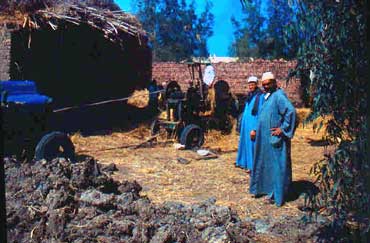 When working with smallholders, it might be worth considering emphasizing communities, rather then individual smallholder producers or farmer groups. If so, the communities may best be viewed as comprised of individual private entrepreneurs divided between smallholder producers and support service providers. The support service providers would include the family enterprises, such as shops and kiosks that provide inputs and purchase produce as well as other not producible essential domestic commodities such as soap, cooking oil, wheat flour, etc, as well as the tractor-thresher combination depicted from Egypt, and even the senior gentlemen with his well used peddle operated Singer sewing machine, sitting in the shade and adding yet another patch to well-worn faded shirt or pants of his clients. It could also include the small village mills used to mill rice or maize that can substantially reduce the domestic drudgery, mostly for women, providing them more leisure time in the evening or allowing them to come to the field better rested with more energy for field work as discussed under Studies Needed.
-
Read More About Smallholder Communities: A Symbiotic Association
The question is “what is the relation between these smallholder producers and support service providers”? It is often considered, primarily by host civil servants and development advisors with vested interest in promoting state or quasi-state enterprises, including farmer cooperatives, to be exploitative of the smallholders. However, this may be more conjecture against vested interests than solid supportable facts. Thus, a closer look may indicate a more symbiotic than exploitive relationship. With a basically Financially-Suppressed Economy, there really is not enough money available for the service providers to become exploitive. Most might just be making a modest living for their families or actually be as impoverished as the producers as noted for the Tomato Vender in Lusaka, Zambia or the Banana Trader in Uganda.
Also, most of the service providers within the village were most likely once smallholders themselves. They drifted into support services probably by doing some marketing or obtaining inputs as favors for their neighbors while make a bus trip to the town. They found providing services better than farming and eventually gave up farming. They could also be individuals that obtain a contract for a couple years as guest workers in the Persian Gulf or South Africa. This then provided the capital for the basic equipment purchase, be it a used tractor, grain mill, or starting capital for an input/marketing business. In any of these situations, the service providers remain an integral part of the community and desire to maintain good relations with their smallholder neighbors.
If this is primarily a symbiotic relationship, then assisting the over-extended smallholders, who may be working beyond the Limited Calories Available to them, may be best done by working indirectly within the community to enhance the support services provided by family enterprises. This would be particularly true of those services offering drudgery relief such as the grain mills mentioned above or contract mechanization services as depicted. The critical concern may be access to these services, as opposed to total or partial ownership. Partial ownership would be organized via credit clubs or other farmer organizations as part of development projects. Such partial ownership needs to be carefully evaluated to make certain the machinery has a full service life. Typical group owned tractors will be survey out after only 3000 of the designed 10,000 operating hours as readily shown by the line-up of out-of-service tractors outside any Agriculture Development Project in Nigeria. Actually, it could easily be better for such services to be provided by non-farmers, as the idea is to enhance the contracting of these services instead of direct use. In this case, managing land would be a conflict of interest. Micro-finance projects could be critical in developing these family village enterprises that would reduce the overall labor requirements, allow the producers to plant crops earlier, and spend more time on mid-season activities that enhance yield or quality when that is important. The emphasis on individual ownership of support services would avoid all the cumbersome administrative and overhead costs normally associated with multi-party ownership and the need to partition costs among multiple owners that is difficult to sustain without external facilitation.
The USAID funded CARE administered REAP (Rural Enterprise & Agribusiness Project) in Zambia is an example of such efforts although limited to input and marketing, and not getting involved in other services such as contract tillage or grain mills that would have a greater impacted on drudgery relief. This project remained viable for several years after the initial funding ended, but eventually encountered financial problems mostly in maintaining the capital needed for cash purchase of produce after harvest.
First Value Added: Clean Bag Of Grain
Assisting smallholders add value to their marketed crops is an integral part of value chain promotions. Perhaps the first opportunity to add value that can be done at the home or community level is providing a clean bag dry of grain that can command full value from the private traders or other purchasing entity to advance up the value chain to the ultimate consumer.
This could be a substantial but underappreciated concern. Frequently bags of grain such as rice, maize, beans, groundnuts and sunflower will contain 10% or more trash, including chaff, mud clods, stones, weed seeds, and other forms of field debris that can easily be seen with a grain thief (spike). This trash must be removed down to the 1% tolerance level allowed by processors. Traders and processors in order to have viable businesses have no choice but to discount the value of the marketed bags received from farmers in anticipation of the amount of trash they contain as well as the cost of removing the trash. This then affects the farmers’ bottom line. In Kano, Nigeria a processor of sorghum, cowpeas and cassava indicated he would deduct 15% for a bag of grain purchased in the open market. That is a substantial deduction. Thus if farmers were able to sell clean bags of commodities they should be able to command up to 15% premium price, once the trades and processors are confident the bags are of high quality.
-
Read More About First Value Added: Clean Bag Of Grain
Frequently, this trash is manually removed prior to or immediately after the bag is sold as shown by the young women in the photo cleaning groundnuts in the commodity market of Nairobi. This is time consuming and expensive, costing about US$2.00 per 50 kg bag of shelled groundnuts, and consumes most of a day to clean one bag. It is a very menial task that can only earns basic survival wage barely enough to cover the 2000 Calories For Daily Metabolism. Fortunately, the task does not require extensive calorie exertion or the wages would be unsustainable, and the young women will be exerting more caloric energy then the wages will provide. Medium and large processors frequently have to spread the grain on large perforated trays to screen out the small material like sand and small weed seeds, but still have to manually remove the larger and lighter foreign material too large to pass through the perforations. Some of this can be blown free with fans. Again this is a time and labor consuming process with associated costs the discount for which could represent an avoidable loss to the smallholder producers.
Ironically, there is the question, how much of the trash is a deliberate or semi-deliberate effort to increase the farmers’ returns by attempting to pass off trash for grain. Some of this could be associated with the repayment of Informal Production Loans with a specified in-kind repayment. The in-kind repayment can be an effective mechanism to encourage early repayments, since the repayment will be a bag of grain one month or five months after harvest. Making early payments shifts the liability for post harvest losses from the borrower to the lender. The effective of trash in the repayment bag is to reduce the 100% quoted seasonal interest rate, but perhaps also forgoing any in-kind discount for promptly delivered clean bags of grain the lender might be willing to offer, and which is in the lenders best interest as a means of encouraging clean bags promptly delivered shortly after harvest. Part of the 100% seasonal interest rate with in-kind repayment has to be anticipating the amount of trash in the bag, as well as the time to clean it and other collection costs, including monetizing the grain back to cash. If the addition of trash is a deliberate effort to inflate the amount of grain, it most likely is not working as the dealers are anticipating and discounting, accordingly.
If this is not a deliberate effort, then it has to be linked to post harvest handling of the grain. If this is mostly manual then there is considerable opportunity for trash to get in particularly during whacking threshing as is common for rice and beans. Also there is ample opportunity for mud and stones to contaminate the grain if it is laid out on the ground for sun drying, prior to being winnowed and bagged, even if done on a paved surface. The common practice of winnowing via the wind does not seem to fully remove the trash. Sometime it simple move the debris from one farmer’s drying winnowing area to the neighbor’s area as the debris slowly makes its way down wind to finally leave the drying – winnowing area. For rice the amount of trash, particular stones and mud clods often results in the paddy being run through a de-stoner prior to milling. A process that typically will kick out about 10% of the good rice along with the stones and mud clogs sticking to the grains. Again the buyers have to anticipate and discount appropriately, from what the farmers receive.
The solution maybe to look more closely at the traditional post harvest handling of grain and see what might be possible to enhance the process to allow cleaner bags of grain to be marketed. This many include looking at some simple winnowing machines. These are often manually operated because controlling the speed of a motorized winnowing machine accurately enough to remove trash, yet not blow off valuable grain, can be difficult. The whole operation could actually be handled through some community based family agro dealer enterprises that are purchasing commodities from the smallholder producers, bulking to a sufficient amount to cell to larger traders as the commodities move up the Six Stage Value Chain that frequently separates the growers from the consumers. They could easily justify the machinery and use it when purchasing grain from the farmers, or cleaning retained seed. This could be particularly useful if the Financial Management Strategy emphasizes retaining goods in kind and marketing only small qualities as immediate cash is required. This would bring continuous small quantities grain for sale over a prolonged period of time after the initial harvest that could easily be put through a winnower and cleaned before being finally bagged by the purchasing agro-dealers, and consume only minimal time while the shop attendant is multi-tasking in attending the shop. The mechanical winnowing operation, when moved to a major multi-person drying – winnowing areas may need to be placed downwind to the prevailing winds to avoid the winnowing of one person’s grain contaminating the next person downwind. This will assure the winnowing tailing will be quickly removed from the area.
This all has to be approached with due consideration for the economic cost associated with cleaning relative to other economic opportunities the farmers may have. This could also change as the post harvest season advances. Shortly after harvest the farmers could be fairly heavily jammed between cleaning the grain, and gathering additional grain. Or, the drying floor could also be in heavy demand across the community, and thus urgency could be getting the grain dried and bagged as quickly as possible, with no time to pay much attention to trash and cleaning. Bags that need to be quickly marketed shortly after harvest to meet delayed financial obligation such as loan repayment, or school fees, may not be cleaned as well as those marketed later when there is not so much pressure on the farmer or his family. However, after the initial flurry of post harvest activity, it might be possible for the farmers or their spouses to re-spread the grain and pay more attention to the quality that is being marketed. This would again be consistent with the desire to retain the grain in-kind as long as possible.
One concern is that once farmers are providing clean bags of grain up the value chain they may need to make certain the bags are clearly marked, as they move up value chain dealers will be anticipating trash and discounting accordingly, thus it may take some time to anticipate the clean bags and provide the extra compensation accordingly. Ultimately, it should provide the farmers with added value for their commodities.
The Crop Genetic Pump: A Possible Task for NGOs
Cost of Credit – Informal vs. Institutional Credit
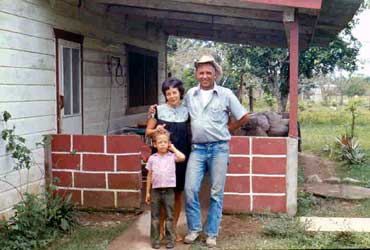
According to most development projects, smallholder farmers, such as the family from Central America depicted in the photo, are in urgent need of credit to the degree that providing institutional credit has become a major part of many development projects. While credit may be important, there are many surveys that do not list it as the highest priority for smallholders. Perhaps it is a service the donors feel they can easily provide. Also, farmers, even when offered institutional credit at subsidized interest rates that are typical 20% or less annually, often prefer to utilize informal credit at what appears to be usury interest rates that are usually quoted at 100%/crop season. This rate is nearly universal over most developing countries. However, the repayment is often quoted in-kind rather than in cash which makes the actual interest rate difficult to compute. An example is 5000 Tanzania Schillings (TSh) of credit at land preparation for a standard bag of rice after harvest with an expected value of 10,000 TSh at harvest. However, since the value of the repayment will vary with the normal cyclic price increases with time after harvest, the interest starts at 100% and goes up depending on how long the lender can hold the rice.
The in-kind payment may actually be highly desirable by the lender as an incentive for rapid repayment. Since the number of bags required for repayment will not change even if the value of the bag goes up, it is best for the borrower to make the repayment as soon as possible after harvest. The lender is then responsible for all the post harvest losses from spoilage, grain weevils, rats, etc. In Tanzania approximately 90% of the informal loans were repaid within two months of harvest.
-
Read More About Cost of Credit – Informal vs. Institutional Credit
This opens the question in smallholder economic environments: what are the costs of providing informal credit from both the farmer’s and provider’s perspective?
From the informal credit providers’ perspective, what are their administrative costs that might justify the 100% seasonal interest rates? Since it is impossible to raise interest rates once the loan has been offered, the rate has to be quoted at the maximum rate acceptable fully anticipating any games the borrowers might play, and they can play games as rarely do farmers queue up in front of lenders’ homes at the end of the season with their clean bags of grain to repay their loans. The interest rates can always be discounted, if the borrower makes timely repayments without any major hassles. This actually happened about 50% of the time. For the other 50%, what are the costs incurred by informal income providers? A brief study in Tanzania indicated they could be substantial. In the study the providers of informal credit were established members of the community and included neighbors, relatives, and local shop owners. The administrative costs of managing the loans included the need to closely supervise the borrowers’ fields to make sure they were maintained sufficiently to produce enough to repay the loan. When possible and if the repayment history indicted it necessary, the lenders even supervised the harvest to make certain the borrowers made the in-kind repayment. All of this requires time and effort, either by the lenders or someone they hired. These costs have to be recovered from the interest charged.
Also, when the in-kind repayments were made, the bags of rice often contained excessive amounts of straw, chaff, stones, mud, etc. Thus, the bags had to be re-winnowed and as much as 25% of the volume discarded. Bags with this much foreign material would never be accepted by private traders coming into the area after harvest to purchase the crop and thus can only be a deliberate effort on the part of the borrower to reduce the interest rate. The poor quality repayment cost the lender additional money to hire a winnower as well as making an automatic 25% reduction in the interest rate. While the 24% trash is excessive, trash frequently exceeds the 1% allowed by processors and result in some Discounts per Bags to cover the estimated amount of trash and cost to remove it. This could be as much as 10 to 15% the value of the bag.
In addition, the lender has to absorb any defaults and listen to many a sob story as to why payments are delayed. However, no mafia style strong arm tactics were used. Again, all of this represents legitimate costs that have to be recovered from the interest charged and reduce the extent to what appears to be usury rates represent the underlying costs of doing business. It would be interesting to see what would happen to farmers who shortly after harvest voluntarily brought their bags of clean rice to the lender to honor their repayment obligation. Would the lender then give him a discount on the interest? It would be in the lender’s best interest to do so as an encouragement to others. However, since the lender is most likely also a local merchant the discount could also be in-kind such as a bottle of cooking oil, some kerosene, etc. and be somewhat difficult to calculate. In Zambia one informal credit provider for maize production would provide a good client with 10 kg of maize seed for the next crop when a loan was repaid on time and with good quality. Finally, there would also be a small costs to the lender to monetize the grain back to cash and close the circle of cash loan.
In a similar manner, the true cost of providing institutional credit needs to be evaluated if the credit program will be sustainable beyond a specific donor-funded project. This has to take into consideration the same business costs discussed for the informal lender, as well as some of the administrative convenience issues, and possible informal baksheesh sought by the administrators, most likely independent of the donor knowledge. Again in Tanzania the institutional credit provided to farmers for land preparation by the donor project experience the same problems in repayment as the informal credit providers including considerable running around by the cooperative officer to collect individual bags and high level of foreign material contained in the bags used for repayment. In this case the costs of collecting the repayment may actually have equaled or exceeded the value of the loan. If the administrative costs are not covered by their subsidized interest charges, then the credit program becomes more a short term donor give-away than a sustainable effort to assist the smallholder beneficiaries.
There is a real need for a full evaluation of the forms of credit available to smallholders with full appreciation for the contributions of the informal credit system. To what degree is the “usury” interest rates reflecting the availability of money vs. the administrative cost of administering the loans.
Most Effective Project: Enhancing Access to Contract Mechanization via Reconditioned Used Tractors
If, as mentioned elsewhere on this website, smallholder producers in many developing countries survive on only 2000 of the 4000 Kcal. they need to diligently work a full 8 hour agriculture day, and they continue to be expected to complete many of the “value chain enterprises” recommended for their benefit in a timely manner, perhaps the best assistance for them could be to concentrate on drudgery relief. The 2000 calories is really just barely enough for to sustain the proverbial couch potato. It provides no calories for heavy manual labor. It thus limits the work day to as little as three or at most four hours. This then impacts on the total time needed to accomplish critical tasks. Basic land preparation that requires some 300 person hour could easily extend from the ideal maximum of three weeks to eight weeks or more from the onset of the growing season. The delay would then render all subsequent field activities equally delayed, reduce the quality of most crop husbandry activities, substantially reduces the area that can be devoted to, the yield, and returns to any “value chain cash enterprise”. The adverse impact on the value chain enterprise would be even greater if, as is the usual case, subsistence crops take priority over cash crops.
-
Read More About Most Effective Project: Enhancing Access to Contract Mechanization via Reconditioned Used Tractors
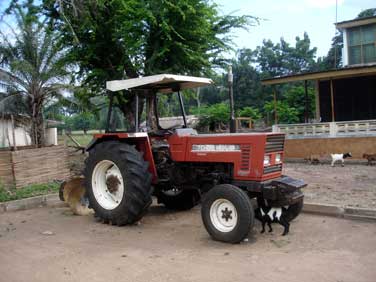
Even if 4000 cal/day were available, a person can still only develop a continuous 1/10 hp of energy output. Perhaps the only means to effectively overcome this 60% caloric deficit is to provide access to contract mechanization within smallholder communities. For upland areas the most appropriate mechanization is individually owner-operated four wheel 65 hp tractors that can pull a three bottom disk plow or similar tillage equipment. Such tractors with a trailer can double up to provide transportation services, including basic commuter service between villages and surrounding but distant fields. This would all be similar to the Fiat tractor shown in the photo from Ghana, although the Massy-Ferguson 165 and 265 tractors are also very popular. Facilitating access to private contract mechanization maybe the only way for “value chain enterprises” to represent an increase in the area cultivated, instead of a substitute for crops already well established. Private mechanization enterprises can also become an integral part of the Symbiotic Community Support Services into which most smallholder communities are divided. Those involved in contract mechanization really should not be producers as that would become a conflict of interest with providing the mechanization service. It would be expected that the servicing the community would become a full time occupation.
It is unlikely shifting to contract mechanization for basic land preparation will reduce the demand for labor. Rather it may simple shift the limited labor supply to other activities that will increase the yield or quality and value of the enterprise. Something that is major problem for High Value, Quality Sensitive Crops often considered for value chain promotions. There is also a need to appreciate the basic oversights of agronomy. Agronomy does an excellent job of determining the potential yield of a give environment, but it fails to determine the Operational Resources Needed to expand from the small research/demonstration plot to the full farm. It just assumes those resources are available. Unfortunately, the evaluation of resources needed to expand to a full field are an administrative void in the development process, as is the drag the limited available resources has on the agronomic potential of an area.
Contracted land preparation through individually owned and operated private tractors is responsible for the vast majority of the basic land preparation throughout most of the Middle East including Egypt, Pakistan, Iraq, and Afghanistan. This is mostly done through individuals who have given up smallholder farming to concentrate on contracted support services. In the fully irrigated Middle East with its subtropical climate defining two mutually exclusive annual growing season, winter and summer, tractor owner/operators can expect a 220 plus work year just on tillage operations. This is more than most professionals have in developed countries when weekends, holidays, and vacation time is factored in. This also does not include double duty for stationary threshing at night, or hauling road construction material when needed. The shift to contract tillage in the Middle East took place at least 30 years ago, and was mostly spontaneous and self financed by the individuals involved without and assistance from the development community.
Private contract mechanization is slowly becoming available through much of sub-Saharan Africa. However, it is all self-financed and represents a lost opportunity for the development community. It is possible to get quotes for contract mechanization service in Zambia, Uganda, Kenya, Tanzania, Malawi, Nigeria and Ghana. Such quotes would are available only when there is a demand for the service, and someone is trying to satisfy that demand. In Tanzania the costs of contract tillage could be part of Informal Loans.
However, new tractors are expensive. Often tractor owners will has taken a guest worker position for a couple years in the Persian Gulf or similar country and very prudently managed their money. Otherwise most members of a smallholder community can afford. But are new tractors necessary? How about a reconditioned used tractor? Most likely the tractors being obtained in smallholder communities are used tractors either purchased at discount from defunct public sector mechanization units or purchased from estate operations that are replacing old tractors approaching the end of their 10,000 hour designed service life.
Thus the real need could be for used tractors that could be reconditioned and brought up to specification enough for another 10,000 service hours. Thus the question is how many used 65 hp tractors are sitting around tractor dealers, or farm yards scattered through the developed world? How much would it cost to round them up, purchase a reconditioning kit, disassemble them, containerize them, ship them to a developing country, recondition them in a host country hopefully as part of a diesel training program, and sell them to members of smallholder communities that are interested in going into the contract tillage business? How many tractors could be obtained as charity contribution, with accompanying tax credit, etc.? Can all of this be done on a revolving fund basis at no cost to a donor government or individual?
A quick and cost estimate would be:
- a used 65 hp tractor with 7000 to 10,000 service hours would be US$5000
- reconditioning kit US$1000
- disassemble and containerizing US$1000
- shipping 40 foot container with three disassembled tractors US$8000 or US$2700 per tractor
- reconditioning training effort in destination country US$1000
- Total cost US$10,700
Sale value US$12,000 to US$15,000 per unit providing an overhead cost or profit margin of from US$ 1300 to US$4300. This sale cost is what an agriculture enterprise individual operating a 1200 ac rice farm leased to tenants in Uganda claimed was reasonable. What kind of credit be arranged to assist with the purchase using the tractors as collateral?
Would this make a reasonable project?
The problem is the development community for some reason appears solidly against promoting mechanization. Perhaps they are concerned with the problems associated with the public sector mechanization units a couple decades ago. They were and continue today to be a major disaster, with the equipment being surveyed out of service with an average of only 3000 or the 10,000 designed service life operating hours. An example would be the tractors attached to the ADPs in Nigeria are in poor condition with less than 500 hours. The number of units per ADP would barely accommodate the political influential or private cultivation of ADP staff. It would be highly unlikely they would ever reach a smallholder producer, proclaimed as the primary beneficiary for the tractors. If they do become available to smallholder most likely the operator and perhaps the officer supervising the operator will be seeking some Informal Income opportunity from providing the services. That is kind of the norm for public sector services and was specifically mentioned in Ethiopia as an access fee.
More likely, if the development community become interested in providing access to mechanization for smallholder community it will be through some form of communal ownership through a farmer cooperative or credit club etc. that development projects like to encourage and often Misrepresent. With communal ownership maintenance can be a concern as noted by the FAO women’s income generation cooperative Shown on an Accompanying Webpage. The cooperative is locked up and has been for months, because they could not sort out some simple maintenance problems with some of the processing equipment.
Because of the maintenance and repair requirements, any mechanical equipment can only be managed by individual ownership. The question is: are the donor concerns about maintenance justified for privately held machinery? Certainly, it is something that has to be considered, but under private management what mechanical maintenance is being done in most host countries? Someone has to be maintaining all those diesel trucks that are plying up and down the highways, and even off the highway to serve remote communities. They often contain the same basic engine as the tractors, just different chassis, drive chains and wheels. Someone is also maintaining all those smaller stationary diesel engines powering the grain mills distributed throughout the remote areas of Africa, that have virtually completely replaced women pounding maize or other grains. Perhaps this is mostly deferred maintenance concentrating on repairing breakdowns instead of scheduled preventative maintenance, but with the overall Financially Suppressed Economy, that severely restricts profit margins, it might represent the economic optimal management.
Note on Paddy Cultivation
As mentioned at the beginning the use of four wheel tractor would be mostly for upland smallholder communities, since for paddy areas the problem has largely been solved with small 12 hp, diesel power tillers. These are all individually owned and operated and usually not contracted out. They have completely taken over the paddy lands of Asia starting nearly 30 years ago. They reduced the time required for land preparation by 50% and even allowed operational holding to expand to around six hectares. Most likely they played a major but unrecognized role in success of the Green Revolution in Asia.
They are moving into the irrigated paddy schemes of Africa. Virtually all of this has been self financed by the farmers independent of the development community’s assistance. It again represents a lost opportunity to provide some clearly needed assistance. The larger four wheel tractors can also have problems when working in paddy fields due to grit getting into the front bearing requiring they be replaced on an annual basis instead of every three years. This can cost about US$400 per replacement and add a couple dollars per hour to the costs of operating the tractor.
Indirect Enhancement – Village Grain Mills
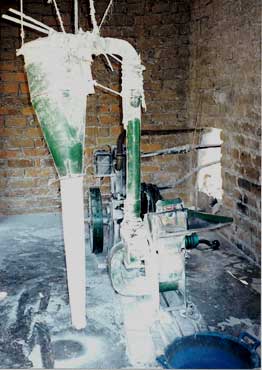
One of the basic premises of this website is that the easiest means of assisting smallholder producers is to enhance the resources with which they have to work. The next question is: does this have to be done directly looking at mechanization, water pumps, and other such crop management tools, or can it be done indirectly? The question then becomes: what is the impact of simple diesel-powered maize and rice mills, like the one depicted in the photo, that are becoming increasingly popular even in remote sections of Africa, on crop management and production? Certainly, by reducing the time women spend on pounding maize, the mills are reducing the domestic drudgery long endured by rural African women. The question is what do women do with time saved? Does it allow them to spend longer days in the field enhancing the management of their crops resulting in either increased yields or increased quality? Or does it simply provide women with increased evening leisure so that they are more rested when they go to the field the next day? This would again allow them to improve their crop husbandry. It would make an interesting study for someone working in close contact to smallholder villages. It would also make a good Peace Corps Masters paper.
To the extent the increasingly availability of rice and maize mills in smallholder communities is reducing women’s drudgery and resulting in improved crop husbandry, the grain mills and those operating them become part of village service sector available to smallholders, in what has been described elsewhere in this website as a Symbiotic Association of producers and service providers that constitute smallholder communities.
Another means of indirect enhancement of the resources available to farmers would be improving the Domestic Water Supply. In addition to reducing sanitary diseases, it should also save labor and energy that would be available for other economic activities.
Indirect Resource Enhancement: Improved Domestic Water Supply
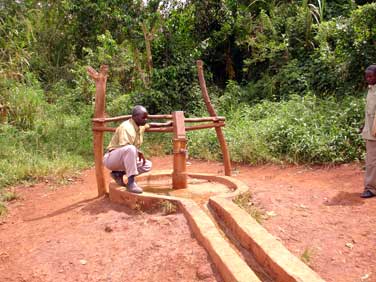
Another means of indirectly enhancing the resources available to smallholder families for managing their lands would be to improve access to the domestic water supply that will reduce the time people, mostly women, have to spend just to get the minimum WHO 50 l/person/day. While many projects currently address improved domestic water supply, it is mostly done to improve public health and reduce the incidents of sanitary diseases such as dysentery, typhoid and even cholera. These are definitely important considerations. However, in addition to saving lives and reducing the down time from sanitation diseases, there is usually a labor saving component. Just as the reduction in women’s domestic drudgery through access to Grain Mills can result in more time to crop husbandry, the reduction of time spent securing essential water supply can also be used for improved crop or animal husbandry enhancing yields or the quality of quality sensitive high valued crops as part of value chain promotions. 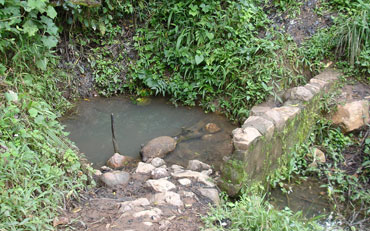 Ultimately this will enhance the overall economic well being of both individual families and the community as a whole. It was estimated that in Parts of Uganda where the water table was up to 100 m below the surface, it was taking women up to 20% of total daylight hours just to procure the minimum WHO recommended 50 lit/person of water. This would involved over one kilometer trek including descending 100 m, filling a jerry can with water from a slightly turbid spring (photo right) before returning home ascending the same 100 meter but now carrying a full 20 lit jerry can of water. Thus UNICEF, Engineers Without Borders, Save the Children, and other organizations involved in promoting improved domestic water supplies for smallholder communities with hand pumps like the one in the photo, might take a little time to determine just how much time they are saving the women in the community, and what the women are doing with the extra time in terms of enhancing their and their family economic well being. Again this could make an good Peace Corps Master professional paper or potentially a thesis.
Drudgery Relief—the key to diminishing food security risk
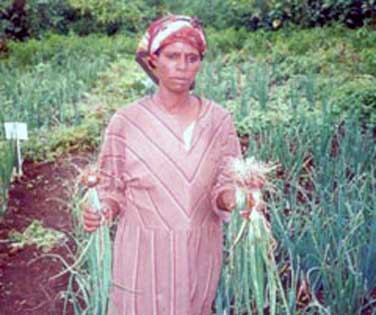
The sheer drudgery that plagues smallholder farmers in developing countries thwarts sustainability and saps productivity on a wide scale. From traveling half a day on foot to gather water and firewood to labor intensive farming done on a calorie deficient diet, smallholder farmers are in desperate need of “drudgery relief.”
-
Read More About Drudgery Relief—the key to diminishing food security risk
For over 40 years the rural development community has been attempting to assist smallholder farmers in the developing world to climb out of poverty, with only modest success. A closer analysis indicates that smallholder communities may have severe labor shortages that can severely hinder smallholder ability to adopt labor-intensive innovations. The problem may be exacerbated by the limited diet available to most smallholders. This diet barely meets the 2,000 calorie basic metabolism requirement, leaving little energy to undertake the extensive manual labor often expected of them.
In order to work a full eight hours of diligent manual labor the diet has to be at least 4,000 calories per day. The result is farmers are only able to work about three or four hours per day with limited diligence. This limited labor has to be rationally spread over all the farm enterprises, both crop and animal, as shown in the case study for Ethiopia.
This implies access to mechanization for basic crop establishment. This could easily be the underlying reason for the success of the “green revolution” for rice in Asia, even though the development community mostly overlooks this.
While the International Rice Research Institute (IRRI) did an excellent job of dramatically increasing the yield potential of rice, it did nothing to get the crop planted in time to take full advantage of the increased yield potential. This was left to the farmers who, concurrent with IRRI’s developing improved varieties and related supporting technologies, shifted from water buffalo to rice power tillers. This more than halved the crop establishment time, provided the smallholder rice farmers with food security of rice that then allowed them to spontaneously diversify their farm enterprises into such cash value chains as building poultry pens suspended over fish ponds.
In the current effort to promote a new “green revolution” for Africa, the overlooked lessons of Asia may need to be reviewed. In this case, there may be a need for contract tillage via private owner/operator 65-to-80 horsepower tractors pulling three-bottom disc plows. It should be noted that in Egypt, as well as many Middle Eastern countries, private individual owner/operator 65-hp tractors do most of the basic land preparation for smallholder farmers. There appears to be a growing demand for such services in Africa—but again, it is mostly overlooked by the development community still promoting mostly manual agriculture.
The need for individual private owner/operator tractors is that any type of communal ownership such as government mechanization units or even farmer cooperatives has been discredited for over 40 years, as it usually results in the tractors being out-of-service with less than half the lifespan of 10,000 service hours. Also, with public mechanization projects there could be a tendency for operators to charge an off-the-books “access fee” in addition to the authorized charges, as appears to be the case for tractors and combines in Ethiopia. This quickly diverts the limited amount of available machinery to the more influential or political endowed farmers instead of the primary beneficiaries. Perhaps one of the more effective projects for poverty alleviation in Africa would be assisting individuals in smallholder communities to obtain reconditioned tractors so they can drift out of farming to become private service providers for contract tillage.
Several questions abound: How many used 65-hp tractors are sitting around tractor dealers or farmyards scattered through the developed world? How much would it cost to ship and recondition them in a host country, hopefully as part of a tractor maintenance-training program? How to finance and sell them to members of smallholder communities interested in going into the contract tillage business, using the tractors as collateral? How many tractors could be obtained as part of a charity contribution, with accompanying tax credit, etc.?
A quick cost estimate to ship and recondition such tractors is $10,700 with a sale value of $12,500 to $15,000. This same sale/cost structure was used in a successful leasing program in Uganda.
How much of the success of the green revolution in Asia should be attributed to reducing the drudgery by shifting to power tillers, and will it be possible to spawn a green revolution in Africa without a similar effort to reduce the overall drudgery of smallholder farming?
Agriculture
Richard Tinsley
Professor Emeritus of Colorado State University
Dr. Richard Tinsley is an emeritus professor of Colorado State University who spent his entire career as a technical advisor to smallholder development projects. In addition, he contributed to a farming systems research and development guidebook. He currently teaches a class in agricultural development at Colorado State University and does short-term consulting.
Enhancing Value Chains – Start at the Farm
Overview Consideration
With the current interest in value chains and having smallholder farmers involved beyond the farm gate with the expectation of increasing their returns as a means of poverty alleviation, the concern has to be how far up the value chain can smallholder farmers profitable be directly involved. In doing a value chain analysis it must be fully appreciated that the further up the value chain you move the greater are the returns, but also the greater the expenses incurred. Thus the need is for the purely economic analysis of when the additional expenses exceed the additional returns. At this point the farmers or their organization representatives are better off turning the value chain over to others. Also, it has to be appreciated that if the farmers are releasing their produce on consignment to a farmer cooperative for advancement up the value chain, the further up the value chain the cooperative retain ownership the more delay before the farmer gets paid for the consigned goods. This most likely would be an important convenience consideration for the smallholder famers in a society that emphasis cash transactions. This would also run counter to a possible Financial Management Strategy that emphasis holding goods in-kind and only marketing what is necessary to meet immediate cash needs, but then requiring immediate cash payments. In addition care should be taken if the value chain is dependent on a cooperative business model, since for most smallholder communities the cooperative model has proven too Administratively Cumbersome and too inconvenient to attract a high degree of reliance by the members, who wisely take the bulk of their business to other service providers. Won’t trying to move further up the value chain increase the administrative requirements and thus make it even more cumbersome and possible attract even less reliance from the intended beneficiaries?
-
Read More About Enhancing Value Chains – Start at the Farm
In addition, if it is appreciated that the smallholders work day may be restricted to 4.5 hrs. because of Limited Calories In Their Diet, the question become will they be better off concentrating their limited energy on enhancing the value chain at the farm level and out-sourcing any value added above the farm level, then trying to directly assist in any off-farm value added. Finally, it might be appropriate to look at the limited role value chains traceable from farmer to consumer play in developed countries. True in the USA there is Land o’ Lakes for dairy, Florida Natural for citrus and Ocean Spray for Cranberries all are cooperative value chains linking producers to consumers with national brand name recognition, but only Ocean Spray commands a majority share of its market, and this is a relative minor commodity confined to some very specific environmental conditions of acidic bogs found mostly in Wisconsin, Massachusetts, and New Jersey. In total value chains directly linked from farmer producers to consumers comprise well less than 1% of commodities on supermarket shelves, at least in the USA.
Farm Level Value Chain Enhancements
Despite the farmer having limited workdays, there are several way to enhance the value chain at the farm level where the farmers have the greatest control. However, most of these require an enhancement of the “operational resources” the farmers have to work with and the need for the development community to facilitate the different service providers that can provide the enhanced operational resources. Operational resources being what is needed to extend small plot research results across a field, farm or community and unfortunately often been overlooked by the development community with an underlying assumption they were infinite and thus not a problem. This has led to beautiful demonstrations of the potential of areas but with limited acceptance by the farmers and concentration on “teaching” farmers best management practices to achieve maximum yields, but not understanding the farmers just don’t have the means to utilize the information.
- If the farmers workday is Calorie Limited To 4 – 5 Hrs. or perhaps even less for heavy digging needed for manual land preparation and this result in taking over eight weeks just to get crops established against declining potential yield with each day’s delay as well as prospects of running out of rain before maturity, then the first means to enhance the value chain would be to facilitate access to individually owned and operated private tractors for contract tillage. This will expedite the crop establishment and substantially increase the potential yields as well as freeing the farmers to concentrate on mid-season crop husbandry that can further enhance production.
- This may actually be critical to any hope of poverty alleviation as if limited to 4 hour diligent work days and taking 8 weeks or more for crop establishment with yield dropping by 50% or more, it will be virtually impossible for smallholders limited to manual operations to dig their way out of poverty. It should also be noted that through much of the fully irrigated areas of North Africa and West Asia basic land preparation has been done through private tractor operators. Also, it should be noted considerable success of the “Green Revolution” could be attributed to the farmers shifting from water buffalo to power tillers.
- Facilitating access to contract tillage might best be done by evaluating the prospects to Obtain & Recondition Used 65 to 80 Horsepower Tractors and sell them to individuals in smallholder communities that would drift out of farming to become full time contract tillage service providers and direct involvement in extensive farming would become a conflict-in-interest.. This would be even better for those with access to used Massey-Ferguson 165 or 265 as these are the preferred tractors throughout most of sub-Sahara Africa.
- Also, the emphasis has to be on individual owners and operators while avoiding any form of communal ownership such as public sector parastatal mechanization unit or even farmer cooperatives. Communal ownership of anything mechanical has been discredited for over 40 years. Typical under communal ownership a tractor will be surveyed out of service with only 3000 of the design anticipation of 10,000 service hours. This can easily been seen at any state ADP (Agriculture Development Project) in Nigeria where there is a nice line-up of tractors surveyed out of service with only 3000 or 4000 hours on the odometer. That is if the odometer has not been broken, perhaps deliberately so the operators can avoid accountability as they engages in some private work. Also, be careful that communal owned tractor may offer some major opportunities for the operator and managers to engage in some informal income opportunities by giving priority to favored farmers in exchange for some gratuities while not servicing the smallholder farmers they were supposed to assist.
- Facilitating access to contract tractors could be a major task for micro-finance programs and would require some major modification to current programs, but would allow for some downstream synergy within smallholder communities. The need may also be for two tier financing. The first would be the capital costs to cover the purchase of the tractor, estimated to be up to US$12,000 but for which the tractor could serve as collateral making it a secured loan. The second would be an operational loan that would allow operators to extend credit to their clients to be repaid at the end of the season, most likely in-kind and according to the normal rules for Informal Credit, that while quoted at usury 100% seasonal interest may not really be as exploitative as it appears.
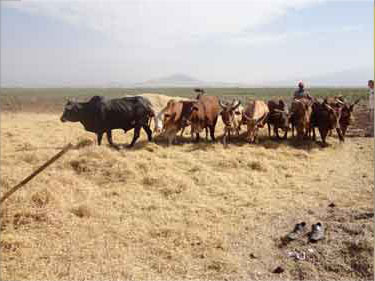
- Another prospect for enhancing the value chain at the farm level would be facilitating access to mechanical threshing service providers, which should increase the yield recovery by some 10 to 15 percent, compared to either hand whacking or trampling that just cannot provide a complete recovery. This represents production already available and included in any careful crop cuts, but lost in the initial handling of the mature crop. Trampling with animals can be particularly problematic as it will often allow urine and feces to contaminate the grain that could downgrade the market value, as well as pushing some grain into the ground where it will be particularly difficult to recover, except perhaps by allowing chickens to scrounge forage the area after threshing & winnowing and then consume the chickens.
- Even though threshing is often done during the dry season with little alternative opportunity for labor and no rush to plant a second crop, the extra recovery should be enough incentive for mechanical threshing. This even blends itself to an in-kind payment in which the thresher owner could be compensated with 5 to 10% of the crop as has been done for several decades with rice in the Philippines. This is for the thresher and operator only, excluding the laborers involved with cutting and hauling to the threshing area. To include all the labor for harvesting and threshing the in-kind charge in the Philippines was 20% of the crop paid each day to the crew. If the percentage payment is less than the increased recovery the mechanical threshing will provide a net gain to the farmers independent of the reduced labor and time required. Also, the in-kind percent charges might actually be encouraged as it shifts the vested interest of the thresher operators from getting the job done quickly and moving on to the next client, to taking the extra time for a more careful and complete threshing as the operators share in the increased recovery. Typical threshers involved are the IRRI Axle-flow thresher, which is widely used for rice, but can be modified to accommodate other grains and beans, and the Turkish thresher that is widely used in Egypt for both rice and wheat. Once mechanical threshing is introduced the gleaners, that come in to pick-up the left over grain, will quietly disappear as there will not be enough grain left to justify their effort.
- It should also be noted that most of the smallholder irrigated rice in Thailand and other parts of Asia is now combine harvested with small combines capable of operating efficiently in one rai (1/6th ha) fields and combining them in about one hour. With access to full all year irrigation there is an urgent need to expedite the whole harvest process which will reduce the conversion time for the next crop. In Thailand this has increased the rice crop intensity from two crops a year to five crops in two years.
- Providing an opportunity for service providers to purchase mechanical threshers could be another important role for micro-finance with downstream synergy in terms of higher grain recovery as well as reduced drudgery. In this case the thresher could be used as collateral for the loan so it becomes a secured loan similar to the tractors. There would be no need for secondary loan to cover operating costs as this is at the end of the season, where immediate in-kind payments are possible and perhaps preferred.
- A third means of enhancing the value chain at the farm and community level could be enhancing the quality by facilitating access to mechanical winnowing as the Initial Value Added. It seems unlikely that farmers, working with traditional winnowing baskets or other means of wind winnowing can effectively reduce the foreign material to meet the international standard of >1%. A standard needed for both local processing for consumer goods or export. This would be particularly true if using communal drying and winnowing floors where the winnowing could simply move the chaff and other foreign material from one farmers pile of grain to the next downwind neighbors. When the >1% standard is not meet the traders have little options but to discount the value of the grain to cover both the volume of the foreign material contained in the bags replacing some grain, as well as the time and effort it will take to remove it. The use of mechanical winnowers could be done at the village market where farmers typically sell their goods to traders to move further up the value chain. This is where the vested interest is greatest and the need sufficient to justify the costs.
- Again there could be a role for micro-finance to assist in the purchase of mechanical winnowers, but this really not a large expense and traders might be able to justify them on their own.
Moving Up the Value Chain
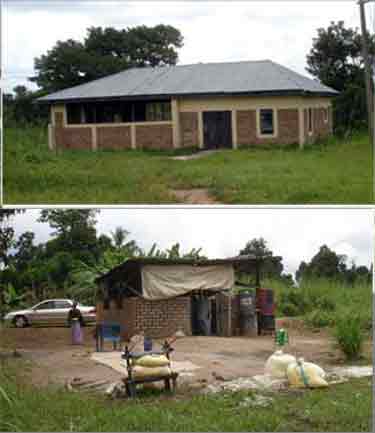
Out Sourcing: Trying to have the farmers involved in enhancing the value chain with value added activities above the farm level may need some serious review. If the farmers have limited energy so the work day is restricted to approximately 4.5 hrs. of diligent effort, the farmers will most likely be better off enhancing the value chain at the farm level, where they have the greatest control and vested interest, and then out-sourcing any value added, such as converting cassava to gari or parboiling and milling rice. These are both labor and capital intensive activities that are mostly done by out-sourcing which tends to be the preferred means. The best example comes from Benue, Nigeria. Here there is a virtually abandoned FAO women income generation empowerment project to convert cassava to gari. While it stands abandoned immediately across the street is a private gari producing family enterprise operating at full capacity with the wife as the business manager (see photo). This family produces some cassava but buys most of it as they really no longer have time for extensive cassava production. Instead they buy from their neighbors who appear satisfied to concentrate on production and allow them to convert the cassava to gari. This is all on a cash basis and not consignment.Similar things happen in rice with the parboiling and milling. Again in Nigeria this is often done in villages specializing in the process so traders will bring truckloads of paddy from the producers to the village, have it parboiled and mill, before being taken to the city market for direct sale to the consumer or consolidation and shipment to major cities like Lagos and Abuja. This can be on consignment particularly the milling, but the traders will closely oversee the entire process. Farmers again do not appear interested in getting directly involved in the process, preferring to remain at home to concentrate on other farm activities. Occasionally you will have farmers hire out to the millers as casual laborers for a day when they need immediate cash or only have limited farm work to do. But this will not involve their rice.
Moving up toward the consumer including establishing group labels etc. really needs to be done with extreme care to make certain the benefit are sustainable and the add income is not fully consumed by the additional costs being incurred.
Feeder Roads: However, there are things that can be done to enhance the returns to smallholder farmers. First among them might be improving the feeder roads that serve rural areas and connect the farmers to the market. Such feeder roads can extent hundreds of kilometer from the main paved highways. Unfortunately, it is the smallholders who have to pay for remoteness in terms of lower prices for goods and higher prices for inputs. This is simply the additional transport costs in serving remote communities relative to those less remote for which the smallholders must compete once they reach or leave the tarmac roads. In Zambia on former transporter claimed that her t/km charges triple once she had to leave the tarmac. This can really be almost transparently accounted for considering:
- Smaller vehicle with less load capacity for off tarmac use.
- Tran-shipment of goods to or from the smaller vehicle somewhere near where the tarmac and unpaved feeder roads meet.
- Warehouse space and storage costs to make the transfer.
- Additional fuel because the smaller vehicle is actually less fuel efficient on a t/km basis.
- Also, additional fuel required due to slower travel with more frequent braking, accelerating, etc. off the tarmac.
- Additional time required to travel each km on unpaved road, increasing the labor costs.
- Additional number of trips to deliver or pick-up the same amount of commodities, again increasing the labor costs.
- Additional frequency of repairs, from more bouncing around, adding wear and tear to the suspension, brakes, axles, etc.
Once feeder roads are improved the remote smallholder should be able to receive better prices for their goods as more traders will be willing to make the trip to the remote communities providing some competition for the business as well as reducing the higher transport costs being charged to the farmers. However, developing and maintaining roads is usually a public sector government responsibility, but given the highly Limited Tax Base Most Governments will have tremendous financial difficulty maintaining feeder roads regardless of the economic stimulus they can provide. Equally, unfortunate is the donors with funds for road construction like to emphasis the main arteries as they provide better publicity opportunities to boast of their contributions to the host country’s economy. Ultimately, the feeder roads are orphaned for essential funding.
Out-Grower Schemes: Another possible means enhancing at least the returns smallholders may receive is through out-grower schemes working in conjunction with a large nuclear farm, particularly ones that also process the commodity. However, this needs to be carefully organized with an emphasis strictly on marketing and avoiding excessive commitments to production. The problems come when the nuclear farm is expected to provide extensive services to the out-grower groups. The example would be Caltech Ventures, Ltd and Kobbiman Farms in Ghana who were encouraged to variegate from their main crops of cassava and mango, respectively, and become major soybean producers involving several small farmer organizations as out-growers. The impression was conveyed that the nuclear farm would essentially provide all services almost in “estate mode” in which the farmer mostly sat around and watched the nuclear farm do all the work with emphasis on mechanized land preparation and planting. The “estate mode” of managing smallholders was seriously discredited with the Gizeria scheme in Sudan nearly a century ago. The biggest problem was the nuclear farms did not have the resources to assist the out-growers without jeopardizing their core operations. Most noticeable was the tractors that on paper appeared in adequate supply, but considering that about 25% of the time individual tractors were out of service for repair with each nuclear farm maintaining full time mechanics to keep them operating. Thus the equipment was fully committed to the nuclear farms needs with only limited time to assist with the out-growers needs as promised. Caltech was more successful with cassava producing out-growers primarily because it was strictly a marketing operation with no involvement in the planting or management of the cassava other than specifying the variety conducive for processing.
Summary
Enhancing the value chain for the benefit of smallholder farmers can be a very challenging activity and has to be done carefully and not just assume that because you have the interest of the farmers in mind you will automatically have the essential competitive advantage. This would include a detail economic analysis of how far up the value chain farmers should remain directly involved to make certain the additional returns are not fully consumed by the additional costs, and any time delay in the farmers getting paid do not become too inconvenient that the farmers will rightfully opt for their more traditional markets.
It also has to be recognized that smallholder farmers may not have sufficient calories in their diet to allow them to diligently work more than 4.5 hours a day, thus what has often been considered as a labor surplus environment may in reality be a highly labor deficient environment in which basic crop establishment can consume up to 8 weeks or more.
Under such overall operating condition enhancing the value chain might be best concentrating at the farm level where farmers have the most direct control and vested interest. This could involve facilitating various service providers to more effectively assist the smallholders. First among these would be access to contract tractors for to expedite crop establishment and allow the producers to concentrate more on yield increasing mid-season crop husbandry activities. Also, facilitate the access to mechanical threshing that could enhance the recovery of the crop and avoid leaving 10 to 15% in the field for gleaners to scavenge, and also mechanical winnowing that will assist in getting the marketed crop close to the >1% international standard for foreign material avoid quality discounts from the traders.
Given the need to conserve their limited dietary energy, smallholders are unlikely to want to be directly involved in enhancing the value chain above the farm and community level. They are most likely better served by outsourcing these activities like par-boiling and milling rice or converting cassava to gari. However, it might still be possible to enhance their returns by improving the feeder roads to help reduce transportation cost or being part of marketing out-grower schemes working with large nuclear farms.
- If the farmers workday is Calorie Limited To 4 – 5 Hrs. or perhaps even less for heavy digging needed for manual land preparation and this result in taking over eight weeks just to get crops established against declining potential yield with each day’s delay as well as prospects of running out of rain before maturity, then the first means to enhance the value chain would be to facilitate access to individually owned and operated private tractors for contract tillage. This will expedite the crop establishment and substantially increase the potential yields as well as freeing the farmers to concentrate on mid-season crop husbandry that can further enhance production.
Informal Information & Distribution System
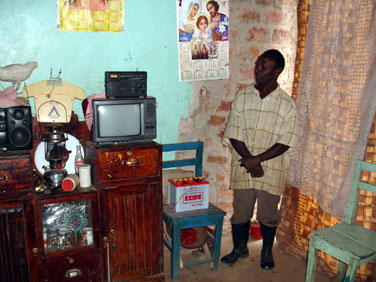
Source of Information
With the government civil services Financially Stalled resulting in very limited financial means to provide the intended and desired agriculture support services to smallholder communities, and with civil servants’ managerial skills, by financial necessity, being diverted to pursue Informal Income opportunities, how do farmers remain dynamic and obtain necessary new information and materials to assure their survival? The default is the informal information and distribution system. This is the system of friends, neighbors, shopkeepers, traders and other people who move in and out of smallholder communities and interact with other agriculture communities both smallholder and large farms alike. The effectiveness of the informal communication system is noted by a farmer survey conducted in India on farmers’ source of knowledge of pesticides which showed no information coming from university or extension personnel as illustrated in the figure. Instead, it came from friends, neighbors, visitors, shop attendants as well as the mass media of newspaper and radio commercials. When officials in the extension program or at universities were interviewed they were not up-to-date on the chemicals available and often recommended chemicals no longer available.
-
Read More About Informal Information & Distribution System
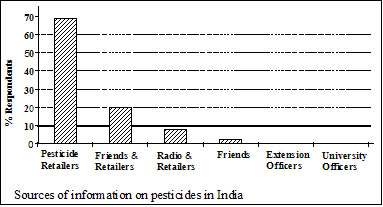 Shop attendants actually are a questionable source of information as they have a highly vested interest as they are trying to generate business. Also, shop attendants are often simply hired clerks instead of owners and may have only a limited background or knowledge of the materials they are selling. This would be of particular concern with pesticides and the potential health and environmental hazards they represent. Likewise, adds in papers and on the radio are vested in generating sales of their specific products.
However, friends and neighbors like to share information during casual home visits or around community gathering places such as bars and teahouses, or other social gathering such as weddings, rites of passage, etc. where casual conversation turns to “shop talk”. This should be a fairly reliable and relevant source of information that will stimulate some innovative farmers to experiment a little. In smallholder communities it only takes one person to putter around with new ideas to maintain a high level of dynamics, and in most communities their will be at least one innovator who will be closely watched by his neighbor while commuting to their fields. The information conveyed in such informal channels will also quickly sort out that which over extends the operational resource base and can not be effectively utilized, as most formal extension programs emphasis, leaving only the most relevant information.
Also, there are always visitors coming and going to and from communities. This would include relatives who have moved away and returned for a visit, or conversely those who have gone to visit relatives and returned. It would also include migratory laborers or service providers who come and go with the peak needs for work, contract tillage and transport, and those community members who have taken a contract labor assignment for a couple years and returned with enough capital to start a small village based businesses. Such business would include service providers contributing to the Symbiotic Associations within the villages such as tractor operators, mill operators, or shop keeper providing inputs and buying produce, or a recreation provider such as a bar and tea house owner with TV and satellite dish or VCR shop, or even a generator operator who charge all those old truck batteries that power lights and boom-boxes, and provide access to the broadcast media including both radio and television as shown in the photo from Uganda at the top and photos to the right from Tanzania. Regardless, there can be substantial opportunities even in highly remote communities for interaction with people from outside the immediate community and exchange information.
The effectiveness of the informal communication system can easily be seen by the donor community as well as government research and extension programs overlooking the mechanization of paddy production in Asia. Thus, the retirement of the water buffalo in favor of the power tiller and continuing to the contract access of small combines has been done exclusively via the informal information, distribution and finance system, mostly by the private power tiller dealers. The demand for mechanization and access to mechanization in Africa is slowly advancing in the same manner, mostly under the development community’s radar screen. How smallholder farmers were able to finance these major capital purchases would make and interesting study.
Variety Distribution
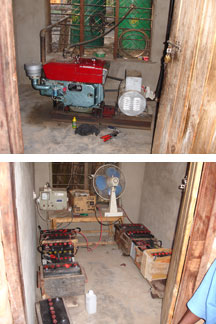
The informal information & distribution system can equally move and maintain genetic material between communities, particularly for self pollinated crops like rice and wheat that do not rapidly lose genetic purity as happens with open pollinated crops such as maize and sunflowers. In the Philippines, IR 1561 can still be identified and produced in many communities. This is a sister line to IR 36, that was released by IRRI and the Government of the Philippines as well as distributed through IRRI’s genetic sharing program to the extent that at one time IR 36 was the most widely cultivated variety of any crop. It was appreciated for its early maturity and drought tolerance. Back in the late 1970s, before it was rejected for release in favor of the sister line that became IR 36, IR 1561 was used in several on-farm demonstration trials. The farmers liked it, retained some seed, and even though it was never released or included in any foundation or certified seed program, it has informally persisted for 30 years.Another example is “Zambia rice variety” that is a widely grown variety in Southern Tanzania including the Madibira irrigation scheme where it was introduced and encouraged by the project staff because it was reasonably high yielding and slightly aromatic. However, its origin is not known. The government of Zambia does recognize it as a variety or at least has never released a variety under that name. Most likely it was an improved variety released in Zambia under another name. Someone from Tanzania liked it, leaked it across the border, quietly renamed it Zambia, and it moved on its own from there. This also happened in Nigeria were farmers were growing a variety they identified as Cameroon. Someone had made a farmers’ study visit to the neighboring country and returned with a handful of seed. Similarly, in Afghanistan the most commonly grown wheat variety in mountainous Panshir province north of Kabul is Mexi-Pak. According to CIMMYT, this was a variety personally developed by Nobel Prize Laureate Norman Borloug in 1964 as part of the Ford-Rockefeller Project as it was evolving into CIMMYT. It was concurrently released in Mexico and Pakistan. It then quietly crossed the border into Afghanistan and became widely accepted and maintained even without any official approval or any formal seed multiplication or certified seed production. It has persisted for some 40 years.
Utilizing the Informal Information System: In working with smallholder communities, it is important to recognize the existence of the informal information and distribution system, and tap into it as needed to distribute brochures or other printed information, and perhaps even allow for local multiplication and distribution of improved varieties of self pollinated crops. With most of the Variety Improvement effort deferred to collaboration with the IARC’s that make up the CGIAR system, and seed multiplication, certification and distribution stalled in the government financial restriction, there may be no other alternative.
 In reality, it is not necessary to undergo the enormous logistical task of providing certified seed to rice and wheat farmers each year. In Colorado, only between 25% and 30% of the wheat land is planted to certified seed. The balance is planted with retained seed. Transferring that to smallholder communities, it is only necessary to introduce relatively small quantities of seed for new varieties. Have confidence that if the farmers like it, the seed will be retained and multiplied and distributed in the community, rather than sold or consumed. Even in periods of food shortages smallholders will protect seed of new varieties that they feel have substantial potential. They may barter some of the seed for less desired variety for consumption to assure it persists. This happened to IRRI when it first introduced the early maturing IR 28 and IR 30 as part of their cropping system program in Iloilo, Phippines. Virtually all the initial harvest was quickly sold to other farmers as seed for the second crop, with very limited amounts being sold for grain or consumed. However, new material will have to meet all the conditions the farmers are interested in and not just the donor anticipated needs. If not, the material will simple be sold and the variety quietly disappear. The example is wheat in Pakistan and Afghanistan, where wheat straw is the major summer fodder and as much, if not more, valued then the grain. Thus, it is possible for donors to promote a wheat grain production program with expectation of the straw being mostly a waste product to farmers who are interested in summer fodder crop of straw with the grain as a by-product. Since high grain yields for wheat are associated with short stature varieties that have minimal straw production, improved varieties can be a difficult introduction, when farmers place equal or greater importance on the straw. It should also be noted that with self pollinated crops there is little or no genetic deterioration with retained seed and thus no significant yield loss as noted by the yield comparison between farmers retained seed and project produced seed in Madibira as shown in the table. It might take an extra growing season for a good variety, fully appreciated by the farmers, to blanket an area, but it considerable less expensive than trying to continually move certified seed into an area.
Mass Media
For broader extension of information it might be best to rely more on mass print or broadcast media including both radio and TV. It is recognized that while most smallholders will own a small battery operated radio fully equipped with oversized batteries externally taped on outside, most also will have considerable access to TV even in remote areas. Local bar and tea house owners can attract substantial extra business with a generator and satellite dish and some individuals will own TV powered by recharged used car and truck batteries. It is always interesting to speculate how many smallholders, even in remote areas of developing countries, are able to view the World Cup matches every four years. This TV access could easily be tapped for agriculture extension messages. The big question might be when would be the best time to broadcast extensions TV programs or how best to distribute VCRs or DVDs with the material.
In reality, few developing country governments can afford more then a mass media extension program. As much as they might desire it, and request donors to provide financial and training support, there really are not enough funds to fully staff an extension program trying to maintain a traceable administrative link to each smallholder producer as envisioned in the Training and Visit Extension (T&V) program. Instead most village extension technicians simply migrate with the different donor funded projects where they receive supplemental income from the project. This may be good for the project but lacks any post funding continuity and sustainability. Donors designing projects and consultant facilitating the implantation should be careful not to encourage governments to overextend their commitment beyond what can be sustained with revenue funds.