Those who have reviewed and agreed with many of the issues discussed in this website would recognize a need for several studies to be undertaken that would help in the overall effort at improving the plight of smallholder producers. These studies might be particularly useful to volunteer organizations such as the Peace Corps and could easily lead to the professional paper required for a Peace Corps Master’s Degree. If developed early enough in close contact with their advisors, this could become a full thesis degree program. The reason volunteer organizations like the Peace Corps can be particularly helpful in implementing these studies is they tend to be somewhat below the radar of most development efforts, while actively working in villages in direct contact with smallholders and mostly free from government activities. Those interested are welcome to contact this website manager for details as to how such studies might be implemented.
This page gathers the Studies Needed section of Dr. Tinsley’s Smallholder Agriculture site in one place. Each topic opens with a short introduction; the full discussion is in the Read More panel beneath it. Use the list below to jump to a topic.
- Cost of Doing Business: Village Enterprises vs. Farmer Organizations
- Post Funding Sustainability of Farmer Organizations
- Under Nourishment: Exerting More Calories Than Consumed
- Impact of Power Tillers On Paddy Cultivation in Asia
- Informal Credit: Usury Interest or Borrower’s Games
- Indirect Enhancements: Grain Mills & Domestic Water Improvements Impact of Agronomy
Costs of Doing Business: Village Enterprises vs. Farmer Cooperatives
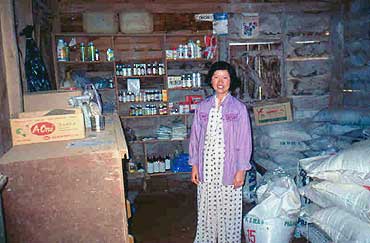 Over the past 20 years or more, much of the development effort to provide support services for smallholders has been funneled through farmer organizations such as cooperatives. The total investments have reached billions of US dollars. However, no one appears to have ever confirmed if farmer organizations are the most cost-effective means of supporting smallholders that will allow farmer organizations to continue without some form of external facilitation. This is in contrast to the private shop owners such as the one from Thailand depicted. Such traders are usually vilified as exploitive of smallholders. However, how much of this is unsubstantiated hype by host country clients, anxious to promote continued public sector support services even though they have long been identified as highly inefficient, or by development professionals anxious to promote farmer organizations. Thus, the most urgent question in smallholder development is “Which is greater: private traders’ profit margins or the farmer organizations’ sustainable overhead costs?” That is the overhead cost to operate the cooperative after donor funding and external facilitation end. There is the need for a good comparative analysis of the two. Basically, what are the costs in procuring inputs or selling produce? What are the required procedures in providing these essential services to the smallholders? Wouldn’t both private traders and farmer organizations would have transportation, repackaging to more convenient sizes, and collecting from or distributing to the smallholders. Then, the farmer organizations would have additional administrative procedures, mostly accounting, needed to maintain individual members’ records. Such administrative procedures are usually a greatly underestimated cost. Once all this is taken into account, which is really offering the smallholder the best deal? Remember that in financially-suppressed economies in which can severely restrict what traders can charge for their services.
-
Read More About Costs of Doing Business
The analysis has to be careful to remove the external facilitation costs provided by the technical assistance team assisting the farmer organizations and which would be expected to end at some point. However, the extra cost that farmer organizations incur would have to be included if they have major capital costs such as maintaining the donor financed lorries, while the private trader is relying on public transportation or contracted vehicles. The emphasis has to be on cost incurred to sustain a farmer’s organization without donor support, subsidies, or external facilitation.
In addition to the financial costs, there is also the concern for convenience in getting the inputs or marketing produce through the private traders or cooperatives. The concern is that cooperatives often require a pre-commitment and funding prior to ordering inputs, and accept produce on consignment with expectation of holding the produce, waiting for the normal increases in prices with time after harvest, but having to absorb all the post-harvest losses to rats, birds, and spoilage. Another concern would be a possible overall Financial Management Strategy that emphasis retaining assets in kind, and only marketing small quantities at a time over a prolonged marketing season, but needing immediate cash once marketed. All of these issues must be dealt with, in addition to the delay in payment while waiting for produce to be sold. How important is cash payments for inputs and immediate payment for produce for the smallholder producers? How much of a discount will smallholders accept for an immediate cash payment? Finally, is there a tendency for cooperative to persist through some Deceptive Bordering on Dishonest reporting to the donor and in periodical articles promoting the cooperative model.
Post Funding Sustainability of Farmer Organizations
a href=”https://labs.agsci.colostate.edu/tinsley/wp-content/uploads/sites/33/2026/09/ZambiaWomenGroupOpt.jpg”>
Along with the concerns for the cost-effectiveness and convenience of Farmer Organizations, as discussed in previous pages, there is an urgent need to evaluate how sustainable they are after donor support ends. Perhaps a good measure is two years after all donor assistance ends. That would represent two complete cropping cycles and should be sufficient to demonstrate long term potential to continue serving their members.
-
Read More About Costs of Post Funding Sustainability
The questions that need to be considered are:
- Do they continue to exist as effective organizations?
- Or, have they remained as nothing more than a shell organization that is no longer providing the intended services to their members?
- If existing, how have they evolved? Are they still a cooperative with annual elections and a timely turnover of officers, or have they been effectively taken over by a single individual, running it as a private business?
- If continuing, are they expanding or contracting in terms of members served, area involved, market share?
- If continuing, what market share do they command, and who commands the balance? Is this increasing and which declining?
- If they have become dormant, what has replaced them to provide the support services to the smallholders?
- If dormant, what happened to the assets?
- Were they divided among the members,
- In a complete state of disrepair, or
- Absconded by an individual?
This might also be a good time to look at just what percent of the beneficiary pool actually participated in the cooperative, even when operating with donor assistance. The beneficiary pool is all members of the geographic area that could have participated in the cooperative, as opposed to those who actually agreed to become members.
The final question is: how many similar organizations were spontaneously inspired in the area? If farmer organizations are a real benefit to farmers they should be stimulating additional organizations without donor assistance.
Ultimately, the bottom line is what percent of the farmer organizations mandated by donors succeed beyond the donor support, and is this rate of success acceptable to the donors and the taxpayers whose funds are being utilized?
Also, if this success rate is not acceptable, what are the options to provide the smallholder with the essential support services with a better chance of long term success?
Under Nourished: Exerting More Calories Than Consumed

One concern expressed in this website is that smallholder farmers are taking an unexpectedly long time to complete basic crop establishment, with a trickle down impact on subsequent field operations and eventual yield potentials and quality. Typically it takes smallholders approximately eight weeks to complete their crop establishment compared to a projected maximum of four weeks. Much of the basic crop establishment requires extensive manual labor, particularly when limited to working with hoes. This is for a group of people reported to produce only a six month food supply. A supply that will start running out just as the dry season ends and heavy manual labor for the next crop season begins. The question then comes, is the calories required to meet manual labor needed for crop establishment exceeding the calories being consumed? If not, what is the impact of undernourishment on future crop production, and the ability of the farmers to utilize production technology intended for their benefit. The estimate is that it takes 2000 cal just to sustain a person for a day, plus some 220 cal/hr additional for work depending on the task, for a Total Calorie Requirement of nearly 4000 cal.
-
Read More About Under Nourished
Most likely within a smallholder community there may be only a couple possibilities. Some might find employment as casual laborers for another farmer that will offer an in-kind payment of a sack of maize or rice that the hungry farmers can consume while working on their fields. The second option would be to simply eat less to prolong the limited available food. This will quickly result in becoming fatigued early in the day and having to return home or to the village to recover. Are there other possibilities? In both cases the hungry farmers’ field activities are delayed and with that the ability to adopt time sensitive production recommendations promoted for their benefit including those promoted as part of value chain projects. Ultimately this will substantially reduce the yield potential.
This is often easily visible by noting considerably more field activity in the mornings than afternoons. Why is this, considering the extensive amount of work needing attention, and a very well understood declining production function for delays?
If people are seen relaxing around a village during the afternoon, it is often thought to be from limited motivation. Could it also be simply exhaustion and recuperating from not having consumed sufficient calories for a full work day? From casual observation can this be separated? Given the continued fieldwork requirements, the loss of yield potential, and risk that brings to food security, which is more logical and more likely? Are delays in field work the result of hunger and exhaustion or risk aversion?
A comparison of the calories consumed and labor exerted should make an interesting study with considerable ramification. If it is correct that farmers are exerting more energy than they are consuming, there would be a major justification for promoting access to contract mechanization so the farmers can expedite their crop establishment and bring it more in line with production recommendations. It is noted that most of the basic land preparation for smallholders in Egypt, Pakistan, and Iraq is done by individually owned private contract tractors as part of the community service providers. There is also an increasing demand for contract tillage in rural Africa such as in Zambia and Tanzania.
The analysis could also determine if it is physically possible for a smallholder family to dig themselves out of poverty if only working with hoes, or will the time taken complete crop establishment and other labor consuming crop management activities reduce the potential yield below what will allow them to meet food security requirements.
Impact of Power Tillers On Paddy Cultivation in Asia

About 20 years ago most of the water buffalos in Thailand and other parts Asia were retired in favor of power tillers adapted for rice paddies that were originally manufactured in Japan, Taiwan, South Korea, and now China. Shifting to power tillers represents a major enhancement of the operational resources available to smallholder rice producers to manage their lands, which addresses a key issue of Drudgery Relief discussed on this website. It should have a major impact on rice cultivation, which may need to be quantified as a guide for other programs interested in making mechanization available to smallholders and understanding the impact of mechanization on individual fields, farms, and across smallholder communities.
-
Read More About Impact of Power Tillers On Paddy Cultivation in Asia
One of the key issues is the impact the shift to power tillers has on paddy establishment time for an entire farm. For rain-fed areas, the time may be halved from four months to two months, as mentioned by a rice farmer in NE Thailand. It could then impact farm size, including both directly owned land and rented land. Additional impact would be the shift from transplanted to direct seeded rice and with that, the use of herbicides for weed control. It might also impact the variegation and intensification of farm enterprises, such as converting a portion of the land to aquaculture with additional poultry or piggery production on top of the fish ponds as the farmer in NE Thailand mentioned above did and shown in the photo below. Also, the shift to power tillers appears to have lead to contract combining with small combines originating in Japan that can operate in the one rai (1/6 th hectare) fields and has this lead to an overall increase in rice intensity from two crops per year to five crops every two years.
Finally, what impact has it had on the material well-being of the farmers in terms of motorcycles, pick-up trucks, TV’s, VCRs, refrigerators, cell phones, etc.? It might also be interesting to see how much of the shift was motivated by the public sector extension effort vs. how much was more spontaneously coming from the private sector.
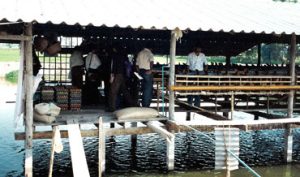
Power tillers are also moving into the rice schemes of Africa as shown in Madibira. This is again all self financed with no assistance from the donor community. It looks like another missed opportunity. The question is how effective will value chain enterprieses be unless they include some means of drudgery relief?
Another unfortunate issue is to correct the impression often conveyed by the development community that the success of the “green revolution” in Asia was virtually exclusively do to the technology development of IRRI and other research organization. Yes, IRRI high yielding technology did dramatically increase the potential yield of rice, but it did nothing to get the rice planted in a sufficiently timely manner to take full advantage of the improved technology, this was done by the farmers shifting to the power tiller. Since this was 100% done by the farmers the development community tends to overlook the impact of the shift to power tillers. This has resulted in the effort to promote a new “Green Revolution” in Africa to concentrate on technology development and extension without looking at the need to adjust the operational resources with enhanced access to contract mechanization. I would contend this is slowing down the prospects for a “Green Revolution” in Africa.
That should be sufficient to stimulate interest and the topic can easily be expanded. That is, if it is still possible to make the study as it may be a full generation of rice farmers since the shift and thus few farmers can relate back to when the water buffalo was the standard,
Informal Credit: Usury Interest or Borrower’s Games

On the issue page of this website there is a page describing the informal credit system and asking to what extent the apparent quoted 100% seasonal interest rate is an usury rate based on limited funds available and excessive profits by the lender, or does it represent the costs of doing business in smallholder communities and the games the borrowers may play in paying back their loans. The discussion was based on a limited number of interviews with lenders in Madibira, Tanzania. It describes their sometimes extensive efforts to obtain the repayments. Thus there is a real need to take a closer look at the informal credit system and see how appropriate or inappropriate it is in assisting the smallholder producers. Can the micro-finance programs providing institutional credit to smallholders and a subsidized interest rate provide sustainable competition for the informal credit system, or if the farmers are playing the same games with the micro-finance projects, will that drive up the administrative costs for administering smallholder loans to cover all the interest earned as well as ultimately consume all capital so the project collapse once external support ends.
-
Read More About Informal Credit
The questions needing answers are:
- How common is the informal credit system? It appears to be fairly common across most developing countries with similar quoted interest rates of 100% per season of 200% annual and found in both rural and urban areas.
- Are the conditions mentioned in the webpage, that largely justify the “usury” interest charges, common to other countries and smallholder communities, or more specific to Madibira? I would venture they are fairly common across the board.
- Who are the providers of informal credit and what is their link to the community?
- Are they mostly permanent members of the community such as larger farmers or shop keepers such as the shop engages in comprehensive good both agriculture inputs, purchase of products and consumer goods as shown in the picture, etc., or temporary people transiting through the community?
- Are they strictly in the money lending business or is this mostly an aside to other business such as shop keeping and partly needed to serve the primary business?
I would expect them to be mostly closely tied to the community and thus neighbors to the smallholder borrowers involved in assorted support services for which informal credit is a service to the borrowing farmers much of which remains with the lender in exchange for services like fertilizer, market seed, or contract tillage.
- If these conditions are common then what is the actual interest rates or profit margin for the informal credit, after discounting for trash, time and effort in collections, defaults etc.
- What are the rewards, if any, for those who pay on time with a clean bag of grain? Isn’t it in the best interest for the lender to reward such payments, even if it is an in-kind reward such as fresh seed for the next crop as reported by a former lender in Zambia, fertilizer, or even consumer goods such as cooking oil, detergent, etc.?
- How important are in-kind payments to the repayment process compared to cash payments? I would venture the in-kind payments are repaid faster and thus preferred by the lenders. This then lead to the cost of monetizing the payment back to cash. Would that be 10% of the value for clean grain and considerable more if the lender has to re-winnow and repackage, as well as absorb any post-harvest losses between accepting and marketing.
- Can a micro-finance project provide sustainable competition to the informal credit system or will the overhead costs of supervising and collecting repayments exceed the interest payments and render the project unsustainable once external funding ends, after which the informal credit system becomes the default provider?
- Should the providers of informal credit be vilified as exploiting the smallholder farmers or acknowledged and appreciated for the services they are providing?
I hope this list of questions in sufficient for someone to take a particularly interest in the issue and undertake some more detailed studies of the informal credit system. This might be considered as an essential initial activity for a micro-finance project assisting smallholder communities. That is because it will demonstrate if the project has a sustainable alternative business model capable of surviving beyond the initial externally assisted period, and show some of the repayment problems that may be encountered that would run up the administrative costs of loans beyond what can be recovered from the interest payments. If not and a micro-finance project just jumps in under the assumption the potentially usury rates are all profit margin with limited administrative costs, could quickly result in an unsustainable business model that will collapse once external funding ends and ultimately be little more than a publicity statement of the donors good intentions, with very limited actual long term impact on poverty alleviation.
Indirect Enhancements: Village Grain Mills & Domestic Water Supply

One of the central themes of this website it the need to enhance the operational capacity of the smallholder farmers so they could better manage their crops and livestock to increase their potential yields. The major thrust was to promote access to mechanization in the form of director ownership of power tillers for rice farmers or access to contract tractors for upland farmers. However, there were a couple pages devoted to more indirect means of enhancing the operating environment of smallholder communities, both of which involved reducing the domestic drudgery for women. The two suggestions were maize and rice mills that have virtually eliminated the extensive time and effort women spend pounding grain, except for specialty crops, and improved domestic water supply. These were both put forth as having a potential agronomic impact with the idea they need to be looked at more closely.
-
Read More About Indirect Enhancements
Regarding village grain mills some of the things they may need to be carefully looked at include:
- Just how much time women were spending in pounding grain before grain mills became available.
- Once available how much did this reduce the time needed for domestic chores
- What did they do with their free time:
- Just remain around the house
- Work longer in their field assisting their spouses
- Work longer in the field on independent crop or animal husbandry
- Become involved in other income generating activities.
- What was in economic impact of these additional activities made possible by the village grain mills?
- How about the ownership of the mills?
- Most were done privately so they were individual owned and operated like the one shown in the photo, perhaps by individual giving up farming to become service providers as part of the family enterprise system.
- A few were developed by NGOs as income generating activities for women groups.
- Which of these business model were more effective and sustainable in providing this service? I would venture the individual owner/operator were far more effective, with the women group were quickly being abandoned, as appears to be the case for gari making in Nigeria.
One problem with this study is that it may be too late to fully evaluate. This is because the availability of grain mills may now be fait accompli or nearly so. Thus there may no longer be a base line reference for pounding grain from which to start a study. Perhaps it can still be done through interviews with some of the elderly women in the community. It seems the traditional women pounding grain in Africa has gone the same way the water buffalo plowing rice fields in Asia. Sorry I will not miss either. I do find it interesting that the initial effort at mechanization for smallholder communities in Africa addressed the drudgery of domestic chores.
Regarding the improvement in domestic water supply

This is mostly done by NGO by drilling fairly deep wells with pumps, either suction if shallow enough (> 10 meters) or lift if < 10 meters. It can also be done with gravity flow from stream or spring to faucets distributed through the village. Most of these donor assisted domestic water improvement were undertaken for health reason reducing many sanitation diseases such as diarrhea, dysentery and even cholera. This could easily result in lower infant mortality, as well less lose time for adults suffering from occasional sanitary diseases. Thus there are several means by which improved domestic water supply could have an agronomic impact on crop and animal husbandry, higher yields or better quality of quality sensitive crops like fresh vegetables. Thus the need to evaluate the agro/economic impact of improving domestic water supply along with the health impact.
The questions that come to mind:
- Direct impact:
- Reduced time spend on getting water, mostly for women,
- How they utilize this saved time in terms of:
- Assisting their spouse with general farm work
- Doing independent farm work
- Doing other income generation activities
- Resting and conserving energy for more diligent effort the next day
- Indirect impact:
- Any noticeable reduction in childhood mortality.
- Reduce down time by family members suffering from sanitation diseases.
It might be noted that in a recent E-discussion on wage income for smallholders someone mentioned that improving water supply had reduced childhood mortality resulting in additional pressure on food security which, without make further operational adjustment, resulted in a substantial increase in out-migration from the farming community to urban areas seeking employment. This is an interesting and totally unexpected consequence of improving water supply.