Development Process
This page gathers the Development Process section of Dr. Tinsley’s Smallholder Agriculture site in one place. Each topic opens with a short introduction; the full discussion is in the Read More panel beneath it. Use the list below to jump to a topic.
- Project Development Process – Who Represents the Smallholder
- Development Hierarchy – Four Layers of Isolation
- Monitoring & Evaluation: The Voice of the Beneficiaries
- MEL – Impressive Numbers but for What Purpose: Deceiving the Tax Paying Public??
- ‘Appeasement Reporting’ in Development Projects: Satisfying Donors at the Expense of Beneficiaries (A Next Billion Article)
- Operational Feasibility Of Innovations: An Administrative Void in Development (AID & International Development Forum)
- Basic Premise – Was Something Overlooked?
- Delayed Adopters – Limited Knowledge or Limited Means
- Integration: Differentiating Research/Extension Officials from Development Officials
- Promoting The Green Revolution in Asia As Solely Technology Driven: A Major Disservice to Africa*
Project Development Process: Who Represents the Smallholders?
Economic Development Projects for Rural Poverty Alleviation appear to become locked into a limited number of approaches, often institutionalized across most of the donor community, that may end up reinforcing mechanisms for assisting smallholders with limited effectiveness while overlooking more critical needs of the smallholder beneficiaries. To understand how this can happen, it might be good to review the process by which economic development projects are formulated prior to implementation. This would include how the smallholder beneficiaries are represented in the early stages, and degree of commitment that predates any opportunity for extensive interaction with the beneficiaries through some form of participatory process such as the Rapid Rural Appraisal (RRA). By the time such diagnostic process can be made, it could be up to two years from the inception of the project, and projects are usually already fully committed to the intervention to be undertaken, with perhaps as much as US$ 500,000 already expended. The process does not, in and of itself, represent any adverse intentions on the part of those involved. Instead, it represents how well intended individuals can be caught up in a bureaucratic procedure of nearly circular self-promotion reasoning and reinforcement with little opportunity for innovation or involvement of the beneficiaries. It is important that those formulating projects are fully aware of the limitations in the project development process and how it can hinder innovative approaches, and become more committed to the mechanisms by which assistance is delivered, than the beneficiaries reliance on the service provided that will reduce the sustainability of the assistance beyond the limited period of donor funding and facilitation. There are perhaps six steps in the development project process that often requires up to two years for completion:
-
Read More About Project Development Process: Who Represents the Smallholders?
Project Identification
The first step in the process is the project identification. This is typically done between the donor and host government with the donor the primary initiator. There is little, if any, interaction with the intended beneficiaries, and in reality it would be very difficult, if not impossible, to effectively include beneficiaries at this point, primarily because the actual location and thus specific beneficiaries has not been identified.
Donors’ initiatives are usually guided by the broad strategic objectives of the donor government. The need to relate to strategic objectives may be necessary to secure the essential political support for funding from an electorate that often is not particularly interested in foreign assistance. This is the case for USAID, the largest donor for poverty alleviation projects, but with the lowest percent of Gross Domestic Product committed to foreign assistance. USAID has to classify all development effort into one of four strategic objectives approved by Congress. While these strategic objectives are broad enough to include most development innovation, they naturally represent the agenda of developed countries and what they can afford with their tax base and levels of discretionary funding being applied to a developing country with its Suppressed Economy and much more restricted tax base and levels of discretionary funding. This often makes for a very awkward fit that many countries do not have the tax base or discretionary funding to support, with the attempt to provide such financially unsupportable services frequently providing host government officers some Informal Income opportunities for claiming services provided that are more on paper than actual. The case of Certified Seed in Nigeria maybe an example.
Furthermore, the donor representatives for proposed projects are often more closely aligned with the developers and promoters of the proposed interventions within the donor’s country, than the end users. This often initially comes from academia, and can be highly promoted to the students as the ideal way of providing assistance. The end users, even in donor countries, then have to factor in the practical implications, such as in the economic costs and benefits as well as some of the intangible considerations such as the operational convenience, etc. that determine the final acceptance or rejection of any innovation. Thus, proposed interventions may be more the ideal of what can be effectively accomplished in the donor country, rather than what is widely accepted in the donor’s country, and giving the impression of a wider acceptance within the donor’s country than reality. The example here would be the use of Farmer Cooperatives to funnel virtually all development project sponsored support services to smallholders, while the agriculture cooperative system in the USA handles less than 30% and declining market share to the extent the US Department of Agriculture no longer tracks membership or market share with the Latest Information now over 15 years old. Another example would be the emphasis on irrigation scheduling consistent with plant water requirements which most USA farmers are familiar with, but not set-up to effective utilize for numerous valid reasons. Another would be the necessity for certified seed for self-pollinated crops such as rice or wheat each year, when less than 30% of the Colorado wheat crop is planted to certified seed while over 70% is planted to retained seed.
Finally, the donor representatives spend most of their time in the host country capital or even their own capital, with limited opportunity to meet with the intended beneficiaries. What contacts may be available could be highly time restricted and well orchestrated by either the host government or project implementing teams of a parallel project anxious to promote their projects’ accomplishments up the four tiers of the Development Hierarchy as necessary to assure future funding for their projects. Such quarterly progress reports or periodicals articles tend to be correct in what they contain, but may use some selective reporting to overlook or side step some of the critical issues that need to be reported to assure post funding sustainability, as may be happening with the information suggested in the Farmer Organizations Survey. Ultimately this results in reports that can be Deceptive, Bordering on Dishonest. The most common means of deception is by omitting the overhead costs of the cooperative that the farmers will eventually have to pay for the cooperative to be sustainable after donor assistance ends. However, it can also be done by expunging information from consulting reports that does not toe the accepted party line of what is politically correct. Project developers and supervisors are usually content to accept reports as written, and are usually too pressed with other project supervisory activities to carefully scrutinize the reports, and make certain the critical needs for post funding sustainability are included. This may be good for the donors and implementers in assuring continued and future contracts, but does little, if anything, for the beneficiaries. Thus, the donor’s representatives involved in project development understanding of the beneficiaries and their development needs is almost exclusively second hand and may rely substantially on the politically correct stereotyping of smallholders and their development needs, which will be repeated nearly verbatim from country to country without ever being substantiated. The result in a superficial understanding of the plight of smallholders that overlooks many of the subtleties discussed in this website in what might best be highlighted by the famous quote:
“A little learning is a dangerous thing; Drink deep, or taste not the Pierian Spring: There shallow draughts intoxicate the brain and drinking largely sobers us again” Alexander Pope, Essay on Criticism, 1711
The intended smallholder beneficiaries are represented by the host government with the assumption that the government is well informed on what the farmers needs really are, and can objectively represent them. Overlooked by the donors’ designing projects is that the host government is most likely Financially Stalled in that the vast majority, perhaps 80 to 90%, of the government revenue funds are committed to personnel contracted obligations such as salaries, health care, pensions, housing, etc, with very limited funds available for operational costs including frequent routine field trips to work with beneficiaries. Thus, the civil servants claiming to represent the smallholder beneficiaries may have had only limited direct contact with the beneficiaries and, within the context of the host country’s top down autocratic administrative environment, the contact more than likely would be more instructional bordering on supervisory than interactive dialogue of equal participants.
In addition, the host government may have a strong vested interest in promoting public sector support services such as parastatal companies or government sponsored cooperatives, even though these have been notoriously ineffective in assisting smallholders and most have been disbanded or privatized. This vested interest by the host government is most likely the original source of the basically slanderous condemnation of private traders that has permeated the rural development effort without any documentary proof or evidence, and could easily represent exposure to those legally responsible for any written statements to possible Slander Litigation by an organization of private traders. The reality may be that the Private Service Providers are most likely the most cost effective service providers to the smallholder and become the default providers when the development efforts fail. There may also be a multitude of private traders living close to or below the poverty line such as the Banana Trader in Uganda or the Tomato Vendor in Zambia. The host government representatives are also most likely the source of much of the stereotyping of smallholders, such as the oft stated claims of illiteracy and lack of motivation. Finally, the host government officials representing the smallholders may be looking more for personal opportunities from the development effort in terms of legitimate supplemental income by being seconded to the implementing contractor or project implementation unit, or less legitimate more informal type of income opportunities. Given the exceptionally low salary scale of most developing country civil servants, much of this might be a financial necessity, but that can easily drift into some major corruption. Hopefully, this will not be as severe as the Voucher Program in Afghanistan or the possible informal land sales in Madibira, Tanzania. Is this really the best representation of the impoverished smallholder beneficiaries?
During this Project Identification process, with all the limitations on involvement of the intended beneficiaries, dependence on second hand information, and possible vested interest of the host government representing the smallholders, the basic innovation is determined as well as the mechanism by which the benefits will be funneled to the beneficiaries. This would include the current in-vogue value chain projects looking at high value crop for export, managed through farmer cooperatives, or micro-finance projects to provide production credits to smallholders, etc. While the host government will normally have considerable say in the project identification, particularly the geographic areas to be involved, the most weight will be with the donors. They hold the money and the ultimate right to determine how it will be spent. Be assured, the host government personnel are normally far more experienced with manipulating projects to their personal advantage than the donors are at avoiding such manipulations, thus the host government can accept most any project and still derive the desired personal benefits.
Project Design
After a project has been identified the project goes into the project design stage. This is mostly filling in the details as to what will be done. This will include stating the assumptions on which the project is justified. At this point they can only be assumptions as there has been no opportunity to confirm the accuracy of them. The effort will be mostly done by the donor with some inputs from the host government, particularly regarding specific sites to be included in the project, and capacity building training opportunities, that will concentrate on government officers and serve as a “perk” for participating. During this stage the basic areas in which the project is to operate will be decided as well as the amount of external facilitation, the basic budget will be outlined along with budget line items. This would include how much will be spent on direct inputs to the beneficiaries, how much on capacity building mostly for host government officers, how much on capital investments for building and processing facilities, and how much for vehicles, etc. There will be virtually no contact with the beneficiaries during this phase. Again, it would be very difficult to effectively include them. The host government will continue to claim objective representation of the beneficiaries.
At the conclusion of the design stage virtually all conceptual thinking has been completed. The remaining stages are mostly fine tuning and reinforcement of the basic design. Despite the limited access and interaction the donor may have had with the beneficiaries, the heavy reliance on secondary information that may have been more promotional to assure future funding, than objective, and the possible contrary vested interest of the representation of the beneficiaries provided by the host government, it is very difficult to make substantial changes in the project beyond this point. Thus, while the intention might be for a bottom up approach to development, the process effectively becomes very top down.
Project Appraisal
Once the basic project design is completed the process enters the project appraisal stage. The purpose of this stage is to confirm the project design and add some site specific details. This stage is a team effort between donor staff or hired consultants with expertise and ideological commitment to the proposed innovation, and the host government. It represents a major and intensive interaction between donor and host government over a three to four week period. It includes site visits to the areas identified in the project design. Thus, this is the first time to meet with intended beneficiaries. However, the contacts with beneficiaries are often limited rather than in-depth and usually well organized, if not highly orchestrated, by the host government. Time limits, usually one day per site for the appraisal team, mandates this. Thus the beneficiaries interviewed will most likely be pre-selected by the host and possible pre-briefed, if not pre-programmed. They will also be preassembled in a central location and interviewed as a group, rather then randomly selected or casually met within the community. The host government personnel also will serve as the interpreters, if needed. This unfortunately will provide the opportunity for the host to leverage questions and answers to the government’s advantage. This often includes AWOA (Answered WithOut Asking) many sensitive questions and dismissing individuals as having too limited an education to be capable of proper responses.
As mentioned above, the objective of the appraisal team is primarily to confirm and fine tune the project design. It is normally not intended as diagnostic to evaluate if the design and innovations are meeting the most critical needs of the beneficiaries. This is assumed! Thus, in addition to the site visits, visits to similar ongoing projects will be made and discussions held with the implementing agency as well as reviewing some of their periodic reports back to the donors. How objective or promotional these discussion and reports are, is something that may need to be sorted out with regards to the Development Hierarchy and their need to assure future funding. Rarely will an appraisal team visit site locations of similar but completed projects to see how sustainable the projects were once donor funding ended, what modifications were made that made it sustainable, and what happened to the completed project resources if it was not sustainable without donor funding and external facilitation. Isn’t sustainability after donor funding and external facilitation has ended the objective of most development projects, with the post funding mutiplier the only real justification to the donor’s tax base?
Request for Proposals
Once the project appraisal is completed the contracting process begins. The first part is to prepare the Request for Proposals (RFP) along with the Expression of Interest (EOI) by those organizations that will be bidding on the project. The request for EOI will include the release of some of the details of the project so organizations will have enough information to decide if they wish to bid. The purpose of the EOI is to develop a short list of organizations that will be asked to develop a final proposal. The RFP is prepared by the donor in order to solicit a contractor to implement the project. It becomes a very comprehensive document that details exactly what the implementing contractor is to do. All the assumptions listed in the project design are now treated as indisputable fact, even though there has been no effort or field time to substantiate them. There will be no opportunity in the proposal to substantiate the assumption, just accept them as established fact. The RFP will include the type of innovations to be done, the mechanism used to convey the innovations to the beneficiaries, the project locations to be utilized, the support services to be built, the capacity building training opportunities and for whom, the vehicles to be purchased, etc. The RFP will also specify what technical assistance will be needed, the qualifications of all expatriate staffing as well as the duration of each advisers’ assignment. Once the RFP is prepared it will be released to the short listed organizations interested in bidding on the project and developing the necessary implementation proposal. Very little conceptually will be left to chance or open for discussion in the RFP.
Project Proposal
Once released, the potential contractors scurry around to respond to the RFP. While the RFP may be released some 18 months after the initial project identification, the response time for the formal proposal is often restricted to one month or less. This makes for a mad scramble in getting the proposal written that could extend for several volumes when all the detailed CVs of the proposed expatriate advisers, past performance of the organization, and budget materials are included. However, the critical portion may be only 10 to 20 pages, barely enough to reiterate the technical concepts of the RFP. Typically the people who prepare proposals are a specialized group within the responding organizations’ headquarter staff with limited opportunities to actually visit field locations, and will not necessarily include those who will implement the project. They will be assisted by any on-the-ground personnel in the host country, if such people exist, or by very brief country visits if time allows. Any such on-the-ground input will most likely come from host government officers or other “key” individuals, but very rarely involve the beneficiaries. The time limitations would severely restrict direct contact with beneficiaries.
To develop competitive proposals, most responding organizations will track projects and have all site visits completed prior to the release of the RFP. However, it still remains a very rushed processed that does not allow for extensive in-depth reflection on what may need to be done and relies heavily on past proposals equally rushed in their preparation. The proposal will respond in detail to the RFP with little if any innovative deviations, particularly conceptual deviations seeking a more effective adjustment to the proposed interventions, or qualification of the advisory staff. Such deviations from the RFP would be considered as non-responsive to the scope of work and the proposal will be down graded for it. It will also consume additional pages that would again downgrade the proposal. It will typically cost a responding organization approximately $60,000 to assemble a proposal. This is the main reason for the EOI and short-listing of organizations.
Project Implementation
After the project proposals have been fully evaluated and whatever contract negotiations needed are completed, the contract is awarded and the implementing team can relocate to the host country and commence implementing the contract. This is now as much as two years from the original project identification. It is also the earliest opportunity for any extensive non-biased participatory activities with the beneficiaries such as a RRA to determine if the beneficiaries’ needs are being addressed. But by this time what is left to decide? The basic project innovation was decided two years ago, the staffing according to the detailed RFP has been hired and relocated with a full commitment to the proposed innovation, and personnel contracts for the stated duration of their assignment. There has been a total upfront investment by the donor and contractor of approximately US$ 500,000. It would cost a similar amount to make major shifts in the project requiring revamping of staff including paying off personnel commitments and relocation costs, if the RRA was not supportive of the innovation.
Thus, there is really little choice but to leverage the RRA to support the proposed innovation. This is easily done by using leading questions in any interviews with the beneficiaries, avoiding asking questions inconsistent with the project objectives, or concentrating on responses that the project can address. This is very natural since the staffing is consistent with the proposed innovation and will naturally make inquiries consistent with the innovation. If the smallholder beneficiaries are not really interested in the innovation or have more important concerns it is too late for the project to pack-up and go home or shift to another location. The smallholder beneficiaries’ only recourse is to allow the project to proceed, to participate where possible as there is some uncertainty as to if it might succeed as promoted, but mostly continue on their own if the project fails to meet expectation. That might be manifested in Smallholders consigning only enough produce to the cooperative to cover debt obligation and side selling the bulk of their produce to private traders for an immediate cash settlement at perhaps a 20% discount from the cooperative price as reported in Kitwe, Zambia. This could be an example of astute smallholders’ response to well intended but highly institutionalized projects not fully meeting expectations, including overlooking their Overall Financial Management Strategy that could emphasize retaining good in-kind, rather then monetizing them. The 20% discount might represent the overhead costs of the cooperative, and returns might be at farm gate parity. Also, consigning only enough produce to cover the Loan Obligation and prevent any produce being used to pay off a neighbors loan in what was a communal loan pool.
Summary
While there is no question as to the sincerity or commitment of the donors and facilitating organizations to eventually assist in the poverty alleviation of smallholders, the process of getting development projects in place to assist them may not lead to the most effective projects. Most of the conceptualization is done very early in the process by people relying mostly on secondary information, limited direct contact with the beneficiaries, or with some vested interest in public sector services or personal benefits. Thus, by the time the project is actually implemented, some two years after being identified, there is little alternative but to leverage the acceptance of the project by the smallholder community intended to benefit from it. In this case, it is highly possible for the mechanism for funneling assistance to the smallholders can become more important and overly institutionalized into the development process than the effectiveness of the assistance even when that mechanism does not have a competitive advantage, and critical issues can be overlooked for decades as with the possible oversights in the Basic Premises, and not consider alternatives explanations for the basic premises, that may indicate a serious imbalance in the Available Calories relative to what is expected to be exerted with serious implications for the timely completion of specific tasks that will substantially reduce the potential yields. This might be extrapolated to consider that many development projects have an inadvertent, at least a conspiracy, for advocating the genocide by starvation of the smallholder producers and be subject to possible referral to the ICC (International Criminal Court) the tribunal in the Hague for crimes against humanity.
While there may not be much that can be done with the overall stages of the process, it is important that those developing projects are fully aware of the limitations on the information they are basing project conceptualization. There is a need to get some highly independent evaluations of the needs of the smallholders and their communities. This would be independent of both the host government and their vested interest, and on-going projects with equally vested interest in promoting their perhaps limited accomplishments. There is also a need to return to completed projects some two years after donor funding and external facilitation has ended to see if the projects still exist, how they have been modified to remain viable, and, if they have not survived then what became of the projects’ resources particularly the financial resources. This may require some fortitude to bite what could be a multi-billion dollar, multi-decade bullet of ineffective, unsustainable projects.
Preferable there is a need for a strong and independent Monitoring and Evaluation (M&E) component for development projects. M&E components that not only measure beneficiaries’ willingness to participate, but more critical the degree they rely on projects for the services provided. M&E personnel must accept that they are not part of the donors’ propaganda of good intentions, but are representative of the underwriting tax payers assuring the tax money is well invested. This also makes them representative of the Beneficiaries assuring they receive appreciated services. Donors designing projects might be well served to develop some strong criteria that will assure the sustainability of projects beyond donor funding, such as the questions in the Cooperative Survey. Then set targets for those criteria for contractors to meet, or explain why they cannot be met, and insist on these criteria be addressed in periodic progress reports
Both the smallholder producers are entitled to such evaluations to assure they fully benefit from the development dollars invested in assisting them, as well as the tax payers funding the donors to assure their taxes are not squandered. In the absence of such evaluations, when projects are not sustainable beyond donor funding and external facilitation, they become little more than an indication of the donors’ good intention with limited impact on rural poverty alleviation. It would also be nice if the RFPs provided opportunity or even required the contractor to varify the assumptions upon which the project was justified.
Example
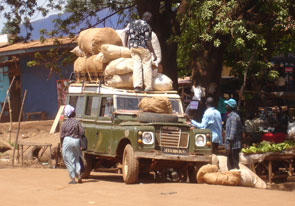
An example of how a development project can get well outside the realities of what may actually be needed is a recent RFP for a major agriculture development project. In the RFP one of the major components was to address the problem of remote areas with poor conditioned roads, and the excessive transportation costs being charged to the farmers. The proposed solution was to provide the farmers with a marketing information service that would advise them of the current consumer prices for their produce. This was intended to provide them more information to negotiate with the traders for a better price. However, in the standard transportation quotes of $/t/km, what goes into the additional transportation costs associated with remote locations? Some of this would include: The need for smaller vehicles that can negotiate the rougher roads. This could be as small as LandRover pickup as shown for Kenya.
- This could result in the need to transship goods from larger to smaller trucks.
- In this case, storage facilities would also be needed for the transshipment.
- Since vehicles are smaller, they may consume less fuel, but because of the smaller load on a t/km basis it will require more fuel, and usually the consumer price of fuel is at a premium to the USA prices.
- Also, because of smaller loads it will take more time and thus more labor costs to move commodities to or from the more remote locations.
- In addition, the overall speed will be substantially reduced, possibly from an average of 80 km/hr on tarmac to an average of 30 km/hr, as well as the amount of breaking and accelerations in the more rutted portions of the road. All of which will add additional fuel and labor costs.
- As trucks will bounce around more negotiating the ruts, the maintenance costs for tires, brakes and suspensions will also increase.
Factor all this in and what would be a transparent additional cost for doing business in remote areas that unfortunately has to be borne by the farmers in terms of higher prices for goods brought in and lower prices for produce being marketed? In Zambia transportation cost off the tarmac were 3x that for the highways. If all the information was available and in the context of a Financially Suppressed Economy that restricts profit margins this could easily be a very transparent cost increase. How a market information system will address these legitimate costs is unclear. Perhaps, it will mostly inform the producers of just how unfortunate they are.
However, since the RFP required a marketing information service, all responders eagerly promoted the service as there was no opportunity to demonstrate an understanding of the legitimate concerns with working in remote areas and asking to address those issues. That would result in a deduction as non-responsive, and would extend the response beyond the allocated number of pages.
Development Hierarchy – Four Layers of Isolation
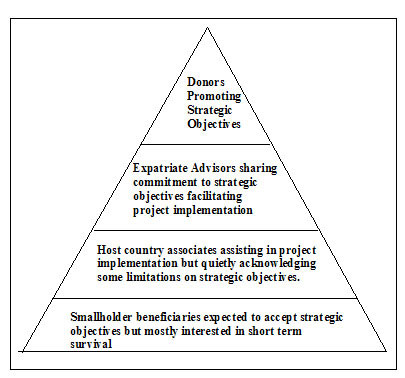
The development process for assisting smallholder agriculturists involves four dedicated groups of people each with substantially different perspectives. The four groups form a hierarchy as shown in the graph below that goes from the donors that conceptualizes designs and funds projects, down through the advisors that facilitate projects to the host clients that implement them, and ultimately to the smallholder beneficiaries who are expected to participate in projects and benefit from them.
-
Read More About Development Hierarchy
Donors: These are the people who design and fund projects. They include such agencies as the bilateral donors including USAID, DFID, DANIDA, GPZ etc., as well as the multi-lateral donors such as the World Bank, Asian Development Bank and African Development Bank. They have to work with the political structure from which they obtain their funds. This requires conceptualizing on a strategic level to appease their political supporters. An example is USAID’s four strategic objectives into which all projects must fit. Since USAID has the biggest budget their strategic objectives heavily influence other donors, particularly the multi-lateral donor to which USAID makes major contributions.
Examples of these strategic concerns are:
- political empowerment of the disenfranchised, such as most smallholders; and
- preservation of the natural resource environment that smallholders are dependent upon.
The donors design the development projects, including specifying in advance what professions will be needed to implement them. The Project Development Process between design and implementation can take up to two years and represent the time between conception and the actual meeting and dialogue with individual beneficiaries.
Expatriate Advisors: The expatriate advisors are required by the donors to be contracted by the clients as a condition for project implementation and funding. They operate from a financially secure position and are hired because they share many of the strategic concerns of the Donors as expressed in their responses to proposals that provide them the contracts to work with the clients for the eventual benefit of the smallholders. They are also recruited for their knowledge and experience in the donor’s strategic objective. They are therefore interested in promoting, to the extent possible, the donor’s concerns and will use their reporting mechanism to emphasize the extent of the donor’s concerns that are being implemented by the beneficiaries. This can be essential to assure continued funding.They are also the primay means of reporting on the project to the outside world as they are responsible for writing the progress report, usually quarterly, to the donor, or to different peridocals both referred or non referred. Neither one of which are readily available to the client or beneficiary. Some of this reporting can become Deceptive Bordering on Dishonest or even expunge information that does not support the accepted politically correct party line. This can nicely institutionalize ideas well beyond their overall effectiveness in assisting the smallholder beneficiaries, and assist with job security through project extensions and new projects, but does little to aid the beneficiaries or lead to more effective means for assisting them.
Clients: The clients are the host government institutions implementing the projects and officially contracting for the Expatriate Advisors. This would normally be from the civil services, either directly or through secondment to the project management unit. These people receive a base salary approximately 1/12 that of the advisors. As a result, they are still seeking additional financial security and a lifestyle comparable to their international colleagues. They will shift with opportunities for supplemental salaries offered from development projects, as well as some possible informal income opportunities. They are content to actively promote the donor agendas, but may not have the ideological commitment to them and are often aware of the limited long term promotional sustainability. In interviewing clients a couple key questions can quickly divert them form the “project party line” to the more realistic appraisal. Given their basic financial means it is difficult to blame them.
Beneficiaries: At the very bottom of this hierarchy are the smallholder beneficiaries who are expected to ultimately participate in the projects and benefit from them. They may have only limited education, mostly from the lack of opportunity, but they are still intelligent individuals who might best be considered as individual entrepreneurs. That is business persons and astute business people at that. However, they normally are primarily concerned with short term returns essential to secure their immediate family needs and perhaps some comfort items such as kerosene lamps and maybe a push-bicycle to commute to and from their fields. They are in need of the most cost-effective support system and not interested in any political baggage that might accompany the support services, but cost them more once donor assistance ends. They also have a limited economic time frame and thus little interest in anything beyond the next cropping season. This presents a large gap between the strategic objectives of the donors conceptualizing projects and the smallholders participants expected to benefit from them. Since the beneficiaries rarely meet the donors, were not really involved in the project design they have little compulsion to participate for participation sake, and will easily divert around a project that does not fully meet thier needs.
Difficult Communications
The manner in which the development process is set up working through these four hierarchical layers makes it very difficult, if not virtually impossible, for the beneficiaries to have an effective link to the donors. The donors tend to be highly involved in the basic management of projects, so they have only limited time for field visits. An example would be the need for nine signatures on a half page memo with a financial value of less than $500. When they do make field visits they have to be guided by the advisors and the hosts. These people have a highly vested interest in promoting continued funding which can best be done by demonstrating the success of the donor’s conceived project without going through the difficulties they encounter, the limited percent of the beneficiary pool actively participating, or the leakage around their efforts. They will guide the donors to those individuals most cooperative with the project, whether or not they represent a minority of the beneficiary pool of possible participants. This can provide a well orchestrated group response leading to a distorted impression of the success of projects and their long term sustainability. There will be no time for individual meetings with community members, particularly those who have opted out of participating with the project. Given the limited time donors have to make field visits, it would very difficult for them to penetrate far enough into rural communities to make a statistically valid sampling of the beneficiary pool to determine how effect a development project is, and what happens once donor support ends. This can really only be done by a separate independent contract with a local consulting company with specific instruction to fully evaluate the impact of the project. Such consulting efforts should be independent of both the host government and implementing contrator.
The net result of this process is that donor conceived projects can become highly institutionalized in the development process, in excess of their post funding sustainability. Similarly, innovations that would lead to more effective projects that will better serve the smallholder beneficiaries and promote their sustainable improved economic well-being are extremely difficult to implement.
One can only wonder what would happen if a micro-finance project, specifying implementation through farmer organizations for the benefit of smallholders, with a specified long term expatriate staff already fielded into a pre-designated project area, initiated their field work with a rapid rural appraisal activity and found the farmers had previous experience with farmer cooperatives and institutional credit. These experiences were not satisfactory and they were not really interested in repeating them. Would the project then:
- Be cancelled,
- Move to another location to be tried again, or
- Leverage the rapid appraisal process to support the predetermined innovations as the only one offered to the farmers?
Unfortunately, the way development processes operate with the two year lead time and commitment of professional staff, the last option is really the only realistic one. It should be noted that there are numerous studies that indict institutional credit is a far lower priority of the smallholders than the donors!
While there is very little that can be done to alter the overall development process, it is important to recognize the nature of the hierarchy and the extent of the vested interest at each levels and how this can result in the over institutionalization of innovations that actually offer limited results. It is really the task of the Monitoring & Evaluation effort to determine the reporting criteria that will not only determine farmer beneficiaries willingness to participate projects but also the degree they are relying on projects for the services offered. As such the M&E professionals have to represent the underwriting tax payers to assure their taxes are not being squandered and the beneficiaries to make certain they are taking full advantage of the projects. Also, donors could contract for independent assessments, that may best be conducted by local consulting firms with no connection to host governments or expatriate contracting organization. This would mostly be looking at the percent of the total beneficiary pool that is participating, the reason others are avoiding participation, the extent those participating are circumventing the project, etc.
Monitoring & Evaluation: The Voice of the Beneficiaries
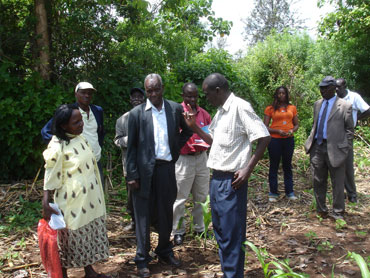
Project Initiation: In initiating a Development Project, such as current fad for “agriculture value chains” to alleviate poverty for smallholder producers, it typically takes up to two years and costs nearly a million dollars to bring it from conception to implementation, and involves a four level Hierarchy starting with the donor and ending with the beneficiaries. Such projects are often based more on the social desirability of what is perceived to be “politically correct” within the donor country, and do not necessarily relate to the Suppressed Economic realities of the host country. Such “politically correct” innovations can be heavily supported by the donor academic community. While I don’t question the sincerity of the academic community and individual faculty members’ interest in rural development, it has to be recognized that faculty commitments to their university for teaching, university sponsored research, student advising, prevents full time career commitment with multi-year residential assignments in host countries. Instead they can only have a “puttering” commitment to development through multiple short term assignments timed mostly for breaks in the academic year. The result is that the projects being conceived really represent more the developers and promoters of innovations, instead of the end users even in the donor country. This often conveys the impression to the host country of considerable more extensive acceptance in the donor country than reality. For example if one goes into a supermarket in the USA, what percent of the goods on display represent the terminus of an “agriculture value chain” traceable back to specific farmers or farmer organizations as envisioned in current emphasis on value chains. My guess it is less than 1% perhaps only 0.1%. Also, overlooked is the Farmland Debacle in which the effort by a conglomerate of farmer cooperatives, following the value chain concept, to vertical integration from producer to consumer with a nationally recognized brand name, resulted in the most massive cooperative bankruptcy in history. Not really the best reference for promoting similar innovations in the suppressed economies of developing countries in which business efficiency is essential to produce and deliver consumer goods at a Fraction of the USA Price.
-
Read More About Monitoring & Evaluation
During this project gestation period the beneficiaries are mostly represented by host government officers. However, because of Limited Budget the government officers may not be in as close contact or as well informed on the plight of the beneficiaries as desired, and perhaps have Personal Vested Interest in how the project develops. This results in their not providing the best representation for the beneficiaries, and making assumption that are taken as fact without need for verification. Sometimes this is expressed in near slanderous terms like the blanket vilification of private traders with statements such as:
Increased market opportunities to enable farmers to improve their produce (both in quality and quantity/variety) and prices by eluding unethical middlemen dictating exploitative prices to farmers will provide a conducive environment for sustained farmer participation and growth.
If no contract provision is made to verify such statement or the implementers do not do so on their own, with some solid business comparisons analysis showing the project is offering a sustainable (non-subsidized) more competitive business model, the smallholder beneficiaries could simple and wisely avoid the project resulting in projects with very limited overall impact.
Thus, by the time a project is contracted for implementation there has been very little if any input from the beneficiaries. The lack of beneficiary input has to be understood and appreciated as logistically impractical, but ultimately it results in very top down projects based largely on what the donor considers the “politically correct” development mechanism, endorsed by the host country civil officers with possible individual vested interest, being imposed on the voiceless beneficiaries. Projects will than require substantial facilitation with some possible subsidies to assure at least some apparent success, but ultimately collapse shortly after the facilitation effort ends.
During Implementation: Similarly, once contracted and there is a real opportunity for extensive participatory interaction with the beneficiaries, most of the conceptual decisions have already been made and the implementing team has no real option but to leverage the participatory process to conditions specified in the RFP, agreed upon in the implementation contract, and for which they are professionally staffed to carry out. This would include accepting as fact such slanderous vilification as mentioned above, and not taking time to confirm the accuracy of such comments, that could show the vilified service providers actually provide a more competitive advantage for the beneficiaries than the innovation being imposed, which might be too administratively cumbersome to be competitive. Furthermore, the implementing team then has little choice except to appease the donor and spin any reports toward the preconceived mechanism for development. A process is greatly encouraged by donors’ regular demands to “show us your success”. Basically this is a mandate to spin the results but with plausible deniability if questioned. It also substantially shifts the projects commitment to the mechanism for assisting smallholders at the expense of the intended beneficiaries, and reduces the beneficiaries to pawn in the modern version of the “Great Game”. Any variation on endorsing the donor imposed mechanism would bring into question their competence as implementer’s and question if their contract can be extended or future contract awarded. However, such spin reporting will encourage a continuation and expansion of project models in future projects even when they have minimal impact. At no time is it really possible to effectively question if the development mechanism is fundamentally flawed, and alternative mechanisms need to be developed for consideration. Basically comply with the donor’s perspective or go home!!
Monitoring and Evaluation: Considering the beneficiaries potential weak representation during project development, and the implementing team’s need to leverage any participatory procedure to support the project processes, then spin results to appease donors, it is really left to the Monitoring and Evaluation (M&E) process to provide a voice to the beneficiaries that will determine how well any project is appreciated and utilized by the beneficiaries, and thus the potential for the project to be sustained beyond donor assistance. As representative of the underwriting taxpayers, for whom they are the stewards of the taxes entrusted to them, it is really their mandated task to assure that the taxes be it dollars, pounds, euros, etc. are well invested. Thus they are specifically tasked with determining the evaluation criteria that will demonstrate if a project will succeed and be sustainable well beyond the end of the donor assistance, or dissolve once the external facilitation and support ends, and ultimately be little more than a publicity opportunity expressing the donor’s good intention. In doing so they must accept most of the responsibility and perhaps liability for perpetuating projects and initiating new projects that beneficiaries have basically avoided, and not assuring new projects evolved in response to beneficiaries accepting or rejecting active projects innovations. This can only be done by becoming the voice of the beneficiaries, independent of the project officers, contract officers and implementing team. In so doing they need to clearly establish criteria that monitors the degree of reliance the beneficiaries place on the projects. This would require establishing specific targets for the various criteria that will demonstrate the effectiveness of the project in serving the needs of the beneficiaries and insisting implementing contractors report these criteria with solid explanations for why targets are not reached and plans to reach them including the timeframe to accomplish this.
For “value chain” projects a set of criteria might be those outlined on a Separate Webpage of this site. While I consider these criteria to be basic business parameter anyone providing a business service should undertake prior to opening the doors, these criteria are basically non-existent in any project reporting including both progress reports and published articles. These criteria have actually been acknowledged as important by the USAID Assistant Inspector General for Audits, but claimed collecting the data would be too costly. This followed a direct inquiry facilitated by former Sen. Mark Udall of Colorado. The Assistant Inspector General’s comment about the data being too costly to obtain I have trouble accepting as with no budget I can get some good estimates using published articles, some simple internet searches, and some basic (non-rocket science calculus) computations. The webpage with the suggested criteria contains values the interested public expects for the various criteria. These were obtained over several years from pre-lecture surveys of students of my credited course or participants in my continuing education course and would serve as reasonable targets for each criteria.
What the M&E officers need to prevent is the tremendous degree of spin reporting that attempt to make programs smallholders are really avoiding appear to be major succeeds, but can be Highly Deceptive Bordering on Dishonest. For value chain projects this often involved using aggregate data so the numbers appear more impressive, but when divided by the stated group members are really trivial, or stopping the accounting of benefits short of the farm gate, which basically allocates much of the overhead costs as direct financial benefits. Why should tax payers, particularly USA tax payers that I have a vested interest in, be burden financing development projects the beneficiaries are not interested in!!!??
If the M&E programs did require the suggested criteria or something similar for value chain projects, it might quickly show that projects were attracting only minimal participation from the intended beneficiaries, and those participating were only committing a relatively small percent of their goods to the project, while diverting the bulk of their business to private service providers that may have been initially vilified by the project. However, given the administrative cumbersome business model and resulting high sustainable overhead costs that exceed any negotiated benefits from consolidated input purchase or produce sales, those vilified private service providers where able to provide a financially more competitive service to say nothing of greater convenience, and more consistent with a reasonable well-conceived overall Financial Management Strategy. A strategy that emphasizes retaining goods in kind, then marketing only what is needed to meet immediate cash needs, but requiring immediate cash on delivery. Ultimate the value chain projects are having a minimal impact of host community and the development community needs to look at other options to assist the smallholders.
The bottom line of this, if the M&E process is not willing to effectively represent the beneficiaries and more concern with assisting project officers in accepting spin reporting is it left to the concerned citizenry to use the court system to assure their taxes are properly invested?? After all in the USA the constitution still reads “Of the People, By the People and For the People”.
MEL – Impressive Numbers but for What Purpose: Deceiving the Tax Paying Public?
Over the past several months I carefully attended the various MEL (Monitoring, Evaluation, & Learning) webinars with much concern. While, as I understand it, monitoring and evaluation (M&E) is designed to be an independent effort primarily to protect the underwriting taxpayers and make certain their taxes are wisely spent and not squandered on ineffective projects, which the beneficiaries largely avoid. This would also provide guidance for future projects to evolve to better serve the beneficiaries. As such M&E also has to represent the Beneficiaries in assuring the projects are meeting their needs. However as presented in the MEL webinars, the effort appears to have reneged on its responsibility to the represent the underwriting taxpayers and beneficiaries to be more committed to data embellishment and assist with publicizing programs even if, by most standards, they are failures and largely avoided by a substantial majority of intended beneficiaries. The result being all development projects, particularly for poverty alleviation for smallholder farmers, appear to be highly successful, when more objective evaluations would show minimal, almost trivial, sustainable impact, with a high probability of forcing the intended smallholder beneficiaries deeper into poverty. This appears as a logical continuation of the Appeasement Reporting aimed at satisfying the donors at the expense of the beneficiaries, who see a lot of publicity for little benefit.
-
Read More About MEL – Impressive Numbers but for What Purpose
The whole process is basically the proverbial “bean counting” that reminds me of my advanced calculus proofs some 50 years ago, but without the confining limits. The idea is to sum an infinite (∞) number of small values to get an impressive but, without confining limits, ultimately meaningless numbers. This really only represents a massive investment of tax dollars and is easily done because there are a very large number of individual projects each working with multiple communities which with even minimal beneficiaries’ participation will sum to an impressive number, perhaps in the 100 of thousands. However, as a percentage to potential participants this could be a trivial representation, perhaps < 10% (Box 1) and well below the > 50% interested taxpayers assume are participating (Box 2). Thus, for every 100 thousand reported beneficiaries there could easily be a million potential beneficiaries wisely avoiding the projects. This limited participation is not enough to have any serious impact on the participating communities’ poverty. It also must be noted while the counting is on individuals, the projects are by the communities served for which the overall objective must be community wide acceptance, and not just isolated individuals.
The low level of community interest in participation in agriculture development projects was confirmed in a recent assignment (2018) to Madagascar during an interview with an externally financed NGO. After an hour discussion of their program mostly based on the old T&V approach, a query was made of the level of participation. The optimistic response was 15%. Allowing for some literary license the actual value was likely closer to 10%. This was followed by a field interview with some beneficiaries that was accompanied by the producer’s organizations head of marketing who was responsible for seeing farmers marketed through the project. He sat quietly as a member discussed how she side-sold her rice instead of marketing through the project as expected and mandated by the by-laws. As the project was concluding, the advisors showed considerable frustration with their overall results, as based on past reports they were expecting a greater spontaneous participation. However, the reality is that the response was typical.
It only takes a few reflections on what criteria should be included and how it should be expressed to realize that the MEL may provide some level of monitoring, but no real evaluation, and certainly no learning other than how to embellish data to deceive the underwriting taxpayers along with their elected representatives who must approve future funding. Ultimately, the MEL effort has no means of guiding future projects to more effectively assist the intended beneficiaries meet the project objectives. Instead the process is inclined to more deeply entrench the current “innovations” even if a substantial majority of beneficiaries are avoiding them or providing minimal participation while diverting most of their business to the competing service providers, when possible. The result is continued squandering of taxes on ineffective projects largely and wisely avoided by a substantial majority of prospective beneficiaries. In addition, this propaganda-based MEL can frustrate new advisors as the proclaimed success of previous projects leads to the expectation that once the “wonderful” new project starts the beneficiaries would be queued up outside the office door and well around the corner to join, only to end up having to persuade individual beneficiaries to participate, and once joined only to have them side-sell the bulk of their business.
Estimates of taxpayer expectation come from a pre-lecture survey by students taking a graduate and upper undergraduate level class I taught. The total sample was about 200 individuals many of whom were in the Peace Corps MS program or considering joining the Peace Corp. The information is available on the smallholder agriculture website.
Justification for Concerns
This provocative or perhaps highly provocative overview can rather easily be clearly supported with some simply consideration of what is missing and simple computations. No rocket science or even advanced calculus required. Just simple objective business arithmetic computations about the Basic Business Parameters that separate success from failure, that even a humble agronomist can do, and the smallholder beneficiaries intuitively understand even with their opportunity (not intelligence) limited formal education.
Agronomic Inputs
A couple examples from the poverty alleviation efforts for smallholder farmers where the MEL effort, as defined in the webinars and referenced handbooks, are misleading the public, their legislative representatives, perhaps worst of all themselves. From the production perspective the concentration is micro-finance of production inputs. This again was an open-ended summation of the individuals participating in various projects providing assistance with micro-financing for fertilizers, improved seed, etc. Omitted were the total number of potential participants within the project communities nor the percent of the area over which the inputs were applied. Likewise, the total number of funded projects included in the summary is excluded. Thus, a probable scenario was that the inputs were provided to 10% of the potential beneficiaries, and the inputs were applied to a relatively small percent of their lands, where timely planting was possible. Thus, since time of planting is typically spread over 8 weeks or more the total input usage could be less < 2% of the communities’ cultivated areas and comes close to the trivial impact projected at the beginning.
Extension
Similarly, the extension/educational effort was an open number of individuals they were able to contact with an administrative valid link. This again can was summed into an impressive number of smallholders reached. However, overlooked was if the technology could be widely adopted or only on a small percent of the area. This endorsed the genocidal assumption that poor hungry farmers would exert about twice the Caloric Energy they had access to and can manage their 1 to 1.5-hectare farms with the same ease as modestly salaried research or extension officers could manage the 0.1-hectare research/demonstration plots aided by a hire labor crew. How ridiculous is that assumption? No concern is expressed as to whether the extension message was appropriate for the famers or what compromises were necessary to Integrate the promoted message to the farmers’ specific economic situation including available operational resources.
Operational Feasibility
Completely overlooked was the most critical concern for smallholder farmers, the Operational Feasibility of innovations. This falls into an administrative void between production and social scientists. It is a historic exclusion from the agriculture research & development process, which does an excellent job of determining the physical potential of an area but says nothing about the operational resources needed to expand the 0.1 ha. research/extension demonstration plot to the whole field, farm or smallholder community. The unfortunate default assumption is that it is not a problem. With highly mechanized developed countries agriculture, it may not be a major problem, but for manually operated developing countries it is a major problem and could be a major reason for the pesky yield gap between research/extension plots and smallholder farmers. This yield gap as historically been addressed in terms of response to various production inputs covered by the micro-finance loans, while ignoring the limited available labor or other operational resources (Box 3). The operational limitations can be easily identified by adding a timing parameter in the evaluation process. This would pick up that initial crop establishment is distributed over an 8-week period with declining potential yield with each day’s delay until the farmers no longer have any prospects of meeting their domestic food security requirements, let alone a surplus to market up the value chain. If the evaluation process picked up the timing delay, future projects could focus less on specific crops and more on enhancing the operational resources available to smallholders with an emphasis on Drudgery Relief such as improved access to contract tractors for land preparation that would expedite all crop establishment, minimize time of planting delays with associated yield loses, increase food security and provide additional produce for sale up the value chain. Would this be a much better approach to poverty alleviation? Without identifying and addressing the operational limitations of smallholder, development projects will continue attribute planting delays to Risk Aversion instead of hunger and exhaustion then continue to badger smallholder farmers with information they are already familiar with but cannot take full advantage off. This might make for good “bean counting” of farmers contacted and “educated” but with limited, if any, sustainable advances in farm production, crop or animal enterprises alike and ultimately poverty alleviation.
Be careful in considering including hired labor in the input package to make certain the hired labor doesn’t represent the Christian proverb “Robbing Peter to pay Paul”. That is how much of the potential hired casual labor are other smallholder farmers who, for any of a variety of reasons, opt for a day of casual labor. This would be at the expense of managing their own land in what for the whole community would be a zero-sum effort.
‘Appeasement Reporting’ in Development Projects: Satisfying Donors at the Expense of Beneficiaries
-
Read More About ‘Appeasement Reporting’
HOW APPEASEMENT REPORTING WORKS
There are usually four techniques involved in appeasement reporting – and these are applied in different ways to development projects of many types. Here’s one example of how this approach can conjure success out of failure, in this case involving farmer organizations and the cooperative business model for poverty alleviation of smallholders.
- Vilify private service providers for presumably exploiting smallholders: This is often stated in the RFP as a fact and justification for the project, with no need to verify. However, a detailed analysis of the private service providers operating within a suppressed economy generally shows very efficient business models with only modest profits, with most of the presumed exploitative mark-ups representing legitimate business expenses, including the fairly transparent costs involved in serving smallholder communities in remote rural areas served by unpaved roads.
- Report aggregate numbers that appear impressive, but which prove to be trivial after a few simple computations. For example, the Ethiopia Fair Trade coffee project listed some 21,891 cooperative members and claimed 181 tons of coffee exported. This sounds substantial, but divide the weight of the exported coffee by the number of co-op members and it amounts to under 8 kg/member, with a possible financial benefit of at most $5.00/year. This would represent less than 5 percent of the members’ coffee production and under 1 percent of their farm income. It is difficult to see any poverty reduction with this kind of limited uptake of the project among farmers, who continue to rely on the vilified private service providers for 95 percent of their business.
- Avoid conveying the true costs of the cooperative, by only counting the benefits it delivers to farmers, while disregarding the expenses involved in running it. The overhead costs of running a co-op often amount to about 30 percent of the selling price of its crops. This 30 percent represents the extra expense required to maintain individual members’ accounts, and to warehouse their crops while bulking produce to get the promoted financial benefit. This requires facilities which need to be maintained, and workers who need to be paid to handle the goods – as well as cooperative managers temporarily assigned to the project. In addition, cooperatives are often expected to get involved in providing social services to members. Thus, the cooperative model is administratively more cumbersome than private service providers, which can quickly translate into excessive overhead expenses that can easily exceed the profit margins of private service providers – as well as the financial advantage of bulking production. When overhead exceeds financial benefits, will relying on the cooperative reduce payments to the farmers and force them deeper into poverty? It should only take about 30 minutes of objective cost comparison to quantify this risk. If this had been done some 30 years ago, how many billions of dollars would have been available for more effective approaches to poverty alleviation?
- Ignore the fact that the project requires continuous, extensive and expensive external facilitation and subsidies to survive. For example, take the Fair Trade Coffee Project in Haiti, where over half a dozen NGOs were facilitating the program. Even with this support, most projects collapse almost immediately once the facilitation effort ends, as with the Farmapine pineapple cooperative in Ghana. And whether or not they ultimately collapse, there are several reasons why cooperatives are likely to lose their envisioned competitive advantage without outside support.
THE IMPACT OF APPEASEMENT REPORTING
While appeasement reporting may please project officers and assist implementers with contract extensions and future contracts, it does very little for the beneficiaries looking for assistance out of poverty. Instead, the appeasement reporting serves to more deeply entrench a project’s activities and focus areas into future development initiatives, preventing these new projects from evolving to more effective approaches to poverty alleviation. Ironically, that means appeasement reporting on a poverty-focused project can ultimately keep the project’s intended beneficiaries from working their way out of poverty.
Keep in mind that the project officers who receive appeasement reports generally accept them at face value, happy with the apparent success of the project. They tend to have little direct contact with the beneficiaries, and what contact they have is highly orchestrated by host officials with possible vested personal interests. These officers are also too tied up in administering the project’s details to carefully scrutinize the reports – even with the few simple computations that would show the limited success of a project. This can lead to frustration among new project leaders, as they are misled by reported success to think their latest project will be well-received, only to find the beneficiaries are not interested. This could cause them to place the blame on “difficult” beneficiaries, when it is actually the project’s model itself that is out of step.
To get development programs on track to better serve their beneficiaries, monitoring and evaluation (M&E) efforts need to tighten up their evaluation criteria. When it comes to assessing the farmer organization model, these M&E criteria should consider basic business parameters that measure not only the farmers’ willingness to participate, but also the extent to which they rely on the project services vs. indigenous business alternatives. Unfortunately, these business parameters are almost always missing from farmer organizations’ reporting. It would be interesting to see why these criteria are not included – though my suspicion is that they would highlight such a low level of beneficiary participation that disclosing this would be embarrassing to the project organizers.
If that is indeed the case, the whole reporting process would represent virtually no commitment to assisting smallholder farmers, but rather a full commitment to imposing a cumbersome business model that is likely to further entrench them in poverty. (Though fortunately, the beneficiaries themselves are not that gullible, and tend to wisely limit their involvement.)
Those responsible for M&E need to fully appreciate that they are not a mechanism for publicizing the project, but are mandated to represent the underwriting taxpayers, assuring that taxes are wisely invested and not squandered on projects with questionable impact on beneficiaries. Avoiding appeasement reporting is essential, not only to improve projects serving smallholders, but to avoid provoking skepticism about reporting in other areas of development.Richard Tinsley is professor emeritus in the Soil and Crop Sciences Department of Colorado State University.
Operational Feasibility Of Innovations: An Administrative Void in Development (AID & International Development Forum)
Basic Premise: Was Something Overlooked?
One of the basic premises for assisting smallholders over the past 40 years was that farmers were inefficient users of the resources available to them, and thus substantial increases in agronomic production and economic well-being could be accomplished with the resources already available to the farmers.
This premise started with the early on-farm work of IRRI and CYMMYT as part of the initial Farming Systems on-farm participatory research effort. It was based on some correct observations that one month after the start of the season a large percent of the land was yet to be cultivated. The assumption was that smallholder farmers were risk averse and deliberately delaying crop establishment, waiting for more assured and favorable climatic conditions. Based on these observations and assumptions it was projected that it would be possible to enhance the economic well being of the smallholders with the resources already available to them by increasing their knowledge of the agronomic potential through new technologies such as high yielding varieties of rice, maize and wheat, and motivating them toward earlier crop establishment. It only required a good adaptive research and extension program. The basic premise was a very good starting hypothesis, and it is necessary to start with some hypothesis.
-
Read More About Basic Premise
The basic problem was underestimating just how long a family like the Sri Lankan couple depicted above takes to establish 1.5 ha of land. If, like most development personnel, the estimate is only three or four weeks, then the assumption would be correct and it should be possible to improve their economic well being by promoting earlier crops establishment, etc.
However, if a more accurate estimate is up to eight weeks with the farmers working as hard as possible from the first opportunity, then the extended crops establishment period will render the farmers late for most follow-up management practices such as hand weeding. After eight weeks the weed infestation and loss in potential yields will be substantial. The problem is the limited resources to manage the land in a timely manner. In this case it would be difficult to enhance the economic well being of the smallholder without first enhancing the resources available for smallholders to manage their lands. It seems in the academic and development worlds it is fairly easy to determine the labor and other resources required to complete a task, such as 60 man days required to transplant a ha of rice. However, it seems considerably more difficult to determine if that labor is available within a smallholder community. Labor can be family, casual and even migratory labor. It is also a mobile resource that moves through a smallholder community and needs to be evaluated on a community basis as well as individual farm basis. In the development community, who is responsible for determining if the farmers have access to the resources needed to implement the development recommendations promoted for the smallholders’ benefit?
Contributing to the oversight that extends the basic crop establishment well beyond the projected time could be the limited diet available to smallholders during critical times of high manual labor needs, such as basic crop establishment at the beginning of the growing season. Under nutrition and malnutrition are recognized as major concerns in smallholder communities, with the oft mention stereotype that smallholders may produce only sufficient food for six months. Also, much of the poverty alleviation effort is intended to reduce the nutritional deficiencies. Overlooked are the options available to smallholders to deal with undernutrition in which their could be a major deficiet in the Caloric Energy Balance, in which farmers may have access to only 2000 kcal. when they need nearly 4000 kcal. to complete a full day of diligent field work. The result is only enough caloric energy to work three or four hours a day and substantially increase the time or days required to complete different agronmic task which will seriously limit the farmers’ ability to take advantage of innovations such as value chain high valued cash enterprises presently being promoted for smallholders’ benefits.
If smallholders produce only enough to feed their families for six months they will be running out of food just as the next growing season begins. The question would be if they are consuming sufficient calories to undertake a full day of crop management field work? If it takes 2000 kcal. just to sustain someone for a day, and an additional 217 kcal/hr for sustainable field work, a person would need to consume nearly 4000 kcal. to work a full 8 hour day. If they are not able to consume this amount they will be unable to complete the days work and be forced to come home early in the afternoon to recover from exhaustion. This could give the appearance of “idleness”. A more typical diet would be 500 g/day of uncooked rice, which is the average per capita consumption in Myanmar and represents the highest average daily rice consumption in the world. This would provide only about 2000 calories, about what is needed to sustain a person without asking them to put in a full day of field work. Furthermore, even at the Low Consumer Prices found in most developing countries a person living near or below the US$/day poverty index would have to spend the majority of their income just to meet the 5000 calories required for a full day of field work. Just to meet this energy requirement would require 1.1 kg of maize, 1.1 kg rice, 2.8 kg cassava, or 3.8 kg of plantains, and may still leave the individual malnourished for protein and other essential nutrients for the good health required for completing a full day’s work. Thus, before any effort is made to mobilize “idleness” it would be appropriate to determine if the individuals have ready access to the upward of 4000 kcal. that would separate idleness from hunger and exhaustion. Perhaps the best motivation would be a hearty meal.
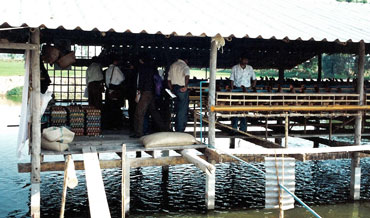
The best example of how enhancing the resources available to smallholders has resulted in substantial increased economic well being is the retirement of the water-buffalo in favor of the power tiller for rice cultivation in Thailand and other parts of Asia. This reduced the crop establishment period in half, allowed farmers to expand their holdings, variegate their farm enterprises and enjoy some comfort items such as refrigerators, motorcycles, TVs and VCRs. With rice production under control Thai farmers were spontaneously able to undertake many of the value-chain cash enterprises envisioned in many development projects. Such enterprises included contract vegetables for the Japanese market, and poultry and pig production suspended over fish ponds (photo). Photo3-1-webThis conversion from water buffalo to power tillers was all self-financed and took place completely under the radar screen of the development community, and remains little recognized by the development community trying to extend the “green revolution” from Asia to Africa.
Even though this basic premise was first conceived some 40 years ago, it still guides much of today’s development effort promoted for the benefit of smallholders. This includes every time it is suggested conducting time of planting trials, or recommending early crop establishment, and even such things as plant population studies working with hill planted maize or transplanted rice. It would also include promotion of high valued crops without indicating the crop being substituted for or the need for additional labor to meet strict quality control requirements of the high value crops, particularly when intended for export to developed countries.
Until it is fully recognize and appreciated that smallholder farmers are more constrained by the available labor and that the extent of this restricts their obtaining the production potential allowed by the natural resource environment, there will be major limits on the long term sustainability of many development efforts.
The enhancement of the resources available to manage land quickly emphasizes “access” to mechanization, which can be substantially different from ownership. This needs to be carefully considered, but most likely not in terms of direct ownership but contract availability via some small family owed village based support service that have a Symbiotic Association with the smallholder producers. There appears to be considerable demand for these services even in remote parts of Africa where manual field operations dominate. In Zambia farmers have expressed an interest in such services and can even quote the price for it. The prevailing price in 2005 was ZK 100,000 (US$ 20) per hour. During this hour they could custom till between 0.25 and 0.50 ha. Similar quotes can be obtained in Uganda, Malawi, Nigeria, Ghana and Kenya. In Egypt, Pakistan, Iraq and Afghanistan most of the land preparation is now done by individually owned 65 hp tractors such as the Massy Ferguson 165. The importance of such contract tillage appears to take place under the radar screen of the development community, that remains fixed on the idea that maintenance of machinery is beyond the capacity of limited educated smallholder communities. Perhaps they are thinking of the difficulties with public sector mechanization units and unable to distinguish public sector from private sector. Will the mechanization of Africa be done without the development communities assistance as happened to Asia, as well as Madibira in Tanzania? Could the need for contract mechanization be provide through Reconditioning Used Tractors from developed countries?
It can also be done somewhat indirectly by other drudgery reduction efforts such as Village Grain Mills. What is the agronomic impact of them on women’s domestic drudgery, ability to remain in the field longer each day or arrive more refreshed and able to better manage the farm enterprises? Also, what would be the agronomic impact of improving access to Domestic Water. Not only will there be a health impact but the time saving will allow women to prusue other economic opportunities for the benefit of their families including assisting their husbands with field work.
Delayed Adopters – Limited Knowledge or Limited Means
Observing the photo to the left of a typical rain-fed rice production area in Asia, it is possible to observe approximately an eight week spread in activities. These go from land preparation with the buffalo in the middle of the photo, to seedbeds and transplanting in the top right, to already transplanted fields approaching panicle initiation at the top. It is apparent some fields have been established early, most likely according to the research and extension recommendations, while others are lagging behind.
-
Read More About Delayed Adopters
The question is: are those who are delaying their field work doing so from:
- lack of knowledge requiring a major extension technology transfer effort,
- desire to spread risk, or
- limited operational resources available to implement what they know and desire to do?
The underlying question is do the completed field represent some farmers getting all their land established on time and others jsut getting started. Or, did all farmers get some of thier land established on time, and are now getting around to other fields, that is all farmers have some early and some late planted fields. Which is more plausiable?
Looking at the typical adoption function (as shown in the figure taken
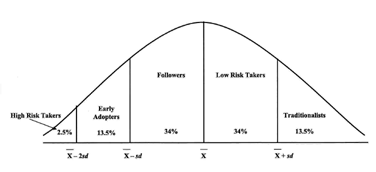 from Rogers, Everett’s Diffusion of Innovations 1985), to what extent does this figure imply that adoption or non-adoption is discretionary on the part of the farmers, and that once they agreed to adopt, it can easily be done across the entire farm holdings? The resources are available.
How would you separate those farmers who:
- Are following the innovations but waiting for additional data for confirmation, as implied in the figure, from those farmers who:
- Have observed the innovation and are interested, but do not have the means to adopt at present,
- Have observed the innovation and are interested in adopting but only have the means to adopt on a limited portion of their land, such as the lower lying fields in the upper section of the photo,
- Have observed the innovation and are interested in adopting and actively sorting out the labor, equipment, or other resources needed to implement the innovation on at least a small portion of their land, or
- Have observed the innovation and recognize that it represents the maximum yields, rather then economic optimal yields, and simply rejected the innovation as inappropriate?
An example of the effort farmers might have to go through to accept an innovation could be the shift to no-tillage dry land farming in Eastern Colorado. Once demonstrated, farmers then have to go visit their equipment dealers to see what additional equipment is needed including a larger tractor and modified planter. Next stop is the bank to get financing for the new equipment and then wait for delivery. This all has to be done once the farmer decides to be an adopter and before he can adopt.
This would most likely not apply to smallholders but they would have an alternative set of resources they would need, with a major concentration on identifying sufficient labor extending beyond family and competing for casual labor available within a community. This then becomes a community function and needs to be evaluated in terms of the community spread in an activity more than an individual farm. This could also interact with the limited amount of calories available to most people that might restrict the hours they can work to five or less.
Given the urgency of the farmers to meet their basic subsistence needs and obtain a few extra comfort items to make life easier, which of the five scenarios is most likely? Would the slow adopting be more likely to represent a lack of knowledge or lack of means? Would development efforts be more effective continuing an extension demonstration effort or facilitating the farmers’ access to the means to adopt a technology?
The bottom line of this is that there appears to be an administrative void in our evaluation of smallholder communities. The void is in understanding the availability of the resources needed to implement more intensive and productive agriculture, within the stated or implied time frame for getting maximum benefit. Who is responsible for this evaluation?
Integration: Differentiating Research/Extension from Development Officers – Science vs. Art of Farming
In the overall development effort to assist the poverty alleviation of smallholder producers to obtain food security and quality nutrition, it is usually not enough to develop and promote technical innovations, but it also requires sorting out the constraints the farmers or other beneficiaries might have in accepting the technical innovations and perhaps providing supporting technologies that will further address the constraints faced by beneficiaries. If one thinks about it, from a crop management perspective, it is somewhat absurd to think that hungry impoverished smallholder farmers have the same operational resources to manage their hectare to hectare and a half farm with the same ease as research stations and extension demonstration plots have to manage their 0.1 ha research/demonstration plots, and the farmers have full discretionary control over their farming activities or dietary needs.
-
Read More About Integration
Research vs. Development
In this regard, it must be recognized that most replicated small plot agronomic research is done at regional research stations under most ideal operational conditions available including unlimited labor, access to mechanization, etc. This does an excellent job of determining the physical potential of an area. Unfortunately, says nothing about the operational needs such as labor, contractible mechanization, etc. to extend the small plot results across the remainder of the field, farm or smallholder community or what are the rational compromises farmers must make in adjusting the promoted recommendations to their specific operational limitations. Such compromises include: time of planting, plant populations and quality of weeding, as well as the need to distribute their limited resources over all farm enterprises, both plant and animal, in an effort, not to obtain maximum yield of a specific crop or farm enterprise, but “MAXIMIZING TOTAL RETURNS TO ALL FARM ENTERPRISES” effectively and rationally sacrificing yield on one enterprise to improve returns on another. This also represents more concern with returns to labor than returns to land and a disconnect with research and extension only emphasizing returns to land, usually for a specific crop. Regrettable, research/extensions officers, usually concentrating on a specific crop, are mostly oblivious to these compromises and just assumes it is not a problem, and the only things preventing smallholder farmers acceptance is knowledge to be provided by the extension/education effort and motivation on the part of the farmer. With this assumption, the research/extension effort is finished, and their hands are washed of further responsibility. Under these circumstances the research officers are responsible for one crop and developing recommendations for an extensive area, but with little direct contact with the smallholder farmers they are serving, and usually concentrate on their own closely defined discipline to determine what subjects will be researched. What little discussion there might be with the limited educated smallholder farmer beneficiaries would be mostly a downward imposition rather than serious interactive dialogue. This is based on the research officers’ higher formal education and “technical knowledge” of crop management for maximum yields, with no regard for the operational limits the famers may have, and how this compromises the maximum yield, but could be the optimal yield for the smallholder farmers overall economic opportunities.
The Development Officers are usually associated with some externally funded projects and thus more confined in the area they work but are in more direct contact with the intended beneficiaries, often carrying out verification trials on the farmers’ fields. They can, if they chose to look beyond extension demonstrations, carefully look at the constrains facing smallholder farmers, the extended time required to accomplish various activities, as well as the interaction between the various on-farm and off-farm enterprises smallholder farmers maybe engaged in. They can then concentrate on facilitating access to various supporting technologies or facilitating access to additional operational resources essential to expediting all farm operations and provide solutions that will reduce the operational constrains. For example, they would be able to note that farmers are spending only limited time in the field tending their crops and recognize there could be major concern with dietary energy balance in which the farmer only have access half the 4000 kcal/day they need for a full day of diligent manual agronomic field work. This limits the hours they can work, the diligence of the effort, and substantially prolongs the time needed to complete specific agronomic tasks, with associated decline in potential yield, response to inputs, and food security. Specifically limiting the intensive manual effort to less than three hours of questionable diligence, and requiring up to 8 weeks for basic crop establishment, as partly shown in the case study from Ethiopia.
Both research and development officers are essential to comprehensively addressing the problems of poverty alleviations, food security, and quality nutrition for smallholder farmers and their families. The research officials tend to get the greatest respect, but really have the easier task, as they are mostly confined to their specific discipline. Their effort also allows publication of refereed research papers to their peers, but rarely the beneficiaries, and they provide donor good publicity opportunity of their efforts to assist the beneficiaries “clearly” specifying what is required. While the researchers accurately define the Science of Farming, because of the need to adjust result to the farmer limited resource base the actual accomplishments can be limited.
The development officials have the more challenging task as they frequently must work across disciplines to sort out needs and address the constraints of the farmers, and the well rationalize compromises they make, identifying and adjusting the science of farming to their individual and specific limited operational base. These rational compromises in the science of farming defines the Art of Farming. Most smallholder farmers are well experienced and very good at the Art of Faming, and have optimized all their farm enterprises to their limited operational capacity. Not a lot of publicity opportunity for development officers, but a good sense of personal accomplishment.
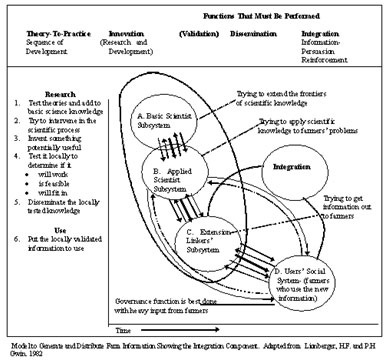
Integration
There is a little emphasized component in some technology development/transfer models that addresses this concern. It is the process of integration, which is placed off to the side between Extension and Users in the accompanying figure. Normally integration is defined in terms of information, persuasion, and reinforcement, implying a refinement in the education/extension process. However, it could be expanded to include additional farm level participatory diagnostics of the resource limitations, and adjustments of the resource base and supporting infrastructure that will provide farmers with the additional resources needed to increase the extent of adoption, in essence moving the dotted line that runs from D through Integration and back to C, and having it run from D back to B in the figure. More emphasis on the integration process with additional participatory involvement could help identify the “Operational Constraints” in terms of labor, power, etc. and then the rational compromises farmers wisely make and identify some “Supporting Technologies” that need to be promoted or provided that would assist the farmers in overcoming the operational constraints and allow them to increase the percent of their holdings that can be utilized according to desired innovations. This would then assist in separating the extent to which delayed adoption represents a Lack of Knowledge vs. Lack of Means. Also, if more attention was given this component of technology transfer, the limitations in the Basic Premise most likely would have been identified and addressed early in the development effort, and the overall development effort for poverty alleviation, food security and quality nutrition been considerably more effective.
Usually there are two components to the integration process. The first is rational compromises in the recommendations to optimize the technology to the farmers limited operational base, and second identifying and promoting various supporting technologies that will allow the farmers or other beneficiaries to overcome the limited resources. Perhaps a couple example will illustrate the importance of integration for both agronomy and quality nutrition.
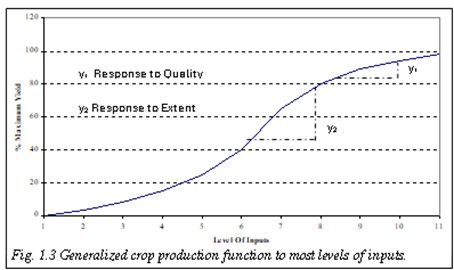
Agronomic Example: In smallholder farming, when there is not enough labor or access to mechanization, the compromises farmers make is first and foremost time of planting and adsorbing the loss in potential yield associated with delayed planting. To minimize this lose they will quickly reduce plant population particularly of hill planted crops like maize and beans, less so with broadcast crops like rice, and forages. The rational is that with limited labor you get a higher total yield from planting a full hectare at half the recommended plant population, instead of half hectare at recommended rates. This follows the well-established sigmoid crop production function by remaining in the steepest part of the curve (See Figure 1.3) in which when labor is limited the maximum output is to concentrate on extending the area rather than enhancing the quality. Time of planting and plant populations can be visually easily seen and photographically documented. The time of planting often extending up to 8 weeks from the beginning of the season voiding the impact of most mid-season recommendations for weeding and fertilizer application rates and accepting the declining yields including its impact on food security. It just requires understanding and appreciation the “poor” quality crop management is more likely reflecting limited labor than limited knowledge so badger farmers with the need to plant early or increase the plant populations is counter-productive. Since the Monitoring,
Evaluation, and “Learning” (MEL) effort by USAID does not include timing or range of timing, the operational limits of smallholders remain undetected, overlooked, and unaddressed. Likewise, there is no accounting for availability of labor and the impact scarce labor has on yield, food security, and quality nutrition.Less easily identified would be the quality of land preparation and weeding. Both can be highly compromised resulting in lower yields and/or lower quality. The latter being particularly a problem for high value quality sensitive crops often heavily promoted for the value chain in the hopes that market for high value cash crops will pull productivity up. However, obtaining those high income usually requires high quality which again implies more labor that is scarce for smallholder farmers. Inputs with lower labor components such as fertilizer and plant protection chemicals would be less effected, other than the fertilizer response being impacted by the delayed planting.
Quality Nutrition Examples: While as an agronomist I mostly look at development from a crop management perspective, the importance of integration can equally be applied to the current effort for improved nutrition with the emphasis on pregnant and nursing women. These are important concerns, but the acceptance can be highly compromised. In this case the question is how easily can smallholder farmers, with their limited caloric diet, produce an improved diet, and how might this impact on their overall economic opportunities that largely represent heavy manual labor requiring 4000+kcal/day? Anything less will limit the work day or at least the diligence of the work effort and possibility reduce the wages earned or the time and effort at agronomic field work. Two hypothetical examples synthesized from some current consumer price data and casual labor wages in Angola. While hypothetical I believe they are realistic.
Affordability: Take the case of porters, as my go to deeply entrenched impoverished laborers. The choice of porters is because I think they are some of the more impoverished workers who tend to be among the “invisible” people, frequently overlooked by development workers, etc. even while providing essential services. They tend to work piece meal manhandling 100 kg bags, hopefully without wrenching their backs and forced to miss a week of economic opportunity to recover. but without any income. Now suppose the porter has a wife, young toddler daughter, and pre-school son. He loves his family very much and wishes to provide for them as best he can. This would include the recent recommendation from a World Bank Webinar/Seminar promoting providing young Infant/toddler children an egg a day to minimize stunting. Allow me to locate this porter in Luanda, the capital of Angola, where he earns piece meal income loading or unloading lorries. His typical daily wage is $2.50 for working as part of 6-man teams loading or unloading 5 10-ton lorries typically filled with 120 100kg sacks per day. Yes, that is a deliberate 20% overload, which I think is typically based on an interview with rice transporter in Tanzania. The wages represent $0.50/lorry/person. The $2.50/day is set to equal the government established agriculture casual labor wage for Angola. Of this $2.50 he earns he can only spend $2.00 on food as he still as non-food costs for transport, rent, cooking fuel, light at night, etc.
His basic family caloric needs are:
• As a heavy manual laborer, he needs at least 4000 kcal/day
• His wife doing mostly domestic work around the house including spending several hours getting water and child care will need 3000 kcal/day
• The pre-school child will need 1200 kcal/day and
• The infant daughter will need 550 kcal/day.Of this the first 2000 kcal/day represent basic metabolism for both the husband and wife, that will be consume even if they are doing no manual exertion as porter or domestic chores. The total family energy requirement will be 8750 Kcal/day. Now with your $2.00 food allowance what can you purchase to meet just this calorie demand? At the current Consumer Prices in Angola, if you spend the whole $2.00 on maize meal as the primary staple food you could purchase 1.7 kg maize meal which would provide only 6000 kcal/day which, with nothing else, would leave a daily deficit of 2500 kcals. No opportunity for substituting some beans to increase the protein in the diet but will reduce the calories and work potential, let alone some green vegetable to enhance the vitamins and mineral consumption. That egg to minimize the little girl’s stunning is really totally out of the question. If they spent the $0.40 for an egg, how would that impact the porter’s ability to load or unload the lorries? Would he have to quit after only 4 lorries were worked, coming home early but with $0.50 less income? Keeping the wage rate and consumer prices as stated what adjustment would you make in food purchased and consumed. Isn’t this an example of some of the Hard Choice: Compromises in Quality Nutrition many impoverished people have to make? Perhaps Angola should adjust the casual daily wage to accommodate a quality diet for the family of four? Would that make for a good policy adjustment for the nutrition improvement effort?
Producibility: Transferring the impoverished family to a smallholder farming community and the question is what can they produce to meet the family’s dietary needs? In this case the farmer has retained two 100 kg bags of maize per adult for subsistence use (based on Malawi interview with similar results from Ethiopia). The 200 kg of maize will provide a daily diet of about 2000 kcal, just enough to meet basic metabolism needs for the husband and wife, but not necessarily the children. This does not allow for any manual agronomic field work. Thus, the family must have some additional stocks of beans etc. or purchase additional food. They do have a few “smart” country chickens that forge around the homestead staying away from predators and providing a couple eggs a day. What should they do with the eggs? They can sell them for $0.40 ea. or provide them to their daughter to minimize the stunting. If they sell the eggs as mentioned as a common practice in the World Bank Secure Nutrition webinar/seminar they could buy 300 g of maize meal that would provide sufficient energy for 3 to 4 hours of diligent agronomic field work, that ultimately assist in improving the family overall food security. What is the rational thing for the farm family to do? Again does this represent Hard Choices? How would you adjust the decisions to better provide the quality nutrition and food security to this smallholder family? How effective will an educational program on quality nutrition be for this family deeply entrenched in poverty?
Finally, I would like to encourage anyone interested to work through the exercise on Hard Choices. It should take about an hour wandering through the open market to collect consumer data, then another couple hour to work through the purchasing and checking with the USDA or other source on the nutritional value of your results. I will be happy to post any results on the website duly crediting the contribution. Isn’t this the most appropriate place to start a nutrition improvement program? Typically, the results of the Hard Choices exercise are both mind-boggling and depressing.
Supporting Technologies
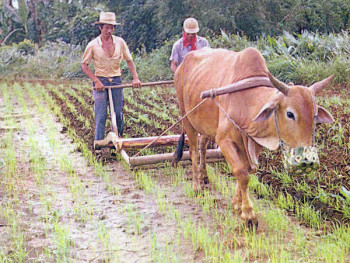
Potato-Wheat in Malawi: An example of how supporting technologies contribute to the integrations process is the introduction of Potato-Wheat sequential cropping in Malawi. This was done by the Adaptive Research Program and illustrates how a comprehensive farming systems research program can effectively undertake integration studies. Using an annual set of on-farm field trials for periodic visits to the area and continuous informal discussions with the farmers, the adaptive research program started out with a traditional climatic evaluation that indicated the physical potential for potato-wheat sequential cropping in high altitude areas such as Dedza Hills some 100 km south of Lilongwe, the capital. This was quickly confirmed with simple on-farm field trials. The potato-wheat sequence would improve upon a maize-wheat relay combination, in which the wheat was planted too late to effectively utilize the residual moisture, resulting in very low yields. Under normal research and extension procedures, the technology could have been recommended to the farmers for adoption with accompanying extension demonstrations. However, it is highly unlikely it would have been widely accepted. It was necessary to undergo an iterative integration process over several years. In the subsequent years the iterations in the program identified and addressed:
- Problems with fluctuating prices with the seasonal low at the peak potato maturing season in February resulted in farmers lifting only what they needed to meet short-term cash requirements while storing most of the potatoes in the soil until the prices increased from June to August. Without good storage facilities, potatoes store better in the ground than lifted. With the potatoes occupying the ground it was impossible to plant wheat. The solution to this problem was promoting simple on-farm potato storage structures, which were being developed by the engineering research section that would allow the potatoes to be stored for up to four months, without the weight losses exceeding 10%.
- The introduction of storage structures quickly highlighted the need to cure potatoes for a few days before storage, which was difficult in the wet season. Thus, it was necessary to modify the curing technology slightly to include curing with weather protection.
- Dibbling individual wheat seeds was too time consuming and costly to plant large areas as expediently as needed following potatoes for an economically viable wheat crop. Thus, it was necessary to introduce and test alternative planting technologies modified from upland rice cultivation in the Philippines (see photo right). The new planting technique helped reduce the time for wheat establishment and lowered the production cost to an economically viable level.
- One area was too isolated, located some four hours from the main road and next to the Mozambique border. At that time, Mozambique was embroiled in a civil war, making security a major concern for private truckers needed to haul the potatoes from the area. The only trucks going in and out of the area were United Nation High Commission for Refugees (UNHCR) trucks contracted to bring in relief supplies and return empty prior to dark. During this period, potato production was temporarily not feasible, and farmers who previously grew potatoes left their fields fallow for most of the rainy season prior to planting wheat. Wheat, at least, could be sold at a modest price through the government marketing structure, but with a noticeable economic decline for the farmers. The potato-wheat sequential cropping promotion had to be curtailed because it was constrained by factors beyond the control of the Adaptive Research Program, and thus the technology was not appropriate for that time. Hopefully, with the improved security resulting from the end of the civil war in Mozambique, the farmers can revert to growing the more profitable potatoes.
- In areas not affected by security problems, concern developed regarding the quality and quantity of seed potato, and the need to multiply a new potato variety introduced into the area by the project. The problem originated from the farmers selling all potatoes, including the small ones, that would normally not command good prices and are usually retained as seed potato, during August and September when the prices had increased substantially. However, there was a means for indigenous seed increase in wetter areas, and this included the new variety without project facilitating. It also provided some positive feedback on acceptance of project inputs. However, the bulking rate for potatoes is very low at 6:1 compared to a 50:1 ratio for most grains, and it is difficult to get an adequate supply of seed potato. This lifting and selling all the potatoes was very much the opposite of four months earlier, when at maturity prices were too low and farmers retained as many potatoes as possible in the ground, hindering the planting of wheat. However, this problem was solved by the farmers as they could increase seed potatoes in the dambo (small wet land areas) within the area.
- Concerns developed regarding survivability of the introduced variety when the onset of the coming rainy season was delayed by three weeks or more, which is the outer limit of normal variation in on-setting rains and has to be included in any planning or anticipations of rainfall variation. The seed potatoes of the introduced variety when dry planted in anticipation of the rains, as was the normal practice, deteriorate with prolonged exposure to the dry condition. This contrasts with the local varieties that could tolerate the delayed onset of the rains. Also, there seemed to be a slow buildup of a virus on the introduced variety, which lowered the yield and increased the percent of potatoes too small to get a high market price.
The bottom line for the potato-wheat sequence cropping is that despite the physical fit to the environment, with careful analysis, several socio-economic and operational constraints were identified that needed to be overcome prior to large-scale farmer acceptance of the potato-wheat sequential cropping. Most of the constraints were eminently valid and indicated the farmers, regardless of limited formal education, were very knowledgeable of their system, highly market oriented, and understood the constraints imposed by limited resources and infrastructure support. The potato-wheat sequential cropping remained a physically appropriate technology, but gaining wide spread acceptance required a full knowledge of the systems and sorting out the various constraints encountered. Many of these constraints were local or regional and would have to be evaluated at that level, and thus not something that national or international research efforts could address. The evaluation is more for development projects and development officers instead of researchers. The promotion of various supporting technologies, such as storage structures, planting methods, etc., will assist in overcoming these constraints and make the technology more appropriate. It also shows a combination of adjusting both the technology and the farming system into which it was being introduced to form a viable combination.
Promoting The Green Revolution in Asia As Solely Technology Driven: A Major Disservice to Africa
While it is very true that Asia has benefited from a major green revolution in rice production, leading to most Asian counties becoming self-sufficient in rice and other food production. It is WRONG to attribute this success solely to technology development mostly in the form of high yielding varieties and it is misleading and a major disservice in promoting a similar green revolution for Africa only through technical advances. While it cannot be denied that IRRI (The International Rice Research Institute) developed high yielding varieties that increased the potential rice yields several folds, there were other things concurrently taking place in Asia that facilitated the wide spread acceptance of the new varieties and accompanying technical advances. Most noticeable the smallholder farmers on their own and without any financial assistance from the development community quietly shifted from using water buffalo to small Japanese 12-15 HP diesel power tillers. This more than halved the time to establish the rice crop, bringing at least twice as much land into the timely establishment required to take full advantage of the new high yielding varieties. Thus, while IRRI did an excellent job of increasing the yield potential of rice, it did not get the crop planted in time to take full advantage of the improved rice technologies. This was left to the farmers. Unfortunately, since the development community was not involved in the shift to power tillers, instead were basically oblivious of the shift, they simply ignored it and arrogantly took credit for the full impact of the green revolution.
-
Read More About Promoting The Green Revolution in Asia As Solely Technology Driven
The underlying problem is the limits of agronomy. Small plot research, which is the basis of agronomic development, does an excellent job of determining the physical potential of an area or technical innovation. However, it says nothing about what are the Operational Requirements for producers to extend that technology from the replicated small plot trials or demonstrations, perhaps at most 0.1 ha, to the rest of the field, farm or smallholder community, which is typically 1 to 3 ha/farmer. It just assumes it is not a problem. Sorry but it is, particularly in limited mechanized smallholder communities that are predominate across Africa. The problem is that the operational requirements of an innovation in terms of labor, access to mechanization, etc. has fallen into an administrative void between the agronomists and the social scientists trying to assist smallholder farmers. Who within a development project is responsible to determine the labor or other operational needs, the availability of these needs and what are the rational compromises the farmers should make when these are not fully available?
The best that I have seen is economists in their cost benefit analysis can usually come up with the labor requirements and the cost of the labor, but not the availability. Nor the more important concern as to what are the rational compromises to recommendations in terms of timing, plant population and quality of land preparation or weeding etc., when these operational needs are limited. Please note that most of these operational needs are more community variables rather than household variables, in contrast to the emphasis on households as the economic unit for smallholder development. Ultimately, no one is conceptualizing on the operational needs for community wide implementation of innovations. Not the Agronomists, not the Economists, not the Sociologists and not the Anthropologist. Please someone step into this administrative void!! The results might be very interesting with a substantial positive impact on smallholders!! Until someone addresses this void most agronomic innovation requiring additional labor will go for naught. At this point IRRI adds to the disservice as, when promoting the Institute, it prefers to show the water buffalo as more picturesque than power tillers. True, but it also illustrates that IRRI is some 30 years out of touch with it’s primary beneficiaries, and highlights the continued lack of conceptualization on the operational restrictions facing smallholder farmers.
So, what was the impact of the shift to power tillers and other mechanization on the rice production and the green revolution in Asia and how should that guide developing a Green Revolution for Africa? It may not have much impact on potential yield, at least not that you could demonstrate in a typical small plot research trial. The major impact would be on timing of crop establishment minimizing the well know declining yield potential associated with time of planting (TOP) delays, enhancing food security, and allowing for crop variegation and intensification. At this point it must be noted and appreciated that water buffalo or cattle are biological entities subject to fatigue that could limit their work day to about 4 hours and they require about an hour or more of labor per day for feeding and other needs. Thus, in rainfed areas, such as NE Thailand where crop establishment must be integrated with surges in rains and curtailed during lulls in the rains, with water buffalo the crop establishment might stretch for 4 months for a 6 rai (1.5 ha. farm) with continuous TOP declining yield potential, and often it is not completed as for those paddies planted 4 months after the on-set of the rains, the rains will end prior to harvest resulting in paddies being left fallow except for years with exceptionally good rainfall. Once the power tillers were introduced the time was reduced to 2 months and the task completed without leaving land fallow. With this rice production and food security assured, the smallholder farmers spontaneously variegated into aquaculture with poultry suspended above, or specialized vegetable cropping for the Japanese market, among others. No external facilitation or value chain promotions required.
As for irrigated areas no need to change, but the possibility to intensify. With the land preparation time halved it become a comfortable fit for annual double cropping rice. Then when the introduction of small Japanese combines with a 2 – 3 m head that could combine a rai (1/6th) ha. an hour for hire, farmers could intensify to 5 crops in 2 years. In both cases it is also possible to increase the area managed to 20 rai or more, or doubling the previous norm of 9 rai or 1.5 ha. The power tillers tend to be individual farmer owned and can easily be enhanced to add pump attachments for low lift irrigation, and trailers for transport. Water buffalo remain in the system but most are too small for draft use. Instead they are small cow/calf operations that when sold for meat at approximately 2 or 3 years will earn about US$2.00/day. The buffalo meat is preferred for the noodle soap such as Vietnamese Pho. Power tillers are also slowly making there way into the rice schemes of Africa. In a return visit to Madibira, a 3000 ha. rice irrigations scheme in southern Tanzania, five years after the advisory and facilitation contract ended, there were some 50 Asian power tillers in use. All individually owned and financed by the farmers.
If you accept, what my international economics professor many decades ago proclaimed, that before a country can successfully industrialize, there needs to be a surplus of rural labor. Didn’t these countries, Thailand, Malaysia, Indonesia, etc. become referred to as the Asian Tiger Economies back in the 1980s? Was this largely the result of the shift to power tillers generating the rural labor surplus that allowed the industrialization to take place or at least expedite the process? To the degree this is correct that would be a fairly massive impact of something mostly overlooked by the development community. This may have also resulted in some interesting land tenure in which land ownership continued to fragment as inheritance was distributed over all siblings but operational units consolidated as those drawn to the industrial opportunities share cropped their land with other siblings remaining in rural areas. How often shortly after harvest to people visit their home villages and return with some bags of paddy or rice? Was this their share of the crop managed by another sibling?
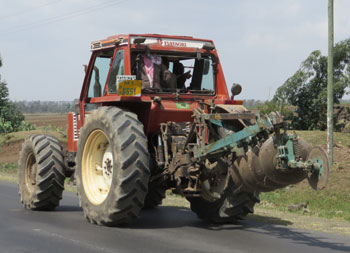
Shifting to Africa, there is no reason a green revolution cannot be just as successful in Africa as it was in Asia, including the prospects to create a rural labor surplus to stimulate increased industrialization. However, all the lesson of Asia must be applied to Africa, for which the operational limits are considerable more critical, as African agriculture was traditional more manual. Thus, if the operational limits are overlooked, my definition of the effort is GENOCIDE. I hope that is provocative enough to get the attention it deserves. However, unfortunately, if the expectation is for farmers to work harder, it is too close to the truth to be overlooked as they are already maxed out to the Limits Their Caloric Intake will allow. I doubt if this is really intended and accept is as initially an oversight. The explanation is that to manually cultivate a hectare of land requires some 300 diligent person hours, mostly man as they tend to be physically stronger than women, exerting up to 300 kcal/hr., which when added to the 2000 kcal/day of basic metabolism requires a diet exceeding 4000 kcal/day. However, the typical diet of most smallholder farmers in closer to 2000 to 2500 kcal/day marginally meeting the 2000 kcal/day basic metabolism and allowing only a couple hours of diligent land preparation type manual work, perhaps paced over a longer period but with limited diligence. This than extends the crop establishment period to 8 weeks or more with TOP induced rapid decline in potential yields, so that it is virtually impossible for farmers working only with hoes to meet their food security needs.
While you might at the household level be able to demonstrate, and probably have many time over with much fanfare of success, a better more recommendation consistent yield result, how often is this the result of, to use a Christian expression, robbing Peter to pay Paul. That is if the demonstration depends on hired casual day laborers and the hired labor happens to be other farmers, as is often the case, so that Paul, receiving the extra labor, is promoted out of poverty, but Peter who contributed the labor at the expense of his own land management is push further into poverty in what community wide is a zero-sum output. At this point it must be recognized that while we work with individual farmers and households, the need is and always has been acceptance across the whole community.
If you think about it, how ridiculous is it to expect poor hungry smallholder farmers working alone or perhaps assisted with some immediate household family members to establish their hectare or hectare and half of crops, with the same ease the research plots or extension demonstration can for their 0.1 ha. trial, aided with an adequately feed paid labor force, even with a limited developing country experiment budget. If someone really wants to promote a green revolution for Africa and not address the operational needs and dietary requirement of the smallholders my inclination is to refer them to the International Criminal Court (ICC) in The Hague for advocating, conspiring and promoting the Genocide of the smallholder as a Crime Against Humanity as it implies people are expected to work well in excess of their available caloric intake. While initially this could be accepted as an oversight, now having been informed of the possibility, if not addressed it become deliberate and thus subject to referral and prosecution by the ICC.
Unfortunately, the current emphasis on improved nutrition, emphasizing pregnant and nursing women, are not effectively addressing the issue of dietary requirements associated with the limited and mostly manual economic opportunities of smallholder or other beneficiaries. That overlooks the importance of the dietary requirements for the beneficiaries’ economic opportunities needed to afford or produce the improved diet being promoted, and perhaps the need to make some major Hard Choice compromises in balancing the diet to individual beneficiaries’ economic circumstances. Thus, the nutrition effort remains mostly academic and needs to be Integrated into the beneficiaries’ economic reality to become a viable development effort.
Thus, it will be very difficult to have a wide ranging and sustainable green revolution in Africa unless you follow the unheralded example of Asia and make some form of mechanization available in Africa. However, the individually owned power tiller is most likely not the answer for Africa as it was in Asia. The power tiller is excellent in paddy where larger tractors have problems with grit getting into front wheel bearing, wearing them out in what is a frequent US$400 Repair. The power tiller is less effective in upland area where there is no water to lubricate the tines and they more quickly wear out the tines than in paddy use. For upland areas the preferred mechanization is 4-wheel 65 to 80 HP tractors equipped with 3 or 4 bottom disc plows. These of course are too expensive and not appropriate for individual smallholder ownership so the access needs to be via contract through private service providers. However, this can be very sensitive and needs to emphasis Individual Owner/Operators, most likely by someone drifting out of farming into being private service providers as part of a Symbiotic Community of producers and service provider. The need is to avoid any form of communal ownership. This might be readily done through facilitating getting Reconditioned Used Tractors into smallholder communities.
Please be very careful of any joint ownership of mechanical equipment. This would include producer organizations/cooperatives and public government tractor units which were tried and fully discredited some 40 years ago that I can personally track, and continue today. Just visit any Nigerian state ADP and see the lineup unrepaired tractors. Check the odometer, provided they have not been vandalized, and see the service hours when they were surveyed out of service. What percent of the 10,000 designed hours does that represent? Typically, only a third, rarely over a half. This private service provider contract tillage would be consistent with Egypt and other North Africa and West Asia countries where most of the smallholder land is contract tilled by individuals owner/operators. These tractors’ odometers will most likely be well beyond the 10,000 hrs. of designed service, perhaps 20,000 hrs. and still operating. Once this crop establishment drudgery has been relieved the rest of crop management is less arduous allowing manual operations to comply more with the recommended timing and plant populations, accompanied by improved yield or crop quality. While the 4-wheel tractors are best managed by individual private service providers, they can also be equipped with trailers that will allow for transporting both people and agriculture goods between village and cultivated fields, as well as some contract hauling for road repair, etc. The return visit to Madibira, mentioned above, not only showed 50 power tillers for use in the rice scheme but also three recently acquired 4-wheel tractors for use in the upland areas around the rice scheme. Again these were obtained without any development assistance and represent how important access to mechanization is to smallholders as well as missed opportunity by the development effort to serve smallholder beneficiaries.
I hope this is useful to those assisting in getting a solid sustainable green revolution for Africa.