Dietary Energy Deficit
This page gathers the Dietary Energy Deficit section of Dr. Tinsley’s Smallholder Agriculture site in one place. Each topic opens with a short introduction; the full discussion is in the Read More panel beneath it. Use the list below to jump to a topic.
Calorie Energy Balance: Risk Averse or Hunger & Exhaustion

Introduction
As discussed in other sections of this Web site, there appears to have been a Fundamental Oversight in the basic approach to agriculture development over the past 40 years. This is associated with casual observations in the mid-1970s and confirmed by averaging some of the initial farm record results, that smallholder producers appeared to delay their crop establishment for up to eight weeks with an average crop establishment of one month after the initial rains or other seasonal starting events such as an irrigation issue. The assumption was that smallholders were risk averse and waiting for more assured rainfall, etc. This was and remains mostly an assumption, supposition, or hypothesis that has become deeply entrenched in the development documentation without any real proof or verification. The result is the economic development for smallholder communities continues to emphasize only technology development through additional small plot trials and an effective extension education program to inform producers on the potential of new techniques. This is often accompanied by a credit package to assist the farmers in obtaining the recommended capital inputs such as certified seed, fertilizer, and crop protection chemicals. Also, the emphasis is usually on the importance of early planting, without ascertaining the resources needed and availability of those resources to extend the small plot to the full farm within the recommended time limits. The philosophy continues today with the Millennium Village Project and the Bill & Melinda Gates/Rockefeller Foundations efforts to bring the “Green Revolution” to Africa.
See also: Rethinking a Basic Assumption in Ag Development: Risk Aversion vs Hunger and Exhaustion (PDF) (ECHO Development Notes, Issue 121, October 2013, PDF).
-
Read More About Calorie Energy Balance
Unfortunately, this overlooks a major limitation of agronomy research and extension. Small plot research only determines the agronomic potential of the physical environment as defined by climate as determined by temperature and moisture including any irrigation water, and perhaps adjusted by soil type and whatever inputs are being evaluated or demonstrated. Agronomy research and extension normally does not ascertain the drag in extending that physical potential from small research/demonstration plots to whole farms imposed by the limited operational resources most smallholders have to manage their land. The operational resources such as labor and labor substitutes needed to manage land rarely appear to be considered by the development community. Instead it is simply assumed the farmers have or have access to the labor or other means needed to extend a research or demonstration plot results to a full farm of 1.5 ha in the timely manner needed to take full advantage of the recommended technology including those associated with value chain enterprises. Perhaps this needs some serious review.
Caloric Energy Balance
A major concern might be the “Caloric Energy Balance” between the number of calories a person is expected to exert in implementing a development program, and the number of calories the person has access to. While it is well recognized that there is major hunger among smallholder producers and their communities, and one of the objectives of poverty alleviation projects is to improve yields to reduce the hunger, rarely is hunger recognized as a potential major impediment to the development efforts. An impediment that, if not carefully considered, could easily render many poverty alleviation projects virtual “non-starters”, or severely limit the acceptance beyond a simple small plot demonstration, and well short of the entire farm as envisioned by the promoters.
For example, if an adult requires approximately 2000 kcal just for bodily maintenance loafing around the village, and if it requires an additional 220 kcal/hr of moderate but sustainable gardening exertion, then for an individual to work a full 8 hr agriculture day, the person needs access to approximately 4000 kcal. This excludes the heavy digging associated with initial land preparation which could increase the energy requirements in excess of basic metabolism to 280 kcal/hr. , but 4000 kcal. is a reasonable approximation of the total daily calories required to diligently work all day. To obtain 4000 cal a person would have to consume each day:
- 1.1 kg Uncooked Rice (3.07 kg cooked), or
- 1.1 kg Maize Flour (6.15 kg cooked), or
- 4. kg Uncooked Plantain, or
- 3.43 kg Uncooked Cassava, or
- 5.83 kg Uncooked Sweet Potatoes, or
- 1.1 kg Wheat Flour (3.07 kg cooked)
This volume of food is shown in the photo for each of the staple listed above. It is a substantial amount of food considering that the maximum per capita consumption of rice is in Myanmar at 200 kg/yr or 547 g/day. This will provide approximately 2000 kcal or about 50% that needed for a complete day of moderate agriculture field work. In Myanmar as in many Asian countries rice is the main staple food contributing most of the calories in the diet.
Cost (US$) for 5000 Calories from Various Alternative Staple Foods in Different Developing Countries in Africa Country Rice Maize Plantain Cassava Wheat Egypt 1.65 0.95 Tanzania 0.89 0.31 0.66 1.23 0.70 Uganda 1.43 1.02 1.26 0.97 1.28 Kenya 1.50 0.70 2.07 0.69 Source: Consumer Price Comparisons
For an individual to purchase the 4000 kcal listed above in various African countries will cost anywhere from US$0.30 to US$1.99 depending on the country and staple food involved (Table). (Additional Countries)
This only provides a source of calories from starchy staple foods, which are normally the cheapest foods. It does not provide all the protein, essential minerals and vitamins that are necessary for a person to be healthy enough to endure a full day of agriculture field work. These have to come from meat, fish, beans, vegetables and fruits that are normally more expensive then starchy foods.
Poverty Affordable Calories
If a person is living at the poverty level, usually defined as 1 US$/person/day, they can spend no more than US$ 0.80 on food. The other money will have to go for other essentials such as cooking fuel, grain milling, candles, used clothes, etc. In the African countries listed, where most agriculture field work is manual, only in Tanzania, with its fixed ceiling price for maize, that may actually be substantially lower the competitiveness and hinder maize production, can a development project justify expecting someone to work a full day, based solely on the calories available from maize.
If the person substitutes the additional more expensive foods to provide a more balanced diet that will provide sufficient protein, minerals and vitamins and other essential components, the individual will have to reduce the amount of calories available. This in turn will reduce the amount of work that can be expected. In a class room exercise using the complete consumer price comparisons lists from which the above data were obtained, when all foods were considered for a more complete balanced diet the total available calories was reduced to approximately 3000 cal. Subtracting the 2000 cal needed just sustaining the body’s biological activities, the calories available for field work could be 1000 or less, and thus the energy for field work would be less than four hours. Isn’t this consistent with what is often observed when visiting smallholder communities? However, it is still necessary to factor in some essential domestic drudgery associated with obtaining domestic water, perhaps getting fire wood, cooking meals, nurturing children, etc. This would be an additional drain on calories for field work. If the community members have less than one US$ per day, then available calories would be even less, and since this cannot come from subsistence calories, it has to come from work calories and reduces further the number of hours the person can work. Perhaps there is an alternative motive when farmers include a well specified lunch when employing a crew of day workers. The lunch might just as easily be called a “pit stop.”
An example of how diet could impact on agriculture field work is an interview with a smallholder in Kenya who would hire workers for a five hour work day, including lunch. When asked if anyone did a double shift and worked ten hours, the answer was no, because if they did they would not be available to work the following day.
Subsistence Supplies
While consumer prices are the most readily available data to collect for this analysis, and the US$1.00/per/day is the accepted standard definition of poverty, it is recognized that smallholder producers usually produce most of the food they consume, particularly the staple food that are the primary source of calories such as those listed in the Table. However, how much subsistence food is available is more difficult to determine and would be more variable even within a specific host country and even between individual farmers. The best estimate would be farmers in Malawi indicating they reserve some four 50 kg bags of maize for personal consumption. This would amount to some 200 kg/yr or 547 g/day. That would provide a diet of 2030 cal/day as the primary source of dietary energy. The four bags of 50 kg each per person is very consistent with the Millennium Village project with allocates 1.1 tons of maize per family of 5.7 people. This amounts to193 kg/per/yr or 529 g/day with provides 1930 cal/per/day or about 5% less than stated by the farmers which is neither significant nor substantial difference, and provides some independent confirmation of the farmers’ estimate. At this rate the subsistence stocks will be sufficient to sustain a person, but not allow them to undertake substantial field work.
Impact on Development
If a development project is promoting a new technology with an emphasis on early planting and expecting farmers to manually expand the technology from the research/demonstration plot to a full 1.5 ha farm, and they only have enough caloric energy to work four hours a day, how long will it take to complete the task? Would this not extend well past the recommended time frame for the new promoted technology, perhaps up to eight weeks? What would be the weed infestation when the basic crop establishment is completed and the farmers return full time to the initial field planted for additional mid-season management activities? How will that impact on the yield potential and prospects for the new technology to improve the limited diet the farmers afford or allow them to become more involved in value chain enterprises being promoted for their benefit? Does it render many rural poverty alleviation projects to near “non-starter” status?
If farmers including any dependents assisting them only have the caloric energy for four hours of work per day and they are seen idling around the village in the afternoon, should this be interpreted as their being lazy and available for mobilization as proposed by the Gates/Rockefeller program, or hungry and exhausted? If the latter and the fuel tanks are empty, there is no way they can be mobilized for extensive additional field work without doing them some serious physical harm. Also, if this has been the case since the beginning of the rural development effort some 40 yrs ago, then if those initial farm records were disaggregate would they show that instead of delaying cultivation, farmers were starting there crop establishment at the first opportunity when the rainfall variable can approach 100%, and continuing as fast as their available energy would allow. Thus, instead of being risk averse, smallholder farmers are and have always been mandatory risk taker, with their very survival dependent upon taking these risks? If their available diet is limiting the hours they can work each day, and this is extending the crop establishment period well into the time when potential yields, particularly for maize in Africa, may be rapidly declining, then any delay will reduce potential yields and put their very survival at risk. Given the critical need for subsistence production and amount of field work clearly visible in need of attention, what is the more realistic scenario for anyone seen idling away the afternoon in the village? Are they being risk averse or hungry & exhausted? Perhaps, any truly risk adverse smallholder most likely starved to death several decades ago.
This limited dietary energy as a drag on farm management does not account for the two or three times a year farmers suffer a bout of malaria and cannot work for a couple days, the times they get dysentery and lose another day, and increasingly the impact the HIV/AIDs epidemic casting a dark shadow over rural Africa and the available labor.
The bottom line is before implementing a rural development project, take the time to determine if the beneficiaries can afford or otherwise have access to sufficient calories and other essential diet needs to complete the daily task expected of them. If not compute the number of hours that can be expected and adjust the area over which the promoted technology can be extended within the recommended time limits. It is really not a very time consuming or complicated exercise that could provide more realistic expectations of potential for introduced technologies to expand across a production area. It may be necessary to be a little cautious about using hired labor. Often the casual labor pool consist of other farmers who on any given day and for a variety of reason opt for doing casual labor instead of working their own fields. This then becomes a question of robbing Peter to pay Paul, to use a Christian metaphor. At this point it is important to remember that as development change agents the task is to increase the economic well being across the host community, and not enhance one cooperating individual at the expense of others.
Drudgery Relief & the Green Revolution of Asia
If the above scenario is accurate and most smallholder producers are more energy limited rather than knowledge limited so that they are “maxed-out” to the limit the calories they have available in their diets, then the best means of assisting them is to enhance the resources available to manage the land with a closer look at drudgery relief. This quickly implies mechanization of as much of the labor intensive agriculture field work as possible, with a particular emphasis on land preparation. For the tractor mechanization of smallholder communities perhaps it would be more accurate to consider access to Privately Owned Equipment made available for contract to members of the community rather than individual ownership. Drudgery relief could also include indirect drudgery relief activities such as privately owned village grain mills, and improved Domestic Water Supplies, etc. The Village Maize Mill appears to be the initial mechanization for rural Africa virtually replacing the pounding of maize and other grains. Women pounding grain in Africa has gone the same way the water buffalo has gone from Asia. Both of the above examples of indirect drudgery relief can have some rapid economic impact in terms of higher yields or the better quality needed to command higher prices, and take advantage of the value chain projects being implemented for their benefit.
This is also most likely the reality behind the success of the “Green Revolution” in Asia. While the development community likes to proclaim this as a success of technology innovations surrounding the development of high yielding rice and related technology, it was also accompanied by the retirement of the water buffalo in favor of rice power tiller. Would it really be possible to extend the high yield rice technology across an entire smallholder farm in sufficiently timely manner, if the farmer only had a buffalo to work with? According to a farmer in Northeast Thailand the conversion to the power tiller reduced by half his rainfed rice crop establishment time, dropping it from four months to two months. Once his rice production and with that his family’s food security was under control this farmer spontaneously variegated into value chain enterprises such as those currently being widely promoted for smallholders’ benefits across the development community. In his case this was poultry suspended over fishpond.
Linking the success of the green revolution to the self-financed shift to power tillers is usually over looked by the development community and has never been fully Evaluated or Appreciated. Overlooking this is a major disfavor and misrepresentation of the reality of how the green revolution of Asia succeeded and thus misleading the attempt to follow the Asian experience for Africa as envisioned by the Millennium Village Project and the Gates/Rockefeller efforts. Both are based on research into improved technology plus enhancing access to inputs, but fail to extend this to enhancing the operational resources needed to expedite crop establishment and land management.
However, largely independent of the development effort drudgery relief is slowly impacting Africa, as farmers or other people in rural villages gain the necessary financial support for purchasing used tractors for contract tillage for their neighbors as occurred in Madibira, Tanzania. As happened in Asia this is all self-financed and represents another lost opportunity by the development community to truly assist the smallholder beneficiaries. The real need may be for a more Community Based Approach to assisting smallholders based on the Symbiotic Relationship within villages of producers and local family based support enterprises, particularly those that can provide some drudgery relief.
Last Revised: 30 Aug 2008
-
Poster: Dietary Energy Balance – Calories Available vs. Calories Exerted
Dietary Energy Balance: Calories Available vs. Calories Exerted (A 50% Deficit)
R. L. Tinsley, Colorado State University, College of Agricultural Sciences, Soil & Crop Sciences
Observation
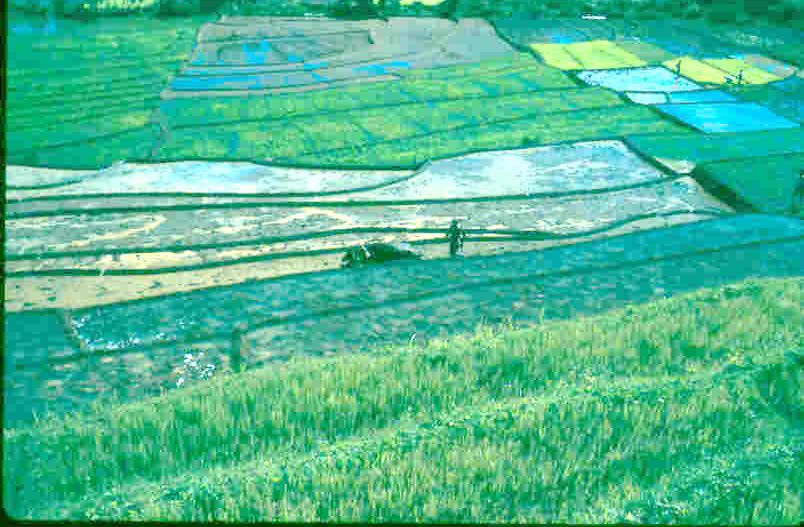
What is the above spread in crop management: unplowed, plowed, seedbed, transplanting and transplanted = 8 weeks? What does this represent?
- A few highly motivated farmers getting their crop planted on time, and others lagging behind, or
- All farmers getting some fields done early and others done later?
Is this delay voluntary or involuntary? Will farmers’ diet explain this delay? Isn’t it the manual labor fuel?
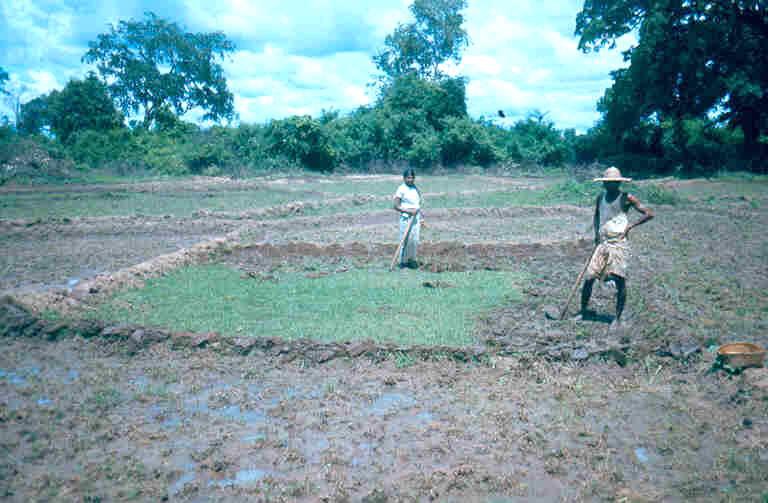
If manual crop establishment takes 300 hrs/ha at 4 hrs/day, how long will it take this couple from Sri Lanka to establish a hectare of paddy? Will that explain the 8-week spread shown above? What will the decline in potential yield be after 8 weeks? Working only with hoes, can they possibly dig their way out of poverty?
Dietary Energy Requirement
- Basic metabolism: 2000 kcal/day
- Manual labor: 300 kcal/hr including basic metabolism (net 220 kcal/hr additional)
- An 8-hour work day requires (2000 + {220 × 8}) = 3760 kcal, or rounded to 4000 kcal/day
- What constitutes 4000 kcal?
How much time would it take just to consume any example of 4000 kcal?
Ethiopia Case Study
- Casual agriculture labor wage: 50 Birr/day = US$2.63
- Maximum available for food = 80%, or 40 Birr/day, with the rest going for fuel, light, housing, etc.
- Food purchased based on consumer prices in Addis Ababa
Food purchased with 40 Birr/day (Addis Ababa consumer prices) Kinds Amount in g/day Daily Price (Birr) Actual Kcal Purchased Beef 64.5 3.33 88.4 Wheat 645.2 5.67 2,154.8 Maize 1,290.3 7.33 4,696.8 Teff 645.2 9.30 2,367.7 Sorghum 483.9 3.00 1,640.3 Chickpea 322.6 3.33 1,174.2 Onion 161.3 0.83 64.5 Potato 322.6 2.00 187.1 Coffee 32.3 3.00 0.0 Sugar 64.5 1.00 249.7 Pepper 32.3 0.92 21.6 Salt 32.3 0.13 0.0 Veg. Oil 32.3 0.73 286.1 Total 40.57 12,931.3 Family to support and calorie distribution Family Member Kcal Distribution Husband 3,000 Wife 3,000 Adolescent Son 3,000 2 Younger Children 2,000 × 2 Total 13,000 The 3000 kcal for Ethiopia is at the high range for smallholder farmers.
Typical Kcal/Day Available to Smallholders Location* Kcals* Workable Hours** Ghana 2,930 4.2 Bangladesh 2,480 2.1 Tanzania 2,140 0.5 Zambia 1,880 Not able to work Kerala, India 2,010 0.0 *Source: ODI opinion paper 8376. ** (Kcal − 2000) / 220
Potential Hours of Diligent Labor
- From 3000 kcal/day must subtract 2000 kcal/day for basic metabolism
- 3000 − 2000 = 1000 to be allocated for manual labor
- Diligent hourly agriculture field labor exertion consumes on average 300 kcal/hr, but this includes 83 kcal of basic metabolism
- Net hourly exertion 300 − 83 = 217 kcal over and above basic metabolism
- Available kcal / rate of exertion is 1000 / 217 = 4.6 hr/day
- Working longer would imply pacing to reduce the amount of calories exerted, or starving
- To diligently work a full 8 hrs/day requires a diet of at least 3750 kcal
- While the case study is for the purchasing power of casual wages, subsistence stocks are similar, with Malawian farmers holding 200 kg of maize per adult and the Millennium Village Project in Africa holding 1.1 MT of maize per family of 5.7; both result in a daily diet of slightly less than 2000 kcal. Meets basic metabolism, but limited work unless supplemented. Source: PNAS 104(43):16775
Commentary
- Typically smallholders will have access to only 0.5 to 0.75 of the dietary calories needed for a full day of agronomic field work.
- After accounting for basic metabolism this results in a diligent work day of zero to 4 hrs, and becomes a major impediment to implementing development innovations designed for their benefit.
- It may sound trivial that you cannot expect a hungry person to work hard, but isn’t that what we have expected for the past 40 years?
- Contrary to traditional belief, instead of being labor surplus, most smallholder communities are severely labor deficient.
- Also, smallholder farmers cannot be risk averse in establishing their crops but are mandatory risk takers, with their very survival depending on it. Any deliberate delay only reduces the total area cultivated and risks food security.
- Reviewing the stereotype of African males loafing around the village in the afternoon, what is more likely: they are lazy and in need of some form of motivation, or hungry and exhausted and in need of a good hearty meal?
- Who is, or should be, responsible to determine the operational limits of smallholder farmers, caloric or otherwise? Is this an administrative void in the development effort?
- What is the possibility that the apparent limited acceptance of agronomic recommendations is an optimizing of the recommendations to the limited operational capacity of the farmer, including limited labor? Most affected would be time of planting, plant populations, quality of weeding, etc.
Implications for Poverty Alleviation
- Assisting smallholders needs to emphasize drudgery relief and avoid labor-intensive innovations.
- This quickly implies enhancing access to mechanization (all mechanization was under the development community’s radar and not acknowledged in any reporting):
- The Asian solution for rice was the shift from buffalo to power tillers:
- Doubled the farm size from 1.5 to 3 ha.
- How much of the success of the green revolution in Asia was technology vs. the concurrent shift to power tillers? If left only with buffalo, how limited would the area be?
- Now Asia is mechanizing harvest with small combines, increasing crop intensity to 5 rice crops in 2 years.
- The African solution is slowly getting access to contract tillage.
- The Asian solution for rice was the shift from buffalo to power tillers:
- If women are equally undernourished relative to their work requirements, and domestic work takes priority over economic work, how will that affect income generation for women or women’s groups?
- Indirect methods of drudgery relief (domestic drudgery):
- Grain mills
- Improved domestic water supply
- What would be the agronomic impact of these innovations?
- Development projects need to assess dietary energy when promoting innovations.
- Nutrition studies need to be based on providing a balanced diet of at least 4000 kcal.
- Likewise, wages need to be based on the ability to buy a balanced diet of at least 4000 kcal.
Survey
- Given the current interest in improving the quality of diet of smallholders to address malnutrition in terms of limited protein, along with various vitamins, minerals, etc., from the farmers’ perspective what will be the higher concern: improved nutrition, or sufficient calories to complete the day’s task? Note that improved nutrition virtually always costs more, thus it can only be done by reducing the caloric intake, and work hours.
- If we advocate innovations that require smallholders to routinely exert more caloric energy than they have access to, are we inadvertently promoting their genocide by starvation as a crime against humanity, subject to referral to the International Criminal Court (ICC) in The Hague?
Please take a copy, complete with comments, and return in the envelope provided or by email.
References
- www.smallholderagriculture.com
- ECHO Development Notes, Issue 121, October 2013: Issue121.pdf
- Ethiopia Case Study: lamar.colostate.edu/~rtinsley/EthiopiaDiet.html
-
Under Nourished: Exerting More Calories Than Consumed
Under Nourished: Exerting More Calories Than Consumed
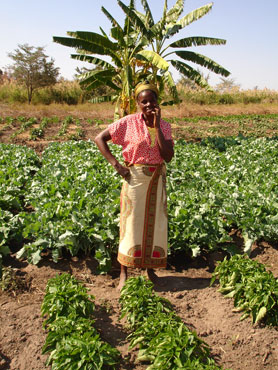
One concern expressed in this website is that smallholder farmers are taking an unexpectedly long time to complete basic crop establishment, with a trickle down impact on subsequent field operations and eventual yield potentials and quality. Typically it takes smallholders approximately eight weeks to complete their crop establishment compared to a projected maximum of four weeks. Much of the basic crop establishment requires extensive manual labor, particularly when limited to working with hoes. This is for a group of people reported to produce only a six month food supply. A supply that will start running out just as the dry season ends and heavy manual labor for the next crop season begins. The question then comes, is the calories required to meet manual labor needed for crop establishment exceeding the calories being consumed? If not, what is the impact of undernourishment on future crop production, and the ability of the farmers to utilize production technology intended for their benefit. The estimate is that it takes 2000 cal just to sustain a person for a day, plus some 220 cal/hr additional for work depending on the task, for a Total Calorie Requirement of nearly 4000 cal.
Most likely within a smallholder community there may be only a couple possibilities. Some might find employment as casual laborers for another farmer that will offer an in-kind payment of a sack of maize or rice that the hungry farmers can consume while working on their fields. The second option would be to simply eat less to prolong the limited available food. This will quickly result in becoming fatigued early in the day and having to return home or to the village to recover. Are there other possibilities? In both cases the hungry farmers’ field activities are delayed and with that the ability to adopt time sensitive production recommendations promoted for their benefit including those promoted as part of value chain projects. Ultimately this will substantially reduce the yield potential.
This is often easily visible by noting considerably more field activity in the mornings than afternoons. Why is this, considering the extensive amount of work needing attention, and a very well understood declining production function for delays?
If people are seen relaxing around a village during the afternoon, it is often thought to be from limited motivation. Could it also be simply exhaustion and recuperating from not having consumed sufficient calories for a full work day? From casual observation can this be separated? Given the continued fieldwork requirements, the loss of yield potential, and risk that brings to food security, which is more logical and more likely? Are delays in field work the result of hunger and exhaustion or risk aversion?
A comparison of the calories consumed and labor exerted should make an interesting study with considerable ramification. If it is correct that farmers are exerting more energy than they are consuming, there would be a major justification for promoting access to contract mechanization so the farmers can expedite their crop establishment and bring it more in line with production recommendations. It is noted that most of the basic land preparation for smallholders in Egypt, Pakistan, and Iraq is done by individually owned private contract tractors as part of the community service providers. There is also an increasing demand for contract tillage in rural Africa such as in Zambia and Tanzania.
The analysis could also determine if it is physically possible for a smallholder family to dig themselves out of poverty if only working with hoes, or will the time taken to complete crop establishment and other labor consuming crop management activities reduce the potential yield below what will allow them to meet food security requirements.
Last Revised: 29 March 2010
-
Impact of Power Tillers on Paddy Cultivation in Asia
Impact of Power Tillers on Paddy Cultivation in Asia
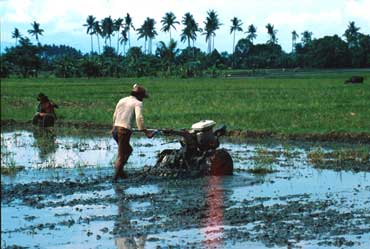
About 20 years ago most of the water buffalos in Thailand and other parts Asia were retired in favor of power tillers adapted for rice paddies that were originally manufactured in Japan, Taiwan, South Korea, and now China. Shifting to power tillers represents a major enhancement of the operational resources available to smallholder rice producers to manage their lands, which addresses a key issue of Drudgery Relief discussed on this website. It should have a major impact on rice cultivation, which may need to be quantified as a guide for other programs interested in making mechanization available to smallholders and understanding the impact of mechanization on individual fields, farms, and across smallholder communities.
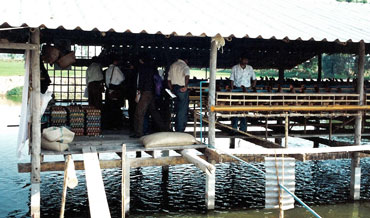
One of the key issues is the impact the shift to power tillers has on paddy establishment time for an entire farm. For rain-fed areas, the time may be halved from four months to two months, as mentioned by a rice farmer in NE Thailand. It could then impact farm size, including both directly owned land and rented land. Additional impact would be the shift from transplanted to direct seeded rice and with that, the use of herbicides for weed control. It might also impact the variegation and intensification of farm enterprises, such as converting a portion of the land to aquaculture with additional poultry or piggery production on top of the fish ponds as the farmer in NE Thailand mentioned above did and shown in the photo. Also, the shift to power tillers appears to have lead to contract combining with small combines originating in Japan that can operate in the one rai (1/6th hectare) fields and has this lead to an overall increase in rice intensity from two crops per year to five crops every two years.
Finally, what impact has it had on the material well-being of the farmers in terms of motorcycles, pick-up trucks, TVs, VCRs, refrigerators, cell phones, etc.? It might also be interesting to see how much of the shift was motivated by the public sector extension effort vs. how much was more spontaneously coming from the private sector.
Power tillers are also moving into the rice schemes of Africa as shown in Madibira. This is again all self financed with no assistance from the donor community. It looks like another missed opportunity. The question is how effective will value chain enterprises be unless they include some means of drudgery relief?
Another unfortunate issue is to correct the impression often conveyed by the development community that the success of the “green revolution” in Asia was virtually exclusively due to the technology development of IRRI and other research organizations. Yes, IRRI high yielding technology did dramatically increase the potential yield of rice, but it did nothing to get the rice planted in a sufficiently timely manner to take full advantage of the improved technology; this was done by the farmers shifting to the power tiller. Since this was 100% done by the farmers the development community tends to overlook the impact of the shift to power tillers. This has resulted in the effort to promote a new “Green Revolution” in Africa to concentrate on technology development and extension without looking at the need to adjust the operational resources with enhanced access to contract mechanization. I would contend this is slowing down the prospects for a “Green Revolution” in Africa.
That should be sufficient to stimulate interest and the topic can easily be expanded. That is, if it is still possible to make the study as it may be a full generation of rice farmers since the shift and thus few farmers can relate back to when the water buffalo was the standard.
Last Revised: 27 March 2015
Ethiopia Diet Analysis – Implications for Development
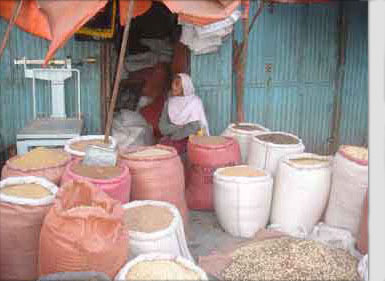
During a recent workshop to develop a curriculum for including value chain evaluations in Ethiopia’s academic extension education program, the question of Caloric Energy Balance was used for small group discussions. One participant, with food science background, did an exceptional job with the assignment. His analysis is as follows:
- Casual agriculture labor wage: 50 Birr/day = US$ 2.63
- Compared to the USA minimum wage of US$ 7.15/hr and 8 hour work day or US$ 57.20/day, it is 4 % of USA minimum wage.
- Maximum available for food = 80% or 40 Birr/day, with the rest going for fuel, light, housing etc.
- Family to support:
- Self
- Spouse
- Adolescent son
- Two younger children
- Food Purchased based on Consumer Prices collected previous week in Addis Ababa.
| Kinds | Amount in kg/month | Amount in g/day | Daily Price (Birr) | Given Kcal/100 g | Actual Kcal Purchased |
|---|---|---|---|---|---|
| Beef | 2.0 | 64.5 | 3.33 | 137.0 | 88.4 |
| Wheat | 20.0 | 645.2 | 5.67 | 334.0 | 2,154.8 |
| Maize | 40.0 | 1,290.3 | 7.33 | 364.0 | 4,696.8 |
| Teff | 20.0 | 645.2 | 9.30 | 367.0 | 2,367.7 |
| Sorghum | 15.0 | 483.9 | 3.00 | 339.0 | 1,640.3 |
| Chickpea | 10.0 | 322.6 | 3.33 | 364.0 | 1,174.2 |
| Onion | 5.0 | 161.3 | 0.83 | 40.0 | 64.5 |
| Potato | 10.0 | 322.6 | 2.00 | 58.0 | 187.1 |
| Coffee | 1.0 | 32.3 | 3.00 | 0.0 | 0.0 |
| Sugar | 2.0 | 64.5 | 1.00 | 387.0 | 249.7 |
| Pepper | 1.0 | 32.3 | 0.92 | 67.0 | 21.6 |
| Salt | 1.0 | 32.3 | 0.13 | 0.0 | 0.0 |
| Veg. Oil | 1.0 | 32.3 | 0.73 | 887.0 | 286.1 |
| Total | 40.57 | 12,931.29 |
Daily allocation of Calories:
- Self 3000
- Spouse 3000
- Adolescence son 3000
- Younger children 2000 x 2 = 4000
- Total 13,000
Potential hours of diligent labor
- From 3000 kcal/day must subtract 2000 kcal/day for basic metabolism
- 3000 – 2000 = 1000 to be allocated for manual labor
- Diligent hourly agriculture field labor exertion consume on average 300 kcal/hr., but this includes 83 kcal of basic metabolism
- Net hourly exertion 300 – 83 = 217 kcal over and above basic metabolism.
- Available kcal /rate of exertion is 1000/217 = 4.6 hr/day.
- Working longer would imply pacing to reduce amount of calories exerted or starving.
- To diligently work a full 8 hrs. /day requires a diet of at least 3750 kcals.
Can anyone provide a comparable analysis for other developing countries?
-
Read More About Ethiopia Diet Analysis – Implications for Development
Comments on analysis:
While the analysis is for casual laborers as the easiest means for doing the initial analysis using consumer prices, subsistence stocks available to the farmer would not be too different. The most common figure for subsistence stock of maize are around 200 kg./adult/year that would provide a daily diet of 550 g/day and 2000 kcal/day as the primary source of calories to be supplemented with other foods. If this constitutes 75% of the caloric intake the farmer would still have a diet in the 3000 kcal/day range or perhaps a little less.
The 3000 kcal/day is slightly higher then the case studies in a recent ODI Paper On Improving Nutrition For Smallholders. The five case studies list kcal/day ranging from < 2000 to nearly 3000 kcal/day as follows:
- Ghana 2,930 kcal
- Bangladesh 2,480 kcal
- Tanzania 2,140 kcal
- Zambia 1,880 kcals
- Kerala, India 2,010 kcal
As the above analysis was done fairly quickly as part of a workshop group discussion, it has to be considered mostly conceptual with some basic assumptions made for wages and family size. However, it is illustrative of the concern and need for more detailed analysis of the impact limited caloric intake can have on agronomic field work and the ability of famers to take full advantage of innovations intended for their benefit, particularly labor intensive innovations.
While it may seem trite to claim that you cannot expect a hungry person to work very hard, isn’t that what the rural development effort has been doing for the past 40+ years?
Considering Subsistance Stock
In a subsequent assignment to Ethiopia it was possible to obtain an estimate of subsitance stocks for the high altitude area around Koffele. The farmers’ consensus of subsitance stock was three quintals of potatoes and 1.5 quintals of maize per adult. This would provide a basic diet of some 2054 kcals. Determined as follows:
- Energy from potatoes:
- 300 kg/365 day = 0.82 kg/day (820 g)
- If 100 g of uncooked potatoes provides 69 kcals then 69 x 8.2 = 566 kcals.
- Energy from maize
- 150 kg/365 days = 0.41 kg/day (410 g)
- If 100 g of uncooked maize provides 363 kcals than 363 x 4.1 = 1488 kcals
- Total is 566 + 1488 = 2054 kcal.
This would only cover basic metabolism, but not allow substantial hours of diligent agriculture labor, that would consume up to 300 kcal/hr. While farmers most likely are also consuming beans and other food, the potato and maize stock will represent well over half their caloric intake. Thus most likely the most calories they could consume would be about 2500 kcal which would allow them to diligently work for 2 hrs/day, perhaps longer by pacing the work load, but then taking longer to complete the task.
Estimated Work Day for Ethiopia
During the same farmer discussions it the farmers mentioned they had to spend two hours in the morning and another two hours in the afternoon caring for thier animals, it was possible to develop an estimate of a typical smallholder wrokday. Since Ethiopia is in the tropics with nearly continuous year round 12 hrs of daylight and 12 hours of darkness, the work day can be reasonable consistent all year. During the day the need to care for animals will have priority over crop management, as they need to be watered and feed or taken to where they can graze for the day, then later returned to the homestead for the night. These animal chores cannot be avoided or substantially postponed, as easily as they can for crop management. The care of animals most likely represents a lot of time, but not a lot of caloric exertion, as occurs with agronomic field work. Thus while there might be eight additional hours for potential agronomic field work, the farmers claimed they only worked about 4 to 4.5 hrs./day. This would go from approximately 9:00 after getting the animals settled for the day, until 1:00 or 1:30. This 4 hrs. also represents the limited energy the draft animals may have for hard pulling in land preparation with only the marginal rations associated with communal grazing lands and crop residue fodders, without any supplemental grain or other feed concentrates. Also, given the limited diet, this human output is most likely not at full diligence, but represent some degree of pacing their available energy to extend the workday. This can also be fairly clearly seen in casual driving through rural areas of Ethiopia. In this case in the morning starting around 9:00 you can see a lot of field activity, but after about 2:00 in the afternoon most of what you see are farmers slowly leading their animals back home, and setting them to feed on straw stacks, while substantial agronomic field work opportunities clearly remain uncompleted. Thus a typical workday would look something like:
- Daylight begins around 6:00 am;
- 6:00 to 8:00 am, Morning care for animals;
- 8:00 to 9:00 am, Return home from caring for animals, breakfast and walking to Agronomic field for the day;
- 9:00 am to 1:30 pm, agronomic field work depending on crop or land needs;
- 1:30 to 4:00 pm, return home for lunch and some well-earned rest;
- 4:00 to 6:00 pm, afternoon care for animals; and
- 6:00 pm, darkness descends and the day ends.
Implications for development
- The 4.6 hrs is consistent with the casual labor work day in neighboring Kenya which is set at 5 hrs./day.
- With a 5 hrs. work day it would be possible for someone to work a double shift, but this does not happen and is not encouraged by hiring farmers. One farmer interviewed indicated, if a person worked a double shift they would be unable to work the next day.
- If the work day is reduced to 4.6 hrs., from limited available calories, then the days required to complete various agronomic field tasks will be substantially prolonged.
- Example: if it takes an estimated 300 person hours to manually cultivate a hectare of land with hoes, then an individual working alone and limited to 4.6 hrs./day will need 67 day or 9.3 weeks to complete initial crop establishment, excluding any return to early established fields for weeding or other mid-season crop husbandry activities. Isn’t this consistent with observed time of establishment?
- However, in the Ethiopian case above, if the farmer’s adolescence son is assisting him full time with an equal amount of calories than it will take 33 days for initial crop establishment. More reasonable but still longer than usually allocated.
- However, this could result in the youth not being able to attend school, and from a development perspective allowing a youth to remain in school should be higher priority, and program expectations adjusted to provide for formal schooling opportunities.
- If the spouse has substantial essential domestic tasks to do, such as fetching water, fetching firewood, cooking, nurturing children, that take priority over assisting with field work, but still only has enough calories for 4.6 hrs. of diligent work, it is unlikely she will be able to provide substantial assistance with the field work.
- If a spouse or independent women head of household only has enough calories to work 4.6 hours a day and domestic tasks take priority over economic activities, how much time will women have to participate in the multitude of income generation, financial empowerment projects promoted for their benefit? Would the family be better off concentrating their limited energy on assisting with basic farming?
- While rarely specified, there is an underlying assumption that crop establishment shouldn’t take more than a couple weeks, perhaps three at the most, after which the expectations are for farmers to concentrate on initiate weeding and other mid-season crop husbandry activities. Thus, if crop establishment is extended up to 9 weeks with declining potential yields with delayed establishment by as much as 50% from optimal physical potential, it will be very difficult, if not impossible, for smallholder farmers to dig themselves out of poverty when limited to manual labor such as hoes. It will be a major struggle just to meet the food security needs for the family.
- Considering hiring labor to expedite crop establishment has to be done with care to make certain it, to use a Christian analogy, is not robbing Peter to pay Paul. How often is the casual labor pool in smallholder communities really other farmers opting for a day of causal labor instead of working their own fields? Thus, hiring out might assist the hiring farmer but result in a drag on hired farmer which for the community could be a zero sum activity? It has to be appreciated that from a development perspective, while we may concentrate on a few cooperating farmers, the objective has to be improved economic well-being across the community.
- Also, as crop establishment is delayed and has to be integrated with weeding and other mid-season crop husbandry activities on early established parcels, farmers will compromise on quality management in favor of a more extensive area cultivated. This is a very rational economic decision, but can give the impression of farmers having limited knowledge of best management practices and need to be taught the best management practices, when they are well versed in such practices but don’t have sufficient labor to fully adopt them. They are actually completely maxed out and fully optimizing the returns to their Limited Available Labor.
- The result could also imply that farmers will be better off using their limited energy to Enhance The Value Chain At The Farm Level, where they have the most direct control and vested interest, rather than getting involved with value added further up the value chain. This might involve improving yield, yield recovery, or quality.
- Thus, value added above the farm level might be better done by out-sourcing than direct farmer involvement. This appears to be the preference for par-boiling and milling rice and converting cassava to gari* as noted in Nigeria and Ghana.
- The real need here might be, instead of proposing labor intensive innovations, Concentrate on Drudgery Relief, either directly or indirectly.
- Ultimately, the most effective means of assisting the smallholder might be to work at the Community Level to provide a more conducive overall operational environment, including improve access to community based family enterprises as the support service providers, particularly those that can provide a mechanized service such as contract tillage to expedite crop establishment or mechanical threshing to enhance crop recovery.
- The typical smallholder farm size of 1.5 ha, that appears common in many developing countries, may represent the outer limited of what a farmer can manually manage more than the availability of land within the community.
- It might also be interesting to revisit the concept of a midday siesta to escape the heat of the day, and consider that it might equally be exhaustion from exerting all the available calories and need to recover from the exhaustion.
- Likewise, it might be worth reconsidering the stereotypic Africa male farmers loafing around the village in the afternoon. They might be more in need of a hearty meal then a swift motivating application to their posterior. Given the work needing to be done and risk to family food security which is more realistic?
- Similarly, reconsider the often stated contention that smallholders are Risk Averse and deliberately delay crop establishment hoping for more favorable rainfall or avoiding lulls in the rain. If only able to work 4.6 hours a day and crop establishment in spread over 8 weeks or longer, risk averse farmers would starve. Instead farmers have to be manditory risk takers starting and the very first opportunity and their very servival depends on it.
- It might also be worth considering that if development projects have an expectation of farmers exerting more energy than they have access to, how close are projects coming to advocating the genocide by starvation of smallholder farmers and potentially referable to the tribunal in The Hague dealing with “crimes against humanity”. Of course farmer will not starve, but then neither will they widely accept innovations.
While the dietary energy balance analysis from Ethiopia is mostly conceptual, the assumptions need to be considered reasonable realistic, and thus the result reasonable valid. Therefore the need for various projects to take a closer look at dietary energy as it can impact on available labor, and wide spread acceptance of more labor intensive innovations. It also has to be appreciated that for the most part operational requirements in terms of availability of labor, access to mechanization of development innovation have long been overlooked and need to be considered if projects are going to effectively alleviate poverty. The limited operational resources can become a major drag on well-intended innovations.
*Gari is a dried less perishable form of cassava.
Last Revised 16 June 2013
I am text block. Click edit button to change this text. Lorem ipsum dolor sit amet, consectetur adipiscing elit. Ut elit tellus, luctus nec ullamcorper mattis, pulvinar dapibus leo.
Hard Choices: Compromises in Quality Nutrition

Photo Credit: Peter Menzel, Hungry Planet (used with permission)*
One of the current emphasis in the Sustainable Development Goals (SDG) is improved nutrition particularly for pregnant or nursing women. While the observation of malnutrition and under-nutrition are accurate and well documented, the question remains to what extent does this represent lack of knowledge and need of massive training effort, versus unaffordability, with a need for improved minimize wage, or drudgery relief so these people can afford or produce more healthy diets. Thus, when funds or labor are limited what are the rational compromises impoverished people make in purchasing and allocating food for their families. Thus, the following hypothetical exercise might be undertaken. It should take about an hour or two, but provide a realistic idea of the compromised choices people have to make and the need for extension/education versus other perhaps more effective interventions. It is based on an exercise used for in-class students, on-line participants, and workshop participants. Those who completed the exercise have always found it enlightening, if often disturbing.
-
Read More About Hard Choices
The Exercise
Boundary conditions
- State the casual labor daily wage for the referenced country or region and provide the exchange to US$ for comparisons.
- Determine how many members of the family will be earning wages and total wages earned.
- State the maximum percent of the income they can spend on food, making allowances for other essentials such as cooking fuel, oil or batteries for light, rent, etc. and compute the food allowance. I typically use 80%.
- State the hypothetical family that needs to be feed from this food allowance. This should include husband, wife, and children, and note if wife is pregnant or nursing.
Purchases
- Purchase the food your hypothetical family can afford according to your estimated food budget. This could require a visit to the local market to collect food prices. Please consider the open market prices instead of the super market, as the prices are most likely cheaper in the open market. It usually only takes an hour to collect the food prices. If you are not on assignment and don’t have access to a host country market you can use the data on consumer prices from the website, but emphasis the US$ values as being more stable than the local currency. The link is: https://labs.agsci.colostate.edu/tinsley/research/economic-environment/#consumer-price-comparison .
Analysis
- Using calories, protein, and whatever other parameters of interest, analysis the nutritional value of the food you provided.
- Allocate the food purchased to the different family members.
- Were you able to provide a balanced diet? What compromised did you have to make in feeding your family?
- If the diet was inadequate, was this because of limited knowledge or affordability?
- In making the allocation to the family members, was sufficient priority given to the wage earner(s) to make certain he or she would be able to undertake the work needed to maximize the affordable food? If not, how would this impact food security?
- Remember that most likely someone in the family will have to earn the money or produce the food and this will mostly likely be obtain from arduous manual labor requiring 4000 kcal/day or more. Estimate basic metabolism at 2000 kcal/day and calories exerted at 300 kcal/hr. representing 80 kcal for basic metabolism and 220 kcal for work energy. See: Caloric Energy Balance
- If you need assistance with the nutritional data please visit the USAD nutrition website at: https://fdc.nal.usda.gov/
Iterations
- Incrementally increase the food allowance in 10 or 15% increments until you can afford the balanced diet desired. How will that impact the food choices?
- Should this become the minimum daily casual wage for your reference country?
That basically concludes the exercise. I hope at least results are appreciated, as differentiated from liking the results. How important is an exercise like this to understanding the dietary limits of beneficiaries and the extent they need training compared to other innovations? Please visit the webpage on the Ethiopian diet, it was done by a food scientist attending a workshop, for which the assignment was a small group exercise. Were you able to come close to his results? What would be the results for the Chad family photographed at the top, with the food consumed shown below**? If an exercise of this nature is not undertake is most of the nutritional programs more academic than practical?
Could this exercise be easily adapted to a survey of intended beneficiaries with the iterations indicating how their diet would improve if additional resources were available? Would such an iterated exercise demonstrate the basic knowledge beneficiaries have of quality nutrition and how extensively they need to be trained vs. looking at alternatives innovations that will more easily allow them to obtain a balanced nutritious diet? Would this knowledge be based on education or natural craving and other mechanism the body naturally undertakes to show discontent?
How do the beneficiaries priorities compare with the professional nutritionists and are the rationales for the differences appropriate? Similarly, would it make an effective workshop exercise on improving nutrition?
While for simplicity this exercise is based on casual wages, it could readily be adapted for smallholder farmers, but it is harder to get the same quality of information based more on crops produced and labor exerted. The starting point would be asking about subsistence stock of stable foods being held for personal consumption, etc. This typically comes to about 2000 kcal/day, at least from the limited interviews conducted, but would not represent all the caloric energy available, perhaps 75% of it.
For those interested, you are welcome to send me your results and I will post them on a webpage linked to this page, similar to the list of consumer prices. My email is richard.tinsley@colostate.edu
Thank you.
One Week’s Food in November
- Grains & Other Starchy Foods: **
- Millet,* 4 coro — a “coro” is a Chadian unit of volume approximately equal to 2.1 qt; millet flour,* 3 coro; sorghum,* 3 coro.
- Dairy: **
- Milk,* 7 coro, from family cows.
- Meat, Fish & Eggs: $2.16**
- Chickens,* 8.8 lb meat, after cleaning; goat meat, dried on the bone, 6.6 lb.
- Fruits, Vegetables & Nuts: $7.19**
- Watermelons, 22 lb; harar (squash), 17.6 lb; dates, 1 coro; okra,* dried, 1 coro; red onions,* 1 coro; garlic,* 0.5 coro; tomatoes,* dried and milled, 0.5 coro; red peppers,* dried and milled, 0.3 coro; peanuts,* 3 coro.
- Condiments: $8.54
- Peanut oil, 1.1 gal; sugar, 0.5 coro; salt, 0.5 coro.
- Beverages: $0.44
- Tea, 3.5 oz; water, hand- or animal-carried half a mile from the wadi, for both drinking and cooking.
Food Expenditure for One Week: 10,200 CFA francs (Communauté Financière Africaine) / $18.33
* Homegrown ** Market value of homegrown foods, if purchased locally: $25.44
Mustapha Abdallah Ishakh, Amna’s father, has cows and goats — co-owned with his large extended family — but you wouldn’t call him a herder. His many children do the actual herding, along with the six children of his eldest daughter, Mariam, 25. “We need many kids to do the work,” explains Mariam’s husband Ishakh, who’s readying his horse to drive two bulls across the scrubland to the market town of Abeche, 40 miles away. Another reason not to refer to Chadians like Ishakh and Mustapha as herders is that they also grow vegetables and grain, because self-sufficiency is the best guard against hunger when there is no government safety net. What they don’t eat, they share, trade or sell.
** A coro is approximately 2 liters, one liter holds approximately 950 grams of dry good such a grain or dried vegetables. Similarly a gal would be 4 lit with each lit holding 910 g oil.
*Complete Photo Caption: The Mustapha family in their courtyard in Dar es Salaam village, Chad, with a week’s worth of food. Gathered around Mustapha Abdallah Ishakh, 46 (turban), and Khadidja Baradine, 42 (orange scarf), are Abdel Kerim, 14, Amna, 12 (standing), Nafissa, 6, and Halima, 18 months. Lying on a rug are (left to right) Fatna, 3, granddaughter Amna Ishakh (standing in for Abdallah, 9, who is herding), and Rawda, 5. Cooking method: wood fire. Food preservation: natural drying. /// The Mustapha family is one of the thirty families featured in the book Hungry Planet: What the World Eats (p. 68). Food expenditure for one week: $18.33 USD. (Please refer to Hungry Planet book p. 69 for the family’s detailed food list.)
Affordability of Improved Nutrition While Optimizing Economic Opportunities
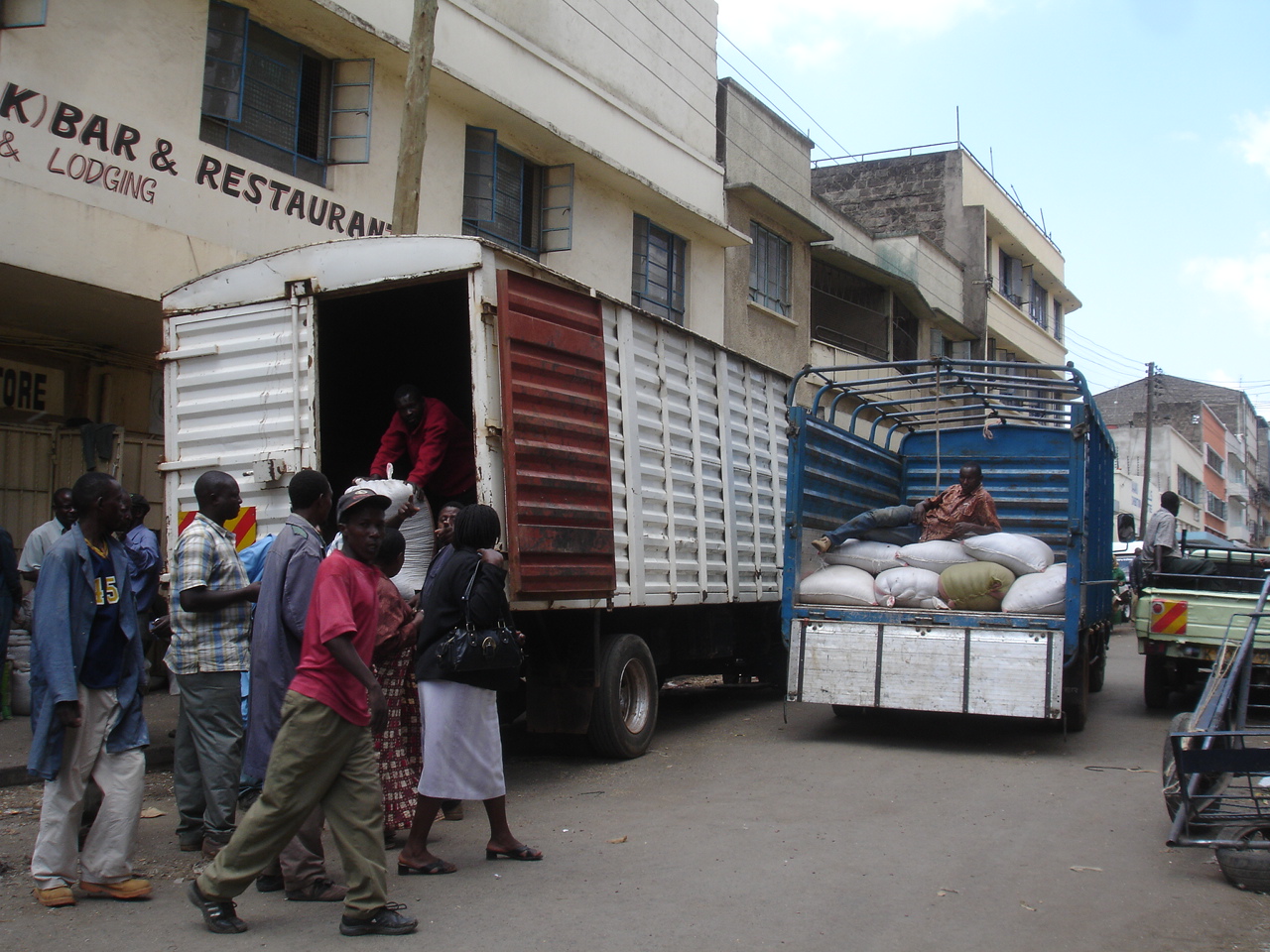 Introduction
From an agronomy perspective the interest in improved nutrition is how malnutrition and under nutrition impact crop management and ultimately household food security. For smallholder farmers this is the calories needed for the manual labor they are expected to undertake in producing their crops and managing their animals. However, it looks like most of the nutritional effort to date is concentrate on the science of nutrition and what constitutes an appropriate varied diet, with an emphasis on pregnant and nursing women. While this is an important consideration, it must also be recognized that someone must be producing the improved diet or earning wages to purchase the improved diet, and this will require some heavy manual labor and calorie exertion. The overall dietary needs are well understood, so that the science of Nutrition is fully define, perhaps only needing some “fine tuning”. Thus, should the nutrition effort start shifting focus to Integrating the science of nutrition into the economic circumstances of the beneficiaries and the compromises they rationally make in adopting the improved scientific derived diet to their specific economic circumstances including the food consumption they can afford or otherwise have access to. Does the food consumption Balance the Dietary Needs (PDF)? Do these compromises separate the Science of Nutrition from the Art of Nutrition; or the academic, where knowledge is the endpoint, from development where acceptance is the endpoint, or at least an understanding of why acceptance is limited? Before embarking on large scale extension/education effort to educate the beneficiaries on improved nutrition, should time be allocated to make certain the beneficiaries have enough discretionary control to take full advantage of improved nutrition or are they forced to make serious compromises, particularly for the caloric energy needed to optimize their economic opportunity, which is largely associated with heavy manual labor. While it is often recognized that people are poor and hungry, rarely is this identified as a major hinderance to their economic opportunities. How much priority should be given to obtaining enough calories to optimize economic opportunities at the expense of a more varied diet? If the economic circumstances are not factored in will nutrition extension/education programs be mostly badgering beneficiaries with information they are reasonable familiar with, but don’t have the means of fully utilizing?
-
Read More About Affordability of Improved Nutrition While Optimizing Economic Opportunities
There are three questions:
- What are the caloric requirements for a manual labor for smallholder farmers or other laborers such as porters living on minimum wage.
- How affordable would an improved diet be with a minimum wage and what are the rational compromises they would make in optimizing the quality of the diet with energy needed for their manual labor tasks?
- How much priority will be given to calories needed to optimize economic opportunities vs. more balanced varied diet?
Dietary Energy Requirements
Figure 1. Examples of 4000 kcal from various staple foods of host countries
Typically, manual agriculture labor such as land preparation with a hoe will consume 300 kcal/hr. and require 300 hrs. of diligent effort per hectare. However, the 300 kcal/hr. includes the basic metabolism estimated at 2,000 kcal/day or 80 kcal/hr. Thus, subtract that from the 300 kcal/hr. and work consumption is 220 kcals/hr. If working 9 hrs./day this would be 220 x 9 = 1,980 kcal of work energy. To this must be added the 2,000 kcal for basic metabolism making a total of 3,980 kcal/day which for discussion purposes rounds up to 4,000 kcal/day as a computed estimate, subject to confirmation. Anything less will mean a decline in the work hours or paced with declining diligence, either situation resulting in declining economic output and prolonging time to complete specific tasks such as crop establishment. The 4,000 kcal/day represents a substantial amount of food (Fig. 1). In the tropics with 12-hour days and night all year, the 9 hrs. work day could represent the maximum practical daylight opportunity. The 4,000 kcal/day manual labor caloric requirement is substantially (30%) greater than 2,800 to 3,000 kcal/day exerted by active people with a healthy exercise regime .
Table 1. Typical Kcal/Day Available to Smallholders Location* Kcals* Diligent Work Hours** Ghana 2,930 4.2 Bangladesh 2,480 2.1 Tanzania 2,140 0.5 Zambia 1,880 Unable to Work Kerala, India 2,010 0.0 *Source: Adapted from ODI opinion paper 8376. ** (Kcal − 2000) / 220
Against this 4,000 kcal/day need there appears surprisingly little available information on calories available to smallholders or other manual laborers. Apparently, the energy available for smallholder relying on manual labor has not be a high priority for development effort. What is available indicates most smallholders have access to only 2,000 to 2,500 kcal/day (Table 1). This is only enough to meet basic metabolism, with little energy to engage in heavy manual labor, perhaps 2 hours of diligent effort but paced over 4 or 5 hours. The result smallholder farmers taking up to 8 weeks for crop establishment over the entire farm, typically 1 to 1.5 ha. After 8 weeks, the potential yield has drop by about 50%, possible more. This 2,000 kcal/day is also consistent with farmer interviews in Malawi and Ethiopia indicating retained subsistence stocks of maize at 200 kg/adult/year in Malawi and comparable combination of maize and potatoes in Ethiopia. Two hundred kilos of maize would pro rate to 0.55 kg/day and provide 2,000 kcal. This will meet basic metabolism, but the farmers would need substantial additional food to accommodate the 4,000 kcal computed work requirements. Also, the per capita consumption of rice in Madagascar is 115 kg/year amounting to only 315 g/day which will provide a diet of only 1,121 kcal/person, half the basic metabolism and quarter the energy for manual labor as mentioned above. Rice is the staple food of Madagascar.
Case Studies
Looking at case studies of buying power vs. wages the difficulty of obtaining an improved diet can be easily illustrated even though the consumer prices in host countries are only a fraction of the USA or EU prices. The case studies will rely on a hypothetical family but use real wage and consumer prices data. It will emphasis the 4,000 kcal/day estimated calorie need for manual labor then see what else is possible. It will also seek to include an egg a day for the children as emphasized in World Bank Webinar (Secure Nutrition Seminar, 26 Nov. 2017, Cracking the Egg’s Potential to Improved Child Growth and Development Global Forum on Food Security & Nutrition) and FAO E-consultation (FSN Forum: Eggs: harnessing their power for the fight against hunger & malnutrition. 9 Nov. 2018), to avoid stunting as well as being a convenient, quick and easy check on what is possible.
The Family: The family is husband who is the sole source of income, wife mostly engaged in domestic chores with limited time to engage in economic activities, pre-school son and toddler daughter. The husband loves his family and wants to provide them as best he can, including providing the young children an egg a day to minimize stunting as promoted in the World Bank Webinar. Unfortunately, his economic opportunity is limited to being a porter, perhaps one of the most deeply poverty entrenched laborers, frequently overlooked by the development community. His work is piece meal manhandling 100 kg bags, hopefully without wrenching his back and being forced to miss a week of economic opportunity to recover, but without any income.
The family basic caloric needs are:
- As a heavy manual laborer, the husband needs at least 4,000 kcal/day,
- The wife doing mostly domestic work around the house including spending several hours getting water, firewood, and child care will need 3,000 kcal/day
- The pre-school son will need 1,200 kcal/day, and
- The toddler daughter will need 550 kcal/day.
The total family energy requirement will be 8,750 Kcal/day.
Angola: First locating the porter and family in Luanda, the capital of Angola, where he earns piece meal income loading or unloading 10-ton lorries. His typical daily wage is $2.50 for working as part of 6-man teams loading or unloading 5 10-ton lorries typically filled with 120 100 kg sacks per day. The wages represent $0.50/lorry/person. The $2.50/day is set to equal the government established agriculture casual labor wage for Angola at 250,000 A0A/mo. Which with an exchange rate of $ 1 = 3,300 AOA provides a monthly income of $75 and a daily income of $2.50. Of this $2.50 he earns he can only spend 80% or $2.00 on food as he still has non-food costs for transport, rent, cooking fuel, light at night, etc.
At the current Consumer Prices in Angola, if he spent the whole $2.00 on maize meal as the primary staple food in Angola he could purchase 1.7 kg which would provide only 6,000 kcal/day. With nothing else it would leave a Daily Deficit of 2500 kcals. No opportunity for substituting some beans to increase the protein in the diet but will reduce the calories and work potential, let alone some green vegetable to enhance the vitamins and mineral consumption. That highly desirable egg to minimize the little girl’s stunning is out of the question. If they spent the $0.40 for an egg, it would reduce the porter’s ability to load or unload the lorries. He likely will quit after only 4 lorries, coming home early but with $0.50 less income. Keeping the wage rate and consumer prices as stated what adjustment could be made in food purchased? This is an example of the Hard Choices: Compromises in Quality Nutrition many impoverished people have to make?
Transferring the impoverished family to a smallholder farming community and the question is what can they produce to meet the family’s dietary needs? In this case the farmer has retained two 100 kg bags of maize per adult for subsistence use (based on Malawi interview (PDF) with similar results from Ethiopia (PDF)). The 200 kg of maize per year will provide a daily diet of about 2,000 kcal, just enough to meet basic metabolism needs for the husband and wife, but not necessarily the children. This does not allow for any manual agronomic field work. Thus, the family must have some additional stocks of beans, etc. or purchase additional food. They do have a few “chickens that forge around the homestead and provide a couple eggs a day. What should they do with the eggs? They can sell them for $0.40 ea. or provide them to their daughter to minimize the stunting. If they sell the eggs, mentioned as a common practice in the World Bank Secure Nutrition webinar, they could buy 300 g of maize meal that would provide enough energy for 3 to 4 hours of diligent agronomic field work, that ultimately assist in improving the family’s overall food security. What is the rational thing for the farm family to do? Again, this represents Hard Choices. What adjustments are possible to better provide the quality nutrition and food security to this smallholder family? How effective will an extension/educational program on quality nutrition be for this family deeply entrenched in poverty?
Madagascar: If the hypothetical family moved to Antananarivo the capital of Madagascar where our porter is employed along with a couple companions pushing heavily loaded hand carts through the hilly streets. Again exerting at least 4,000 kcal/day. Here the legal minimum monthly wage is 450,000 Ar. which with an exchange rate of $1 = 3,280 Ar is a monthly income of $137, and daily allowance of $137/30 = $4.57 and if they allocate 80% for food the daily food expenditure is $3.60.
The family will still need a daily diet of at least 8,750 kcal to meet both basic
Table 2. Possible Daily Food For Family of 4 Earning Minimum Wage in Madagascar Item Amount Cost ($) Calories (Kcal) Protein (g) Rice 1.7 kg $0.99 6,205 121.2 Dry Beans 0.5 kg $0.50 1,285 100.0 Eggs 4 ea $0.70 289 24.0 Fish 0.25 kg $0.53 150 8.4 Milk 0.5 lit $0.43 32 1.7 Mix. Veg 0.3 kg $0.18 90 2.0 Veg. Oil 0.1 lit $0.16 857 0.0 Totals $3.49 8,899 257 metabolism and optimizing economic opportunity as a porter. With the Current Consumer Prices the 8,750 kcal requires 2.4 kg of milled rice, the staple food for Madagascar and cost only $1.40 or approximately 1/3rd food allowance. Thus, the Madagascar family has the opportunity for a more varied nutritious diet than the Angola family. This will allow them to reduce their rice consumption to allow for some dry beans that will provide both calories and protein. They can also provide each family member with an egg, plus half a fish divided among the family (the typical farm raised marketed fish such as tilapia is approximately 0.5 kg), provide each child a glass of milk, share 0.3 kg of mixed vegetables, and still use a 100 cc of vegetable oil to prepare the food. Thus, the family daily food expenditures could be Table 2. This would allow them to undertake a full day of diligent manual labor, and still have a reasonable balanced budget.
Zambia: Moving the porter family to Zambia where the husband is loading and unloading 10 t lorries. The family daily energy requirement remains at 8,750 kcal as is the desire to provide the young children an egg/day to minimize stunting. In Zambia the official minimum monthly wage for general workers is ZK 699 which converts to US$ 58 or $2.00/day. Again, if he can only spend 80% on food, the food budget would be $1.60.
In Zambia the only way he can obtain the needed calories is to rely on maize meal at $0.27/kg . The Maize Price is 1/4th the price of alternatives including rice that is widely grown in Zambia. To use alternative stable crops would require spending more than the $1.60/day budget just for the staple energy food. It would require:
The low consumer maize price in Zambia is indicative of a national policy, used in many countries, of having a suppressed ceiling price for the primary staple crop as a means of making more affordable food in urban areas. This is usually counter-productive as it reduces the profit margin of farmers, lowering their incentive to produce the staple crop, as well as diverting fertilizer and other inputs to other more profitable crops. The result is low national yields, usually blamed on poor weather, reducing national food security, and the need for massive food aid imports.
- 3.3 kg of rice costing $2.48
- 2.3 kg of pasta costing $2.28
- 5.3 kg of cassava costing $2.17
- 10 kg white potato costing $5.60
- 9.8 kg sweet potato costing $12.15
Table 3. Possible Daily Food For Family of 4 Earning Minimum Wage in Zambia* Item Amount Cost ($) Calories (Kcal) Protein (g) Maize meal 2.1 kg $0.57 8,000 200.0 Eggs 2 ea $0.16 142 12.5 Fish 0.5 kg $0.62 390 80.0 Cabbage 0.5 kg $0.27 125 6.5 Totals $1.59 8,658 299.0 *Consumer prices and wages for Zambia provided by Marjatta Eilitta, CNFA’s Program Director for Farmer to Farmer
With maize it is possible for the family to meet their energy requirements to optimize their economic opportunities. They can also include an egg for each child but no milk for the infant nor any vegetable oil to assist preparing the food. A possible daily food consumption could Table 3.
Ethiopia: Finally move the hypothetical porter and family to Ethiopia but continues to load and unload 10 t lorries. In Ethiopia the minimum agricultural wage is 50 Birr/day which equals US$ 2.63. Again, he can only spend 80% or US$ 2.10 on food but still needs 8,500 kcal for energy and wants to provide the children an egg a day. While he would like to eat teff, the national grain of Ethiopia, According to the Consumer Prices, it is three times as expensive as maize meal, and even 1.5 times as expensive as rice. Allowing some Teff the food must concentrate on maize meal. It is also
Table 4. Possible Daily Food For Family of 4 Earning Minimum Wage in Ethiopia Item Amount Cost ($) Calories (Kcal) Protein (g) Teff 0.5 kg $0.60 1,835 128.3 Maize meal 1.5 kg $0.62 5,715 142 Egg 2 ea $0.32 140 12 Chicken 0.1 kg $0.69 215 18 Totals $2.28 7,905 317.3 possible to include an egg for each child, but that is about all. Chicken is the cheapest meat protein, but the family can only afford 100 g for the day. There is no milk for children and no vegetable oil to assist with meal preparation and fresh vegetables. A possible daily food consumption could be Table 4. Giving up some Teff would allow some more variegating of the diet.
Commentary
While the article is conceptual and the family hypothetical, the wages and consumer prices were real. Thus, the case studies emphasis the difficulty of purchasing a balanced diet with minimum wage and the need to fully evaluate the importance of manual work energy in nutrition studies when the beneficiaries’ economic opportunities are limited to high manual labor employment or manual farming. It is possible that a person with a more nutritional background could tamper with the food purchase mentioned above but unlikely it will result in the quality diet desired to meet a family’s nutritional needs and while the current emphasis is on improved diet for pregnant and nursing women, it has to be recognized to obtain that diet someone in the household is obligate to undertake some hard manual labor consuming 4,000 kcal/day. While for the case studies discussed above, in 3 of the 4 countries it was possible to obtain the necessary daily calories needs by the hypothetical family including the 4,000 kcal to optimize the husband’s economic opportunity, and even include an egg for the children. However, there was not much else they could afford, and some critical needs had to be overlooked. It also must be noted that the family was relatively small for most developing countries. The more typical larger families will require more calories putting more pressure on obtaining a well-balanced varied diet. Conversely a smaller family would have an easier time. Also it is noted that the calories obtained are considerable higher than mention in the beginning as being available to smallholder farmers (Table 1). Thus, if the farmers are sacrificing energy and economic opportunity for more varied diet, smallholder farmers are economically worse off than wage laborers, or most likely the government does not have the financial resources to enforce minimum wages and many employers are paying below the mandated minimum wages.
Future Needs
The article highlights the need for:
- Nutrition studies to consider the economic opportunities of the beneficiaries likely requires heavy manual labor and large calorie consumption, wish probably has priority over improved nutrition.
- Within the overall effort at improved nutrition with emphasis on pregnant and nursing women, who is responsible to determine if the scientific results are financially feasible for the beneficiary’s households?
- Review the calories needed by manual labors. The article used 4,000 kcal as a computed estimated based on some internet values, but this needs to be confirmed as it could be considerable higher . With the current availability of sport watches that monitor calorie exertion getting solid data on calorie exertion should be relatively simple to obtain. While spots watches are not the most accurate means of measuring calorie consumption, they should be relatively easy to calibrate and provide substantially better-quality data, then the estimates currently used.
- There is a need to look at the relationship between nutrition and manual labor, including if supplemental food interventions will substantially increase productivity and food security.
- Future development projects should but more emphasis on drudgery relief, which for smallholder farmers implies access to contract tillage and other forms of mechanization.
- Be careful of manual labor intensive “appropriate technology” innovations such as treadle pumps and bicycle-based processing to make certain beneficiaries have the energy to operate them. The example would be treadle pumps that have been widely distributed by NGOs, but very limited open market sales. How often are those distributed by NGOs quickly set aside by recipients in favor of small petrol pumps? Does it require an advanced appointment to see one in operation? Similarly, the soybean promotions are emphasizing bicycle powered grinder for making soymilk, which could become excessively tiring for the operator unless well fed with an unusual hardy meal.
- As a policy minimum wages should be set to make a quality nutritional diet affordable, although this may be the case. Just not enforceable!
- If most of the population is spending over 80% of their income to purchase a meager diet, there is not enough discretionary funds available in the population to have viable tax base to fund civil services, including enforcing minimum wages.
- Does the limited purchasing power of most a country’s population put sufficient downward pressure on consumer prices so private food value chain participants have razor thin profits making it exceptional difficult for an administratively cumbersome business model like a cooperative to effectively compete without forcing the producers deeper into poverty?