Featured Publications
Recent papers from the Prenni Lab and our collaborators. The full publication list is on Google Scholar.
View All Publications on Google Scholar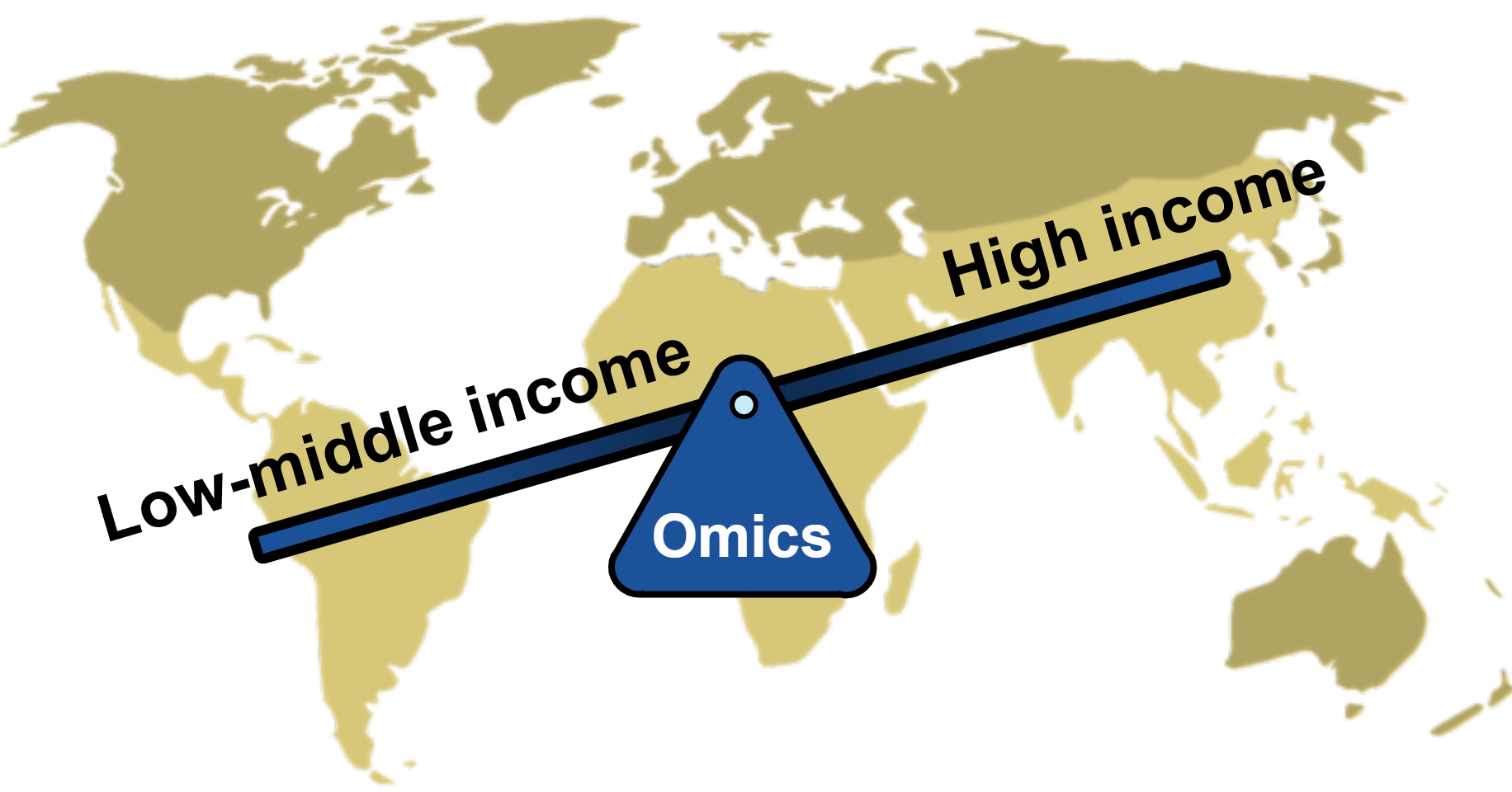
Drawing on the experiences of 19 partner laboratories in the Periodic Table of Food Initiative, this perspective explores what it takes to measure food chemistry consistently across the globe. We share lessons from implementing standardized omics methods, including challenges with instruments, supplies, and training, and discuss how to make these tools more accessible to researchers worldwide.
Odenkirk, M. T.; Amponsah, E. A.; Anim, A.; Chaura, J.; Read, M. L.; Shah, S.; Koroijiuta, J.; Chimasangkanan, J.; de la Parra, J.; Ahmed, S.; Prenni, J. E. Standardized Omics at a Global Scale: A Perspective on Barriers, Opportunities, and Lessons Learned. Anal. Chem. 2026, 98 (8), 5815–5827. DOI: 10.1021/acs.analchem.5c05737
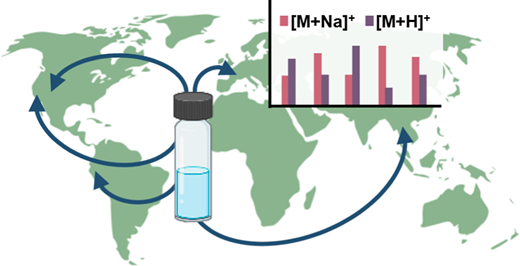
When laboratories analyze the same sample by mass spectrometry, do they see the same chemical signals? Across 10 laboratories using instruments from four vendors, we found that the same molecules can appear as different ion species even when standardized methods are used. This variation matters for identifying compounds accurately and comparing results across foodomics studies.
Odenkirk, M. T.; Chaparro, J. M.; Montgomery, N. T.; Leaptrot, K. L.; Sherrod, S. D.; May, J. C.; van Eekelen, H.; Schipper, B.; Chaura, J.; Velez, G. E.; Chathiran, W.; Michel, C. R.; Doenges, K. A.; Reisdorph, R.; Maeda-Yamamoto, M.; Valdiviez, L.; Keshet, U.; Wells, J.; Mackell, S.; Bell, D.; Tapia Leiva, S.; Partridge, S.; Rago, D.; Ahonen, L.; Ito, Y.; Read, M. L.; Evans, J. C.; Gruszczynski, M. J.; Szalach, L.; Boyko, S. C.; Watkins, S.; Ledesma Amaro, R.; Fiehn, O.; Reisdorph, N.; Srichamnong, W.; Jaramillo-Botero, A.; de Vos, R. C. H.; Hall, R. D.; McLean, J. A.; Broeckling, C. D.; Prenni, J. E. Multi-Laboratory Assessment Reveals Variable Ion Species Profiles in Electrospray Ionization Mass Spectrometry. J. Am. Soc. Mass Spectrom. 2026. DOI: 10.1021/jasms.6c00011
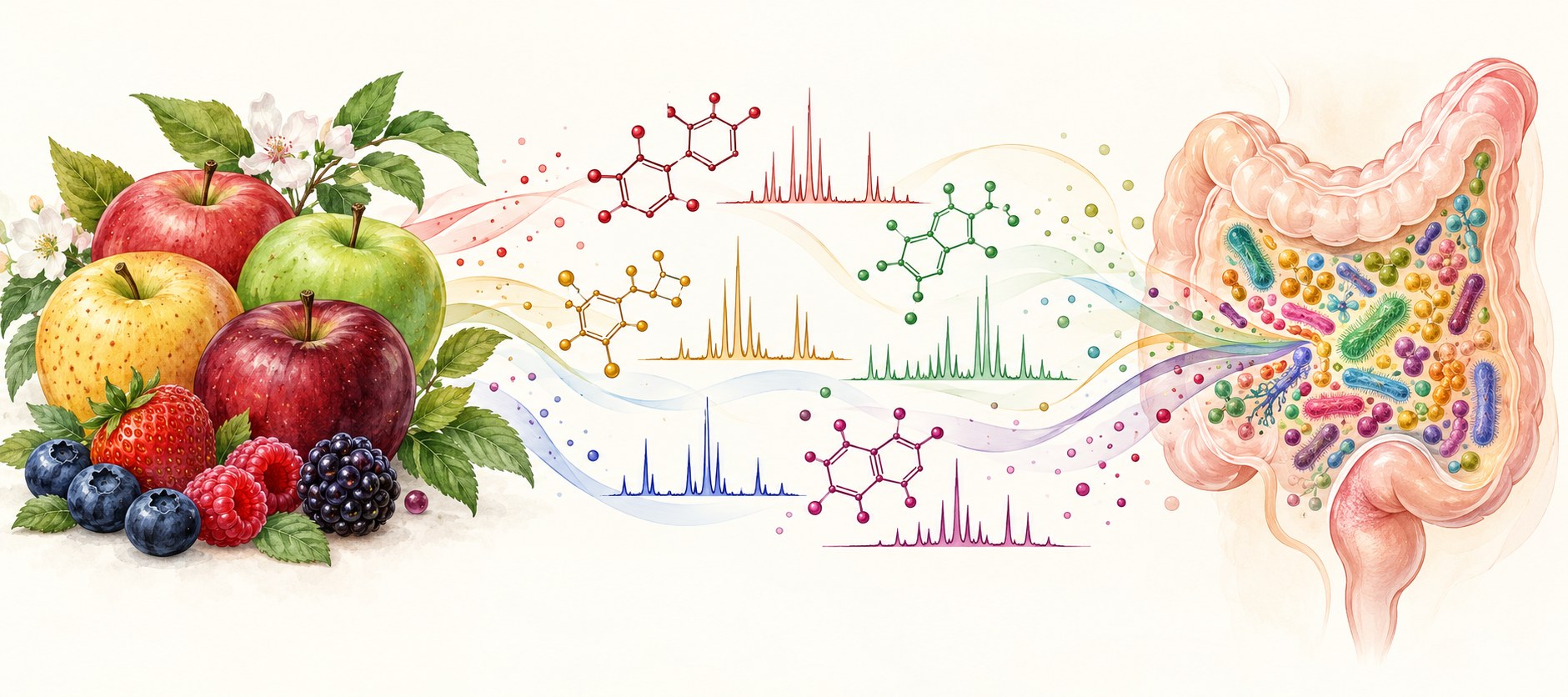
In this review, we examined 38 clinical studies of polyphenols and the gut microbiome and found a striking gap: none used untargeted omics to characterize the foods participants consumed. We explain how more complete measurements of food chemistry could help researchers compare results across studies and better understand why people respond differently to the same foods.
Keohane, E.; Prenni, J.; Johnson, S. A.; Van Buiten, C. Comparing Apples to Apples: Evaluating Foodomics in Precision Nutrition Research Featuring the Influence of Polyphenols on the Gut Microbiome. Nutrition Research 2025, 142, 76–90. DOI: 10.1016/j.nutres.2025.09.003
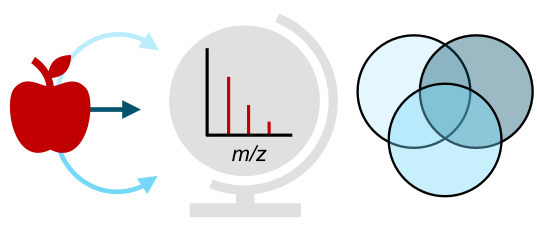
We developed a standardized mass spectrometry method to capture the diverse small molecules in food, along with a new reference mixture that helps align results across instruments. Testing five foods in three laboratories showed that the method can detect many of the same chemical features, laying a foundation for richer, more comparable food composition data.
Odenkirk, M. T.; Michel, C.; Doenges, K. A.; Leaptrot, K. L.; Sherrod, S. D.; May, J. C.; Read, M. L.; Chaparro, J. M.; Montgomery, N.; Brinkley, S.; Vaniya, A.; Mitchell, S. B.; Yu, B.; Elhaderi, J. K.; Henson, L.; Broeckling, C. D.; Fiehn, O.; Reisdorph, R.; Reisdorph, N.; McLean, J. A.; Chien, C.-M.; Shafizadeh, T.; de la Parra, J.; Ahmed, S.; Watkins, S.; Prenni, J. E. A Standardized Nontargeted Metabolomics Method for Cross-Laboratory Comparison of Food Profiles. Food Chemistry 2025, 493, 145934. DOI: 10.1016/j.foodchem.2025.145934
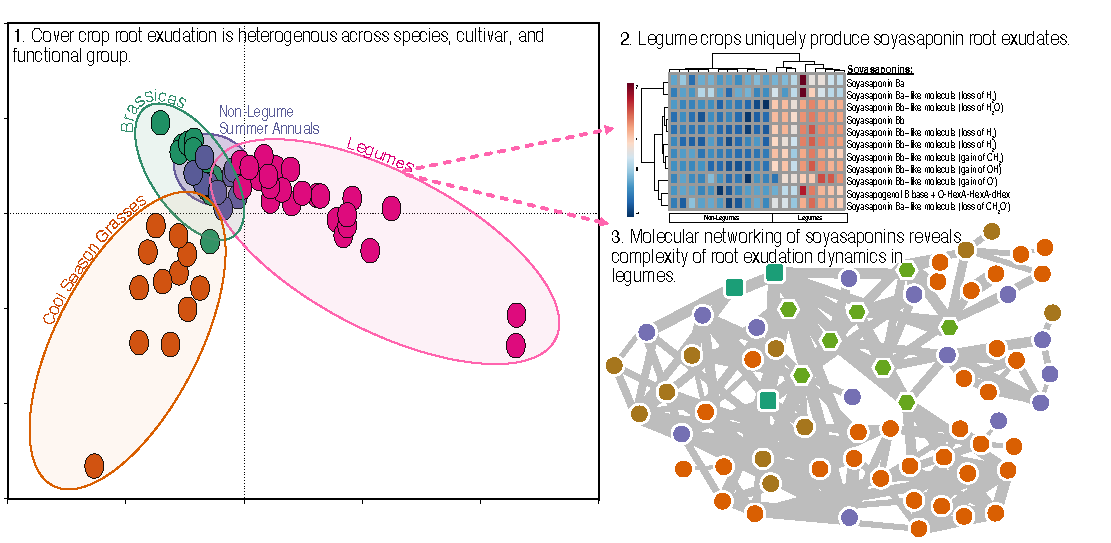
What chemicals do cover crops release through their roots? Using LC-MS and GC-MS, we compared root exudates from 16 cover crop species and three hairy vetch cultivars and found distinct chemical profiles, even among cultivars of the same species. Legumes stood out for their diverse specialized compounds, offering clues to how cover crop choice may influence the environment around plant roots.
Seitz, V. A.; Chaparro, J. M.; Schipanski, M. E.; Wrighton, K. C.; Prenni, J. E. Cover Crop Cultivar, Species, and Functional Diversity Is Reflected in Variable Root Exudation Composition. J. Agric. Food Chem. 2023, 71 (30), 11373–11385. DOI: 10.1021/acs.jafc.3c02912