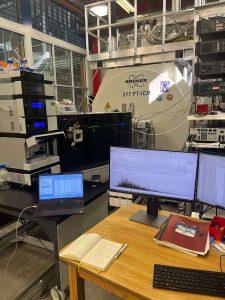
Sensing and characterizing environmental contaminants in environmental samples is not a simple task. Across many projects in the Borch lab, high resolution (and ultrahigh resolution) mass spectrometry is frequently used to characterize contaminants and organic matter shifts in a variety of environmental sample types. Examples of usage include
- characterizing small organics and surfactants pre and post treatment of oil and gas produced water
- understanding shifts in soil metabolites after a wildfire
- characterizing chemical changes to PFAS following treatment
- identifying leached plastic additives from consumer plastics
- characterizing phototransformed small molecule contaminants
- quantifying PFAS in soil and water
Although traditional targeted mass spectral analysis is used in most of our projects, many members of the Borch group specialize in non-targeted analysis of small molecule contaminants (e.g. phtalate esters, PFAS, VOCs, PAHs…), surfactants, and non-targeted metabolomics. We utilize a variety of cutting-edge analytical techniques across these projects including UHPLC-QTOF-MS, GC-QQQ-MS, GCxGC-TOF-MS, UHPLC-orbitrap-MS, and FT-ICR-MS in frequent collaboration with the National High Magnetic Field Laboratory and the National Lab of the Rockies.
See some recent publications using non-targeted techniques below! (Many more to come soon!)
Role of permafrost thaw transitions in biogeochemical nitrogen cycling
Fire Impacts on the Soil Metabolome and Organic Matter Biodegradability